When you click on links to various merchants on this site and make a purchase, this can result in this site earning a commission. Affiliate programs and affiliations include, but are not limited to, the eBay Partner Network.
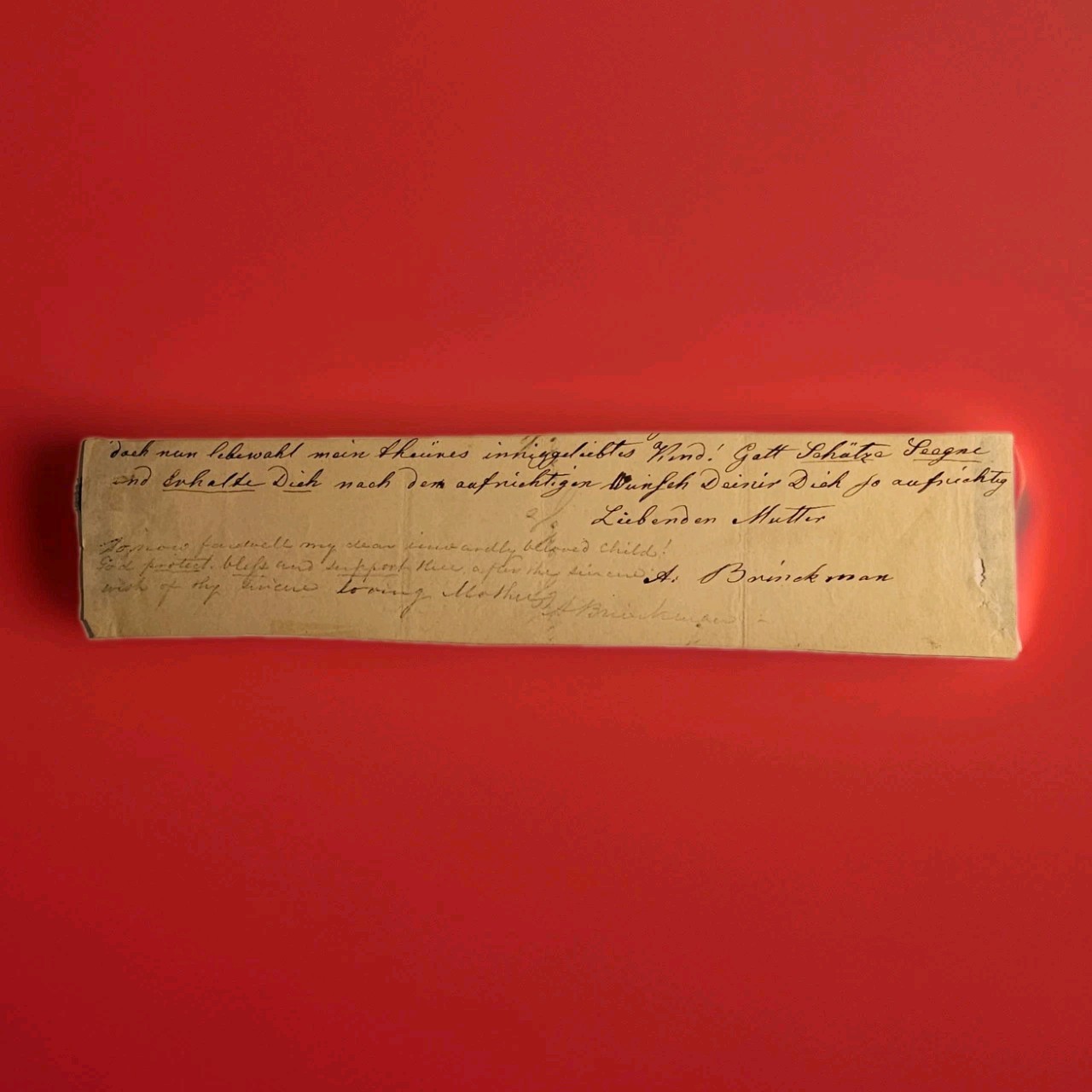
Offered here is an evocative circa 1830-1850 handwritten German-language farewell note from a mother to her beloved child, preserved on a narrow strip of period paper and accompanied by an early English translation written beneath the original text.
The note is signed “A. Brinkman” and appears to have been addressed or associated on the reverse with “Herr John Brinkman.” The exact identity of A. Brinkman has not been conclusively established, so the piece is offered conservatively as an early 19th-century family manuscript rather than attributed to a particular notable person.
The German text is a deeply personal maternal blessing and farewell:
“Doch nun lebewohl mein theures inniggeliebtes Kind! Gott schütze, segne und erhalte Dich nach dem aufrichtigen Wunsch Deiner Dich so aufrichtig liebenden Mutter.”
“But now farewell, my dear, deeply beloved child! May God protect, bless, and preserve you, according to the sincere wish of your mother who loves you so truly.”
A faint period English translation appears below the German, reading approximately:
“So now farewell my dear and beloved child! God protect, bless and support thee after the sincere wish of thy sincere loving Mother.”
The reverse contains additional faded manuscript writing and a darker name or address inscription that appears to read “Herr John Brinkman.”
Historical Interest
This is a particularly appealing example of early 19th-century private correspondence because of its unusually intimate wording. Rather than a commercial receipt, legal paper, or routine family note, it preserves a mother\'s direct farewell and prayer for the protection of her child.
The bilingual German and English presentation may indicate a family living between German- and English-speaking communities, an immigrant context, or a later translation made so that the sentiment could be understood by an English-speaking reader.
The narrow format, trimmed edges, and traces of old mounting suggest that the passage may have been removed from a larger letter and deliberately preserved, possibly in an autograph or manuscript album because of the signature, recipient, or sentimental content.
People Mentioned
A. Brinkman
The writer and apparent mother of the recipient. Her full identity has not been positively established. She signs or is identified as A. Brinkman and describes herself simply and movingly as the recipient\'s loving mother.
Herr John Brinkman
Apparently named on the reverse. “Herr” is the German equivalent of “Mr.” and may indicate that John Brinkman was the recipient or person with whom the note was associated. No attempt is made here to identify him beyond the evidence visible on the manuscript.
Condition
Original period manuscript fragment with expected age toning, folds, edge wear, minor tears, discoloration, old mounting or adhesive traces, and dark blue/black staining at portions of the extremities. The writing remains largely legible, with some lighter pencil or faded ink passages more difficult to decipher.
Please examine all photographs carefully as they form an important part of the condition description.
A charming and highly personal early German-American manuscript fragment, ideal for collectors of 19th-century letters, German immigration material, family correspondence, sentimental manuscripts, genealogy, or historical ephemera.