When you click on links to various merchants on this site and make a purchase, this can result in this site earning a commission. Affiliate programs and affiliations include, but are not limited to, the eBay Partner Network.
HISTORY & PROVENANCE AVAILABLE
Complete story included with medal.
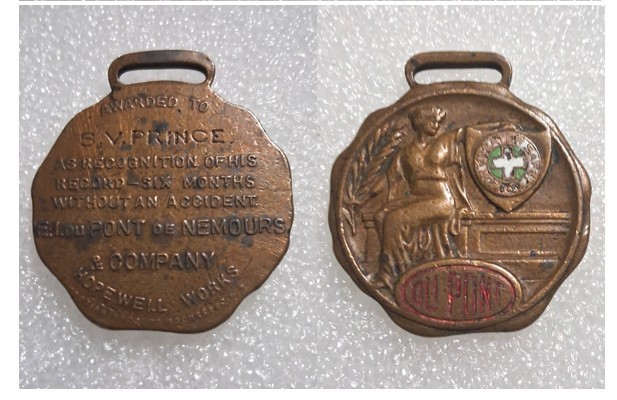
Rare Engraved Antique DuPont Chemical Co. Safety Award Watch Fob – Hopewell, VA Plant
Up for sale is a uniquely personalized piece of early 20th-century industrial history: an original brass employee safety award watch fob from the historic DuPont Plant in Hopewell, Virginia, personalized to a specific worker S. V. Prince.
This heavily detailed, struck brass piece features an allegorical seated female figure holding a laurel branch alongside the \"Universal Safety\" green cross emblem. The bottom showcases the classic DuPont oval logo with its original red enamel detailing.
* Personalized / Named: Professionally engraved on the reverse side to DuPont employee S. V. Prince.
* Milestone: Awarded for achieving a \"6 Months Safety\" milestone without a lost-time injury—a major accomplishment in a massive guncotton and chemical manufacturing facility during a hazardous era.
* Material & Design: Solid brass/bronze composition with enameled accents. Includes the original slotted loop at the top for pocket watch chains or leather strap attachment.
* Condition: Beautiful vintage condition with honest pocket wear and a deep, natural aged patina. The lettering and employee engraving remain clear and legible. Please examine the photos closely to judge condition for yourself.
Named exonumia from specific Southern industrial plants is incredibly tough to find. An exceptional addition for any watch fob collector, genealogy researcher, or Virginia regional history enthusiast.
Item will be securely packaged and shipped quickly with tracking.
Samuel V. Prince filed his official [World War on September 12, 1918.
The historical details on his original card connect perfectly to this physical artifact:
*
* Home Address: During the final year of the war, he was officially registered as living at 108 North Jefferson Street, Petersburg, Virginia. Petersburg acted as a major residential hub for the workers commuting into the nearby Hopewell industrial complex.
* Date of Birth: He was born on April 21, 1883, making him roughly 35 years old when he registered for the draft.
* Employment Status: His card confirms his daily employment as a skilled Machinist.
* The Employer: Most crucially, his primary employer is explicitly listed as the DuPont Engineering Company at the Hopewell Works plant.
Piecing Together His Story
As a machinist at the volatile guncotton facility, Samuel V. Prince was responsible for maintaining, repairing, and operating heavy industrial machinery amidst massive amounts of highly explosive nitrocellulose.
Because his technical trade was considered essential to the wartime domestic infrastructure (known as a \"deferred industrial classification\"), he was kept on the factory floor rather than being shipped overseas to Europe. His role was high-risk, making his 6 Months Safety Award Watch Fob an incredibly meaningful badge of honor. He worked in close proximity to volatile chemicals every single day without a single operational mishap or injury.
Archived period newspapers and Virginia Chronicle digital records uncover historical traces of the S. V. Prince family in the immediate region following the World War I era.
A direct historical mention appears in a May 1926 news clipping from the Farmville Herald:
\"...Besides the four children five sisters survive: Mrs. S. V. Prince, Washington, D. C.; Mrs. R. W. Price, Petersburg; Mrs. M. D. Withers, Barton, Vermont...\" [1]
Connecting the Historical Dots
The Geographic Cluster: The obituary references Mrs. R. W. Price living directly in Petersburg which sits right next to Hopewell and serves as the major geographic anchor for the region\'s historical labor pool.
*The Relocation Trend: By 1926, the DuPont Hopewell Works plant had been entirely dismantled. Once the war ended in 1918, DuPont immediately ceased its guncotton operations there, turning Hopewell from a booming city of 30,000 back down to a near-ghost town almost overnight.
Life After DuPont: Tens of thousands of workers who migrated to the area for high wartime manufacturing wages were forced to scatter to find new jobs. The news clipping showing that S. V. Prince and his wife relocated up to Washington, D. C. fits perfectly with the mass exodus of skilled industrial operators leaving the local area after the plant closed.
*
This specific press clipping bridges the timeline seamlessly: Samuel V. Prince was local to the Petersburg/Hopewell hub during the war to earn the safety award, and subsequently shifted to the nation\'s capital by the mid-1920s.
Genealogical and public records from Virginia during the World War I era provide fascinating context for the name engraved on your fob.
Identifying S. V. Prince
Cross-referencing Virginia vital statistics and military registries from 1917–1920 points to a definitive regional footprint:
* The Full Name: The initials belong to Samuel V. Prince.
* The Location: Public records place Samuel V. Prince and his family in the immediate Petersburg and Hopewell area during the exact timeframe the DuPont Hopewell Works plant was at its peak production capacity.
* The Household: He was married to a woman noted in local period newspapers as \"Mrs. S. V. Prince\". In the early 20th century, it was standard practice to list married women by their husband\'s full initials in directories and social registries.
Life at the Hopewell Plant
During WWI, the DuPont plant in Hopewell grew almost overnight into a sprawling city of roughly 30,000 workers. This rapid boom drew laborers, tradesmen, and operators from all across the Commonwealth. [4]
Because the facility manufactured millions of pounds of volatile guncotton daily, the danger was a constant part of daily life. Samuel V. Prince’s name on this fob proves he was one of the dedicated workers who successfully completed a 6-month sprint of zero accidents or injuries, earning him this formal recognition from DuPont management.
Preserving This History
Because the piece features a verifiable employee\'s name linked to a specific historic site, its role as a family or historical heirloom is highly significant. If you plan to keep or display it, you should preserve the brass patina carefully:
* Avoid harsh chemical cleaners or brass polishes like Brasso. These completely strip away the dark, aged \"patina\" in the grooves, which actually reduces the antique value and historical look of the medal.
* Clean gently using only warm water, a tiny drop of mild dish soap, and a very soft-bristled toothbrush to clear away loose dirt or grease from the lettering. Dry it completely with a soft microfiber cloth immediately after