When you click on links to various merchants on this site and make a purchase, this can result in this site earning a commission. Affiliate programs and affiliations include, but are not limited to, the eBay Partner Network.
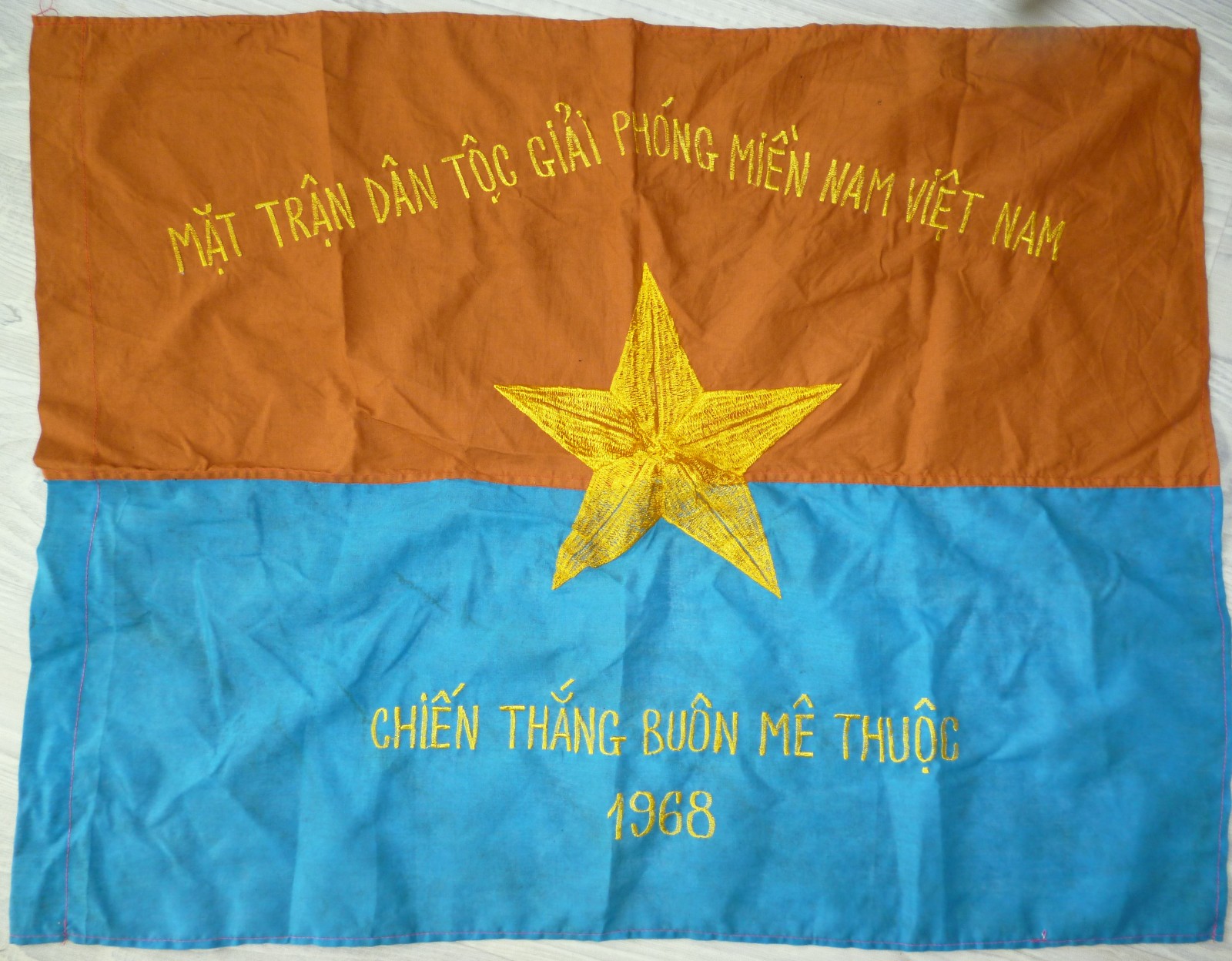
Measures - 29 x21 inches (75 x 54 cms) Excellent PieceNLF, NVA, VC - Viet Cong / National Liberation FrontBan Ma Thuot - Ban Me Thuoc
This exceptionally rare National Liberation Front (NLF/Viet Cong) flag is attributed to the Ban Me Thuoc area during the 1968 Tet Offensive. Of particular historical interest is the use of the older "Ban Me Thuoc" spelling rather than the modern Buôn Ma Thuột.This obsolete form derives from earlier Rhade (Êđê), French and Lao transliterations from the 1930's through 1950's.
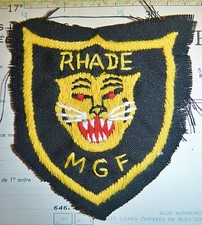
While some Rhade supported or were associated with the National Liberation Front (Viet Cong), the majority who became involved in the conflict served alongside the United States and South Vietnam through the Civilian Irregular Defense Group (CIDG), U.S. Army Special Forces and Mike Force units.
Material directly linking the NLF with the Rhade homeland is therefore encountered far less frequently than items associated with Allied forces.
Produced during one of the most intense periods of the war, as the Tet Offensive spread across South Vietnam in early 1968, the flag represents a combination of the Viet Cong, the historic Ban Me Thuoc spelling, and an area more commonly remembered for its Special Forces and CIDG history.
30th of January 1968 – First Night of the Tet Offensive
Whether by accident or design, the first wave of attacks began shortly after midnight on 30 January as all five provincial capitals in II Corps and Da Nang, in I Corps, were attacked.
Nha Trang, headquarters of the U.S. I Field Force (FFI), was the first to be hit, followed shortly by Ban Mê Thuột, Kon Tum, Hội An, Tuy Hòa, Da Nang, Qui Nhơn, and Pleiku.
During all of these operations, the Viet Cong and North Vietnamese followed a similar pattern: mortar or rocket attacks were closely followed by massed ground assaults conducted by battalion-strength elements of the Viet Cong, sometimes supported by North Vietnamese regulars.
These forces would join with local cadres who served as guides to lead the regulars to the most senior South Vietnamese headquarters and the radio station.
The operations, however, were not well coordinated at the local level.
By daylight, almost all communist forces had been driven from their objectives.
General Phillip B. Davidson, the new MACV chief of intelligence, notified Westmoreland that "This is going to happen in the rest of the country tonight and tomorrow morning."
All U.S. forces were placed on maximum alert and similar orders were issued to all ARVN units. The allies, however, still responded without any real sense of urgency. Orders cancelling leaves either came too late or were disregarded.
NLF - National Liberation Front
The Việt Cộng, also known as the NationalLiberation Front (NLF), was a communist political organization with its ownarmy – the People's Liberation Armed Forces of South Vietnam (PLAF) – in SouthVietnam and Cambodia that fought the United States and South Vietnamesegovernments, eventually emerging on the winning side
It had both guerrilla and regular army units,as well as a network of cadres who organized peasants in the territory itcontrolled. Many soldiers were recruited in South Vietnam, but others wereattached to the People's Army of Vietnam (PAVN), the regular North Vietnamesearmy.
During the war, communists and anti-waractivists insisted the Việt Cộng was an insurgency indigenous to the South,while the U.S. and South Vietnamese governments portrayed the group as a toolof Hanoi. Although the terminology distinguishes northerners from thesoutherners, communist forces were under a single command structure set up in1958.
North Vietnam established the NationalLiberation Front on December 20, 1960, to grow insurgency in the South. Many ofthe Việt Cộng's core members were volunteer "regroupees", southern ViệtMinh who had resettled in the North after the Geneva Accord (1954).
Hanoi gave the regroupees military training andsent them back to the South along the Ho Chi Minh trail in the early 1960s.
The NLF called for southern Vietnamese to"overthrow the camouflaged colonial regime of the Americanimperialists" and to make "efforts toward the peacefulunification".
The People's Liberation Armed Forces of SouthVietnam (PLAF)'s best-known action was the Tet Offensive, a massive assault onmore than 100 South Vietnamese urban centers in 1968, including an attack onthe U.S. embassy in Saigon.
The offensive riveted the attention of theworld's media for weeks, but also overextended the Việt Cộng. Later communistoffensives were conducted predominantly by the North Vietnamese. Theorganization was dissolved in 1976 when North and South Vietnam were officiallyunified under a communist government.
For your kindConsideration.