When you click on links to various merchants on this site and make a purchase, this can result in this site earning a commission. Affiliate programs and affiliations include, but are not limited to, the eBay Partner Network.
A Rare Labeled Survivor From The Legendary Comstock Boomtown
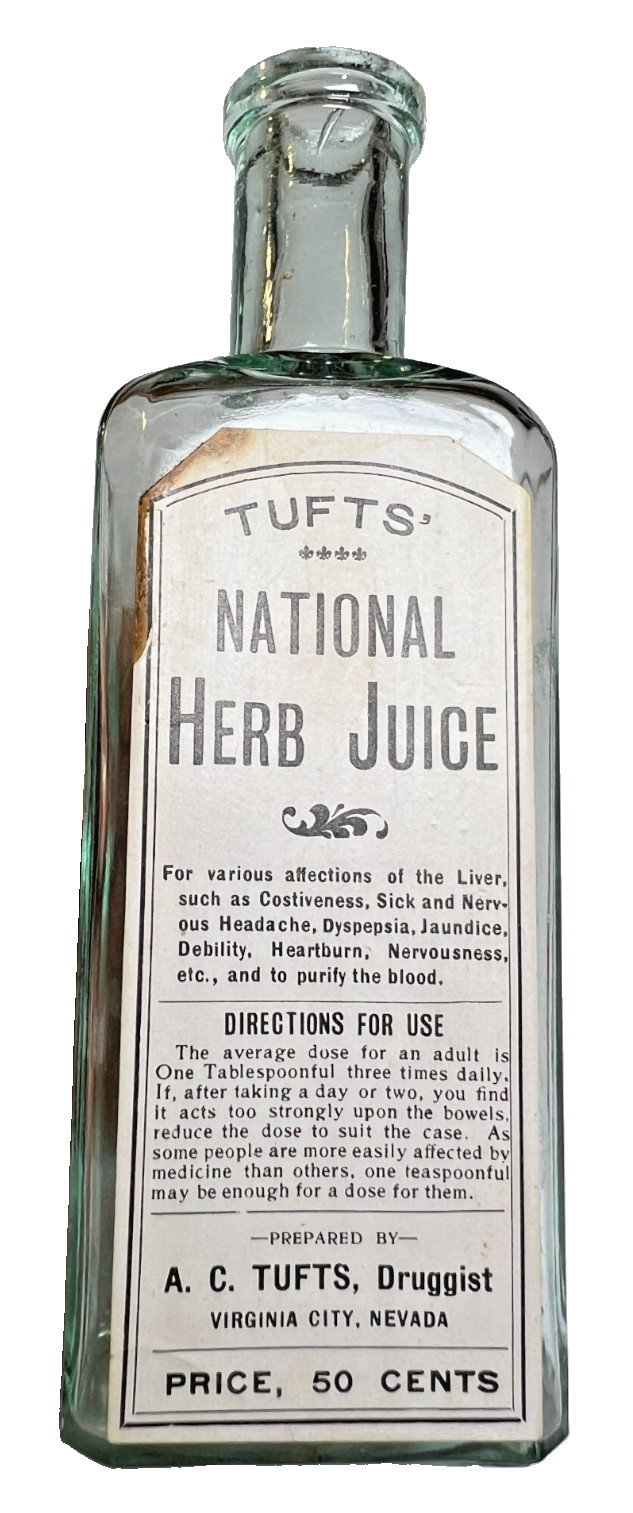
From a Western mining town built on silver, gold, and spectacular fortunes comes an especially scarce survivor: Tufts’ National Herb Juice, prepared by A. C. Tufts, Druggist, Virginia City, Nevada - with its original paper label still remarkably intact and readable.
Virginia City is one of America’s legendary “living ghost towns,” where the Comstock Lode transformed a rugged mountainside into a roaring center of mining, money, and ambition. A medicine bottle bearing that town’s name is compelling enough. Finding one that still wears its fragile paper label is what makes this example particularly special.
Glass can survive long after the paper identifying its contents has vanished. Here, the story remains: the bold “National Herb Juice” name, the Virginia City druggist, the sweeping promises of relief, the surprisingly frank dosing instructions, and the original 50-cent price. Together, they preserve a vivid glimpse of the drugstore counter in a town where fortunes came out of the ground—and relief came by the tablespoon.
Fifty Cents For Relief In The City Of Silver And Gold
Imagine Virginia City when the mine whistles sounded across the mountainside, ore cars rattled toward the mills, and fortunes rose or collapsed with the latest underground discovery. Beneath the streets, men pursued silver and gold. Above ground, druggists sold another valuable commodity: the promise of feeling better.
Offered here is an exceptionally evocative survivor of that world: Tufts’ National Herb Juice, bearing its original paper label identifying A. C. Tufts, Druggist, Virginia City, Nevada.
The pale glass is attractive on its own, but the label gives this bottle its remarkable personality. Still clearly readable are the product’s name, its ambitious medical claims, its dosing instructions, the local preparer’s name, and the original selling price:
“PRICE, 50 CENTS.”
A small purchase in its own day, preserved as a fascinating piece of Nevada pharmaceutical history and Western Americana.
The Bottle At A Glance
Product: Tufts’ National Herb Juice.
Preparer named on label: A. C. Tufts, Druggist.
Location: Virginia City, Nevada.
Estimated period: Late 19th century, provisionally circa 1870–1900.
Height: Approximately 7 inches; please see the measurement photograph.
Color: Pale aqua with a greenish cast, especially noticeable through the thicker edges and base.
Form: Rectangular body with beveled corners, rounded shoulders, and a long neck.
Closure: Cork-style mouth; no cork present.
Label: Large surviving paper label with bold black typography, decorative flourishes, medical claims, directions, and price.
Original advertised price: 50 cents.
The Comstock Connection: A Drugstore Remedy From A Legendary Mining Town
Virginia City owes its fame to the Comstock Lode, discovered in 1859. Although remembered especially for silver, the district also produced tremendous quantities of gold.
This was a place where an extraordinary mineral discovery transformed a mountainside into an industrial city. Mining attracted workers, merchants, engineers, investors, entertainers, and medical practitioners. The wealth generated underground helped shape both Nevada and San Francisco.
The Big Bonanza discovery of 1873 brought another spectacular chapter. John Mackay, James Fair, James Flood, and William O’Brien became the celebrated Bonanza Kings, associated with fortunes that reached far beyond the mines themselves.
For the ordinary resident, however, Virginia City was also a place to work, eat, raise a family, suffer a headache, and visit the druggist.
That is where this bottle becomes especially compelling. Its label preserves the commercial identity of a local medicine offered in the very town whose name became synonymous with the Comstock.
It brings the history down from the millionaires’ mansions to the drugstore counter.
What Was National Herb Juice Supposed To Do?
The label presents an ambitious list of complaints for which the preparation was marketed:
“For various affections of the Liver, such as Costiveness, Sick and Nervous Headache, Dyspepsia, Jaundice, Debility, Heartburn, Nervousness, etc., and to purify the blood.”
The language is a fascinating window into the medical marketplace of the period.
“Costiveness” meant constipation. “Dyspepsia” referred to indigestion. “Debility” described weakness or diminished vitality. The promise to “purify the blood” belonged to a familiar vocabulary of proprietary remedies, in which a single preparation might be promoted for numerous seemingly unrelated troubles.
The label makes the liver a central character in the story. Headaches, digestive complaints, weakness, and nervousness all appear beneath the same broad therapeutic umbrella.
The precise formula is not given on the surviving label. “Herb Juice” was the product’s identity and selling language; it does not provide enough information to reconstruct the ingredients.
The Directions Reveal An Especially Memorable Detail
The recommended adult dose was:
“One Tablespoonful three times daily.”
But the instructions immediately qualify that recommendation:
“If, after taking a day or two, you find it acts too strongly upon the bowels, reduce the dose to suit the case.”
For particularly sensitive customers, the label suggests that a teaspoonful might be sufficient.
That warning strongly suggests that a bowel-moving or purgative effect was an important part of the preparation’s intended action, although its exact ingredients remain unidentified.
It is unusually revealing advertising: the broad promise of relief, followed by a practical acknowledgment that the remedy might work rather more energetically than the customer expected.
The label preserves the sales pitch and the fine print together.
Medicine In A Town Built On Risk
Comstock mining demanded strength and endurance. Underground work involved heat, heavy labor, machinery, and the constant challenges of keeping deep workings supported and usable.
At street level, drugstores formed part of the commercial infrastructure that supported this demanding industrial community.
The medical world was changing, but proprietary remedies continued to compete for customers through memorable names, confident claims, and the reputation of the person selling them.
Here, the prominently printed “A. C. TUFTS, Druggist” is part of the appeal. The label presents a named local preparer behind the product. Meanwhile, “National” gives the remedy an expansive identity, despite its very specific Virginia City address.
For a collector, that combination is particularly satisfying: a grandly named preparation anchored to a real Western town by a surviving piece of printed advertising.
Steam, Engineering, And The Industrial West
Virginia City’s mining history was also a story of technological invention.
In 1860, engineer Philipp Deidesheimer developed square-set timbering in Virginia City. Its interconnected wooden framework supported the enormous underground spaces created as ore was removed, helping miners exploit deposits that conventional timbering could not safely accommodate.
Steam-powered machinery, hoisting equipment, ore transportation, and stamp mills made the Comstock an industrial enterprise on a formidable scale.
The Virginia & Truckee Railroad reached Virginia City in 1870, linking the mining community more closely with the wider transportation network.
Picture the contrast: sophisticated engineering moving tons of rock, while a drugstore label offered a spoonful of herbal medicine for nervousness, indigestion, and an overburdened liver.
This bottle belongs to the commercial and medical history of that changing Western world.
Silver Was Politics, Too
Nevada entered the Union on October 31, 1864, during Abraham Lincoln’s presidency and the Civil War.
In the decades that followed, the metal beneath Virginia City helped fuel a national argument over money itself.
The Coinage Act of 1873, which discontinued the standard silver dollar’s coinage, became notorious among silver advocates as the “Crime of ’73.” Nevada Senator William Stewart was a prominent critic.
In a mining community, debates over silver were tied to livelihoods, investment, and the future of the region.
That political struggle forms part of the broader setting behind this modest 50-cent remedy: a town whose underground wealth carried consequences all the way to Washington.
The Great Fire And A Changing City
On October 26, 1875, a fire originating in a boarding house spread through Virginia City. Thirty-three blocks were leveled, including much of the business district, major public buildings, and mining infrastructure.
The city rebuilt, but its history continued through cycles of mining prosperity and decline.
The fire is an important part of Virginia City’s story. There is no established evidence that this particular bottle predates or survived the fire.
Its significance rests on the locality printed on the label and its survival as a piece of the town’s pharmaceutical trade.
A Fascinating Tufts Research Lead
A contemporary advertisement in the November 1, 1874, Lyon County Times places Drs. Packer & Tufts, Homeopathic Physicians and Surgeons, at 62 South C Street, Virginia City.
The advertisement even lists Dr. Tufts’ office hours: 10 a.m.–noon and 7–9 p.m.
This provides an intriguing additional Tufts reference within Virginia City’s medical community during the Comstock boom.
The bottle’s own label remains the direct evidence for its named preparer and locality.
Why The Surviving Label Matters
A discarded glass bottle can survive after its paper identification has disappeared.
Here, the paper preserves almost the entire commercial story:
The distinctive product name.
The preparer’s initials and surname.
His occupation as a druggist.
The Virginia City, Nevada, location.
The ailments the preparation claimed to address.
The recommended dose.
The warning about excessive bowel action.
The original 50-cent selling price.
Without that label, much of this identity would be lost.
Its survival gives the bottle appeal across several collecting interests: Nevada bottles, Western Americana, Virginia City and Comstock history, pharmaceutical antiques, proprietary remedies, and antique advertising.
Apparently rare in this original-labeled presentation, with no verified surviving-example count established.
Condition
An attractive display example with bright, transparent pale aqua glass.
No obvious major chips or cracks are apparent in the supplied photographs. Small bubbles and variations in the glass add visual character. Please examine the close-up photographs of the mouth, edges, and base for surface details.
The paper label remains substantially complete and remarkably readable. It shows age toning, scattered spotting, and localized browning and edge wear, most noticeably toward the upper-left portion. The product name, preparer, locality, directions, and price remain clear.
The bottle is empty and has no cork.
Please review all photographs as part of the condition description.
An Evocative Survivor Of Virginia City’s Medical Marketplace
Silver and gold made Virginia City famous. Objects such as this preserve the lives and businesses that grew around the mines.
With its pale aqua glass, bold typography, expansive medical claims, and unmistakable Nevada identification, Tufts’ National Herb Juice offers a particularly vivid connection to the everyday commerce of a legendary Western mining town.
An antique bottle whose surviving label still tells its story - right down to the fifty-cent price.
Offered as an antique collectible for historical display.