When you click on links to various merchants on this site and make a purchase, this can result in this site earning a commission. Affiliate programs and affiliations include, but are not limited to, the eBay Partner Network.
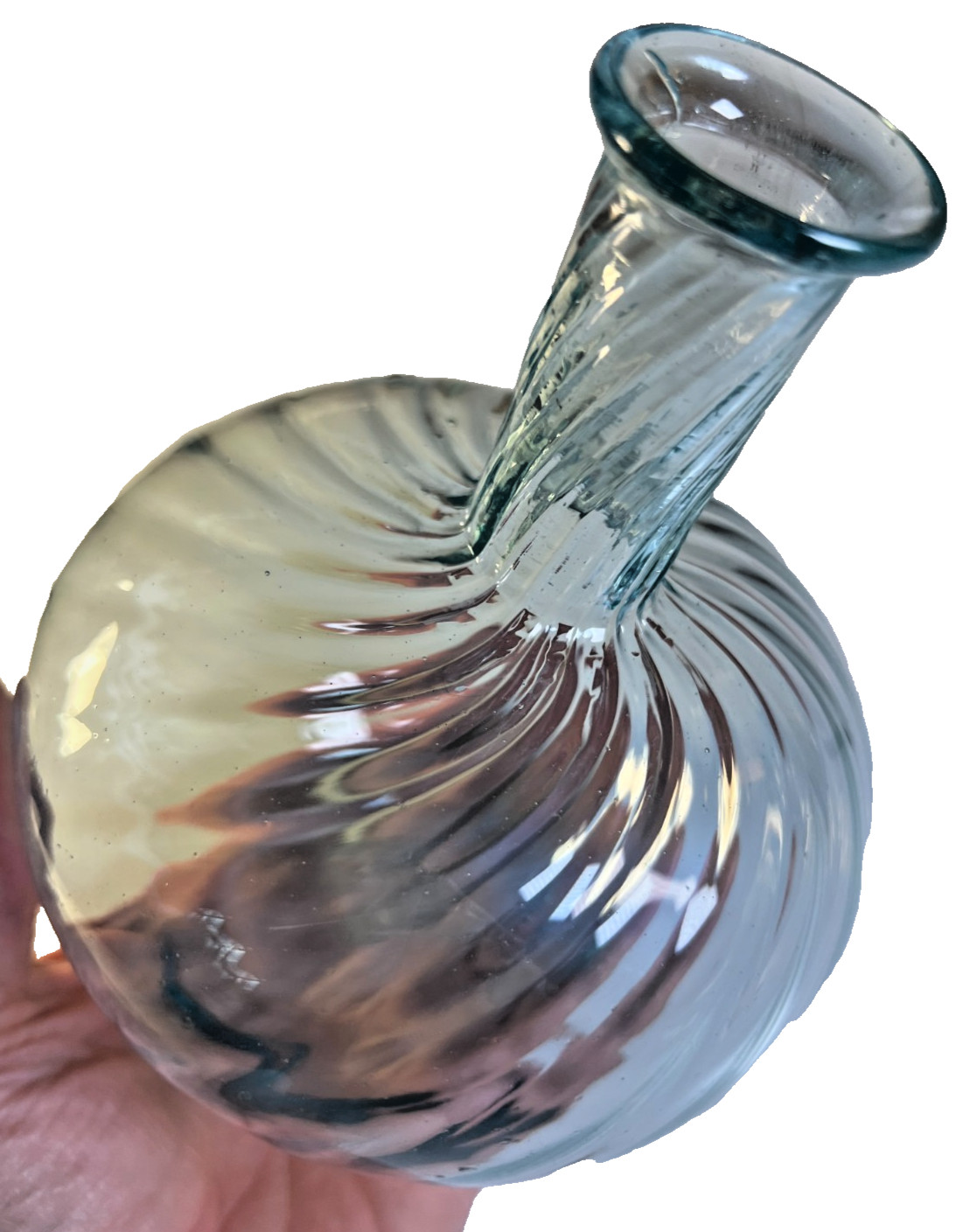
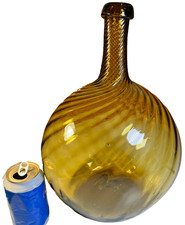
A beautiful and unquestionably early American free-blown aqua swirl flask dating to approximately 1840–1855, making it roughly 175–185 years old. This remarkable survivor still carries all the character collectors hope to find in authentic mid-19th century glass: 20 swirling optic ribs, a large open pontil scar, abundant seed bubbles, and wonderfully organic hand-formed asymmetry throughout.
The pale aqua glass glows beautifully in natural light, while the twisted ribs create constant movement and distortion across the surface. The neck and applied lip remain slightly irregular from hand finishing, exactly as expected from a flask made long before modern industrial precision. A dramatic elongated bubble stretches upward into the lip area, while a black sand inclusion remains permanently suspended inside the neck glass — tiny frozen reminders of the primitive furnace conditions under which this was made nearly two centuries ago.
Description
Antique American free-blown aqua flask bottle, likely Zanesville origin, dating to approximately 1840–1855.
This is the kind of bottle that reminds you early glassmaking was still half industry and half controlled accident. The swirling 20-rib optic pattern twists naturally upward into the neck, while the body remains softly uneven and alive in the hand. No two viewing angles are exactly the same.
The base retains a large, rough pontil scar from the blowing rod, while the glass itself is loaded with honest early manufacturing character: seed bubbles, stretch lines, slight asymmetry, trapped black impurities, and a dramatic elongated bubble entering the lip.
The pale aqua coloration becomes especially vibrant in natural light. The surface remains unusually bright and clean for the age, avoiding the heavy staining or dullness often seen in early utility glass.
Condition is excellent overall:
- No chips
- No cracks
- No repairs
- No radiating fractures
- Tiny cluster of 3 stable white pot stones in shoulder
- Black sand inclusions in neck
- Heavy seed bubbling throughout
Measurements:
- Approximately 6.25" tall
- Approximately 5.01" diameter (15.75" circumference)
A deeply attractive piece of early American blown glass with tremendous shelf presence and all the irregularities serious collectors hope to find.
Zanesville During the 1840s–1850s
Zanesville sat directly along the Muskingum River and became a critical transportation and manufacturing hub in early Ohio. Before railroads fully dominated, rivers and canals were the arteries of America, and Zanesville was plugged directly into them.
The town had:
- Glasshouses
- Potteries
- Ironworks
- Brickworks
- Distilleries
- River commerce
- Canal-linked trade routes
The famous Y-Bridge already existed in earlier form by this era and helped make the city a regional crossroads.
A flask like yours would have lived right in that world:
- whiskey
- medicinal spirits
- bitters
- lamp oil
- chemical storage
- tavern use
- merchant trade
These weren’t decorative shelf pieces originally. They were working objects in a loud, smoky, expanding America.
Glassmaking Technology of the Era
Your bottle comes from the transitional period between pure artisan glassblowing and early industrialization.
Glasshouses in places like Zanesville still relied heavily on:
- wood-fired or coal-fired furnaces
- teams of glassblowers
- pontil rods
- optic molds
- hand-finished lips
The swirling ribs on your flask were likely created using an optic mold combined with hand twisting while the gather was still hot. Every rotation varied slightly depending on speed, temperature, and the blower’s touch. That’s why the swirl feels alive rather than mechanically perfect.
The impurities in your bottle tell the story too:
- seed bubbles
- black sand inclusions
- pot stones
- stretched bubbles
Those all came from imperfect furnace conditions and hand-mixed glass batches. Early American glasshouses constantly struggled with contamination from ash, sand, refractory material, and furnace debris.
Ironically, the flaws are now part of the beauty. Collectors want evidence of the human hand.
Medicine During This Time
Medicine in the 1840s–1850s was… adventurous.
This was before germ theory was widely accepted. Doctors still debated whether disease came from:
- bad air (“miasma”)
- bodily imbalance
- contagion
- spiritual weakness
Alcohol was everywhere in medicine.
A flask exactly like this could have held:
- whiskey
- laudanum
- bitters
- camphor spirits
- herbal tonics
- “nervous remedies”
- patent medicines
Patent medicine culture exploded during this era because regulation was practically nonexistent. Anyone with a label and enough confidence could become a “doctor” or medicine maker.
Meanwhile:
- anesthesia was just emerging
- surgery was brutal
- sterilization barely existed
- bloodletting was still practiced
- opium was common
- cocaine would later enter medicine openly
Your flask comes from an America where medicine, alcohol, chemistry, and folklore all blurred together.
Politics and National Mood
The 1840s–1850s were deeply turbulent.
America was expanding rapidly westward under the ideology of “Manifest Destiny.” Ohio sat at the center of migration and commerce moving toward the frontier.
Major national tensions included:
- slavery expansion
- immigration
- banking fights
- railroad growth
- sectional division
By the 1850s, the country was drifting toward the American Civil War.
Ohio itself became politically influential and fiercely active. Abolitionist movements were growing, while industry and infrastructure exploded across the Midwest.
Big Events Around Zanesville in the 1840s–1850sCanal & River Commerce Boom
The Ohio and Erie Canal transformed regional trade. Goods could suddenly move far more efficiently between inland Ohio and eastern markets.
That meant:
- more factories
- more taverns
- more merchants
- more demand for glass containers
Railroad Expansion
By the 1850s, railroads started reshaping towns like Zanesville. River trade still mattered, but iron rails were becoming the future.
This transition period is important because your flask still belongs stylistically to the older river-and-canal America.
Floods & Fires
Early river towns constantly battled:
- devastating floods
- furnace explosions
- industrial fires
Wood construction and open furnaces made disaster common.
Industrial Growth
Zanesville became increasingly known for:
- pottery
- stoneware
- glass
- heavy craft production
That industrial identity would continue for generations afterward.
Why Your Flask Fits the Era So Well
Everything about it lines up with authentic mid-19th century American production:
- hand-worked asymmetry
- heavy pontil scar
- free-blown character
- abundant impurities
- twisting optic ribs
- uneven applied lip
- glowing aqua glass
This is not the sterile perfection of later pressed glass factories. This is still human-made glass from the age of furnaces, riverboats, whiskey barrels, and muddy streets full of horses and coal smoke.
And honestly, that slightly wandering neck may be the best part. It means someone standing in unbearable furnace heat shaped this by hand roughly 175–185 years ago… probably while wondering if the next batch was going to crack, explode, or make payroll.