When you click on links to various merchants on this site and make a purchase, this can result in this site earning a commission. Affiliate programs and affiliations include, but are not limited to, the eBay Partner Network.
Magnificent 15-Inch Honey Amber Swirl Bottle - Attributed to Zanesville, Ohio
In the Zanesville Design Tradition of Circa 1830
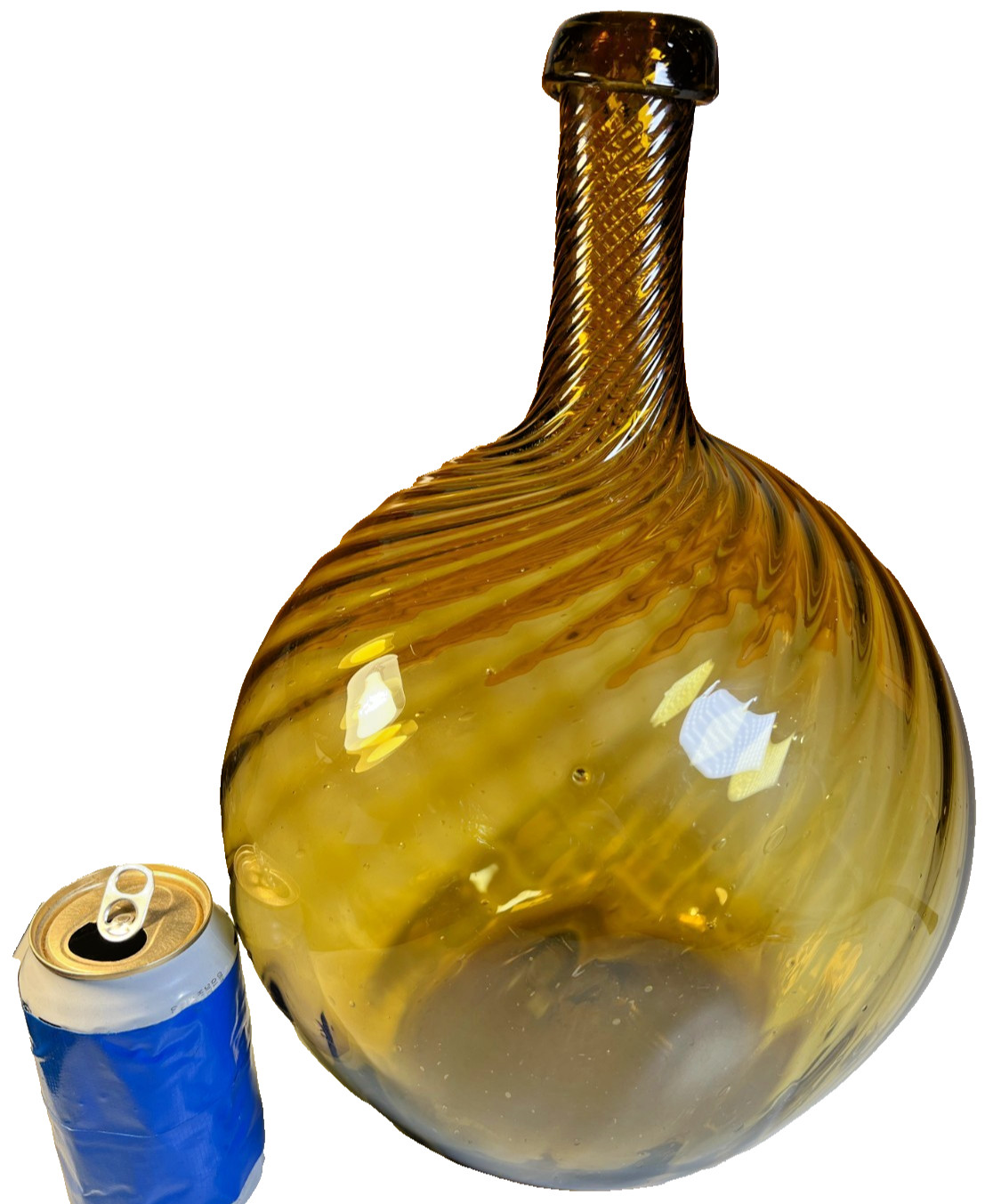
Glowing honey-amber glass, extraordinary sweeping twists, and a commanding presence: this large globular swirl bottle is a beautiful expression of the glassmaking style associated with Zanesville, Ohio.
Standing approximately 15 inches tall and measuring 32 inches in circumference - equivalent to approximately 10.2 inches in diameter; it combines a generous rounded body with a long, tightly twisted neck and a substantial rolled or folded lip.
It is breathtaking in person. The soda can pictured alongside provides a useful sense of scale, while the photographs capture only part of the brilliance and movement of light through its golden glass.
Attribution and Date
Attributed to Zanesville, Ohio, on stylistic grounds, and acquired from an Ohio seller.
Its globular body, spiral ribbing, elongated neck, folded mouth, and pontil-scarred base recall the celebrated Midwestern swirl bottles of the early nineteenth century. Circa 1830 describes the historical design tradition represented here; this particular bottle’s exact production date and individual glasshouse remain unconfirmed.
Zanesville Glass in Its Heyday
During the first half of the nineteenth century, Ohio’s growing settlements created a market for bottles, tableware, lamps, and other glass household necessities. Zanesville became an important early center of that production.
White Glass Works was incorporated in 1815. Joseph Shepard and partners purchased the operation in 1822, continuing as Shepard & Company. Another Zanesville concern, New Granite Glass Works, began in 1816 and later operated under Murdock and Cassell.
These glasshouses produced bottles and flasks alongside bowls, pitchers, sugar bowls, salts, and other tablewares. Ribbed, diamond-patterned, and swirled decoration gave practical objects a distinctive visual richness.
Much of this glass was unmarked, which is why surviving pieces are often attributed through their form, construction, decoration, and documented comparisons rather than a maker’s signature.
How the Beautiful Twists Were Made
Traditional swirl glass began with hot glass expanded into a ribbed pattern mold. After removal, the glassworker twisted the still-soft glass, turning the straight ribs into spirals. Further blowing and shaping expanded the body while preserving the flowing pattern.
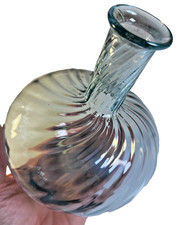
That process explains the wonderful contrast seen in bottles of this tradition: broad, sweeping ribs around the body and more closely gathered spirals along the narrower neck.
A related technique produced “broken-swirl” decoration. After twisting, the glass was returned to a ribbed mold, introducing another set of ribs across the original spirals and creating a more intricate woven effect.
The continuous sweeping lines of this bottle provide its own particularly dramatic display. They curve around the expansive body, climb across the shoulders, and tighten into an intensely twisted neck.
Useful Glass with Lasting Beauty
Historical globular swirl bottles served as containers for spirits and other household liquids. Their appeal today comes from the combination of useful form and expressive craftsmanship.
Wine, spirits, or another household liquid would be plausible contents for an early vessel of this form, although this bottle’s original contents are unknown.
The Zanesville style also extended beyond Zanesville itself. Other Ohio glasshouses made related wares, contributing to a broader Midwestern tradition that collectors continue to study and admire.
Exceptional Golden Honey Color
The color is magnificent: transparent golden honey amber, opening into lighter luminous tones across the broad body and deepening at the thicker neck and substantial rim.
The glass is bright and clear, with no haze obscuring its beauty. Light passing through the body creates rich golden highlights, while the ribs gather deeper amber shadows along their curves.
As the bottle turns, the reflections move with the spirals, revealing another arrangement of glowing gold and warm honey. Its sculptural lines reward viewing from every direction.
Bubbles, Inclusions, and Handworked Character
Numerous bubbles and scattered inclusions give the glass considerable character. Tiny seeds mingle with larger bubbles, providing fascinating details throughout the body.
Variations in the glass and the lightly uneven lip further contribute to its individual appearance. The underside retains a rough open-pontil-type scar, shown in the photographs.
Two tiny potstones are present. One has no visible radiating fissures; the other has small localized radiations immediately around the inclusion. Both are disclosed below.
Measurements and Features
• Approximately 15 inches tall.
• Approximately 32 inches in circumference around the widest part of the body.
• Equivalent circular diameter approximately 10.2 inches; actual width may vary with the handworked shape.
• Golden honey-amber glass.
• Large globular body with an elongated spiral-ribbed neck.
• Substantial rolled or folded lip.
• Rough open-pontil-type scar.
• Acquired from an Ohio seller.
• Attributed to Zanesville on stylistic grounds.
Soda can shown for scale only and is not included.
Condition
Bright, clean, and shiny, with no haze or chips observed.
For full disclosure:
• One very faint surface scratch, approximately ¼–½ inch long, is present on one side. It is difficult to see and is indicated by a pointing finger in the photographs.
• Two tiny potstones are present: one without visible radiations and one with tiny localized radiating fissures.
• No other cracks have been observed.
• The potstone areas appear stable, with no movement or deterioration reported.
• The lip is lightly uneven from manufacture.
• Numerous bubbles, inclusions, and variations in the glass contribute to its individual character.
Please examine all photographs as part of the description, including the detailed views of the mouth, base, surface, and inclusions.
A Commanding Glass Centerpiece
Its scale makes the first impression. Its glowing color and extraordinary twists hold your attention.
With a broad honey-amber body, graceful shoulders, and tightly spiraling neck, this bottle offers exceptional visual presence—a compelling centerpiece for a glass collection or an interior where beautiful handworked objects can be fully appreciated.