When you click on links to various merchants on this site and make a purchase, this can result in this site earning a commission. Affiliate programs and affiliations include, but are not limited to, the eBay Partner Network.
🏡 Brick's Old Homestead Mince Meat Label Set — Edgar Brick & Sons, Crosswicks, N.J. — NOS
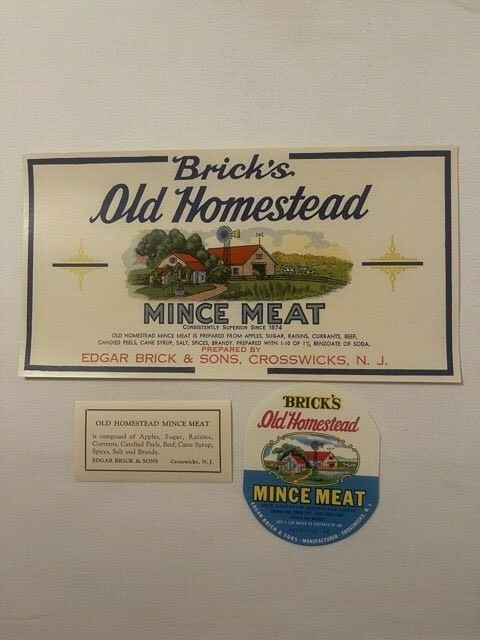
Three original, unused labels for Brick's Old Homestead Mince Meat, 1910s–1930s, from the Crosswicks, New Jersey firm that was the largest mincemeat maker in the United States during World War II. Every one lists beef and brandy.
SPECIFICATIONS
- Brand: Brick's Old Homestead Mince Meat
- Maker printed: Edgar Brick & Sons, Crosswicks, N.J.
- Era: 1910s–1930s
- Pieces: 3 — large farm-scene label, die-cut oval jar label, typeset ingredient card
- Size: large label 9.5" x 5" ~; the other two are smaller
- Large label prints: CONSISTENTLY SUPERIOR SINCE 1874; the full ingredient list; PREPARED WITH 1-10 OF 1% BENZOATE OF SODA
- Oval label prints: ADD 1/4 CUP WATER TO CONTENTS OF JAR; NET WT. 1 LB. 1 OZ.
- Artwork: farmhouse, barn, windmill and cows
CONDITION
New old stock: unused labels, never applied. Plain backs with the printing faintly showing through. Please see the photos.
THE STORY
Edgar Brick began making mincemeat in 1874 because he was dissatisfied with the Philadelphia product he sold in his Crosswicks store, and he sold 76 pounds that first year. In 1879 he built his factory by moving two local farmhouses onto the property and joining them. By the early 1900s Edgar Brick & Sons was the largest mincemeat maker in New Jersey. After Edgar's death in 1920 his sons Arthur, Josiah and Charles ran it, and during World War II it employed 40 workers and made three million pounds a year, the largest in the country. It turned to alcoholic beverages in 1968, stopped making mincemeat, and closed in 1979.
The brandy on these labels has a Prohibition twist: in 1922 a court ruled that culinary products, mincemeat included, could contain liquor, and the firm's Banquet Hall label of the 1920s printed a federal Prohibition permit and a 14 percent proof alcohol statement.
Crosswicks itself is a Revolutionary War village. Its 1773 Quaker meetinghouse was struck by three cannonballs in a skirmish on June 23, 1778, five days before the Battle of Monmouth, and one of them was later mortared into the wall where it hit.
GOOD FOR
- Food and grocery label collections
- New Jersey and Burlington County history
- Prohibition-era collections
- Farmhouse kitchen and holiday baking decor