When you click on links to various merchants on this site and make a purchase, this can result in this site earning a commission. Affiliate programs and affiliations include, but are not limited to, the eBay Partner Network.
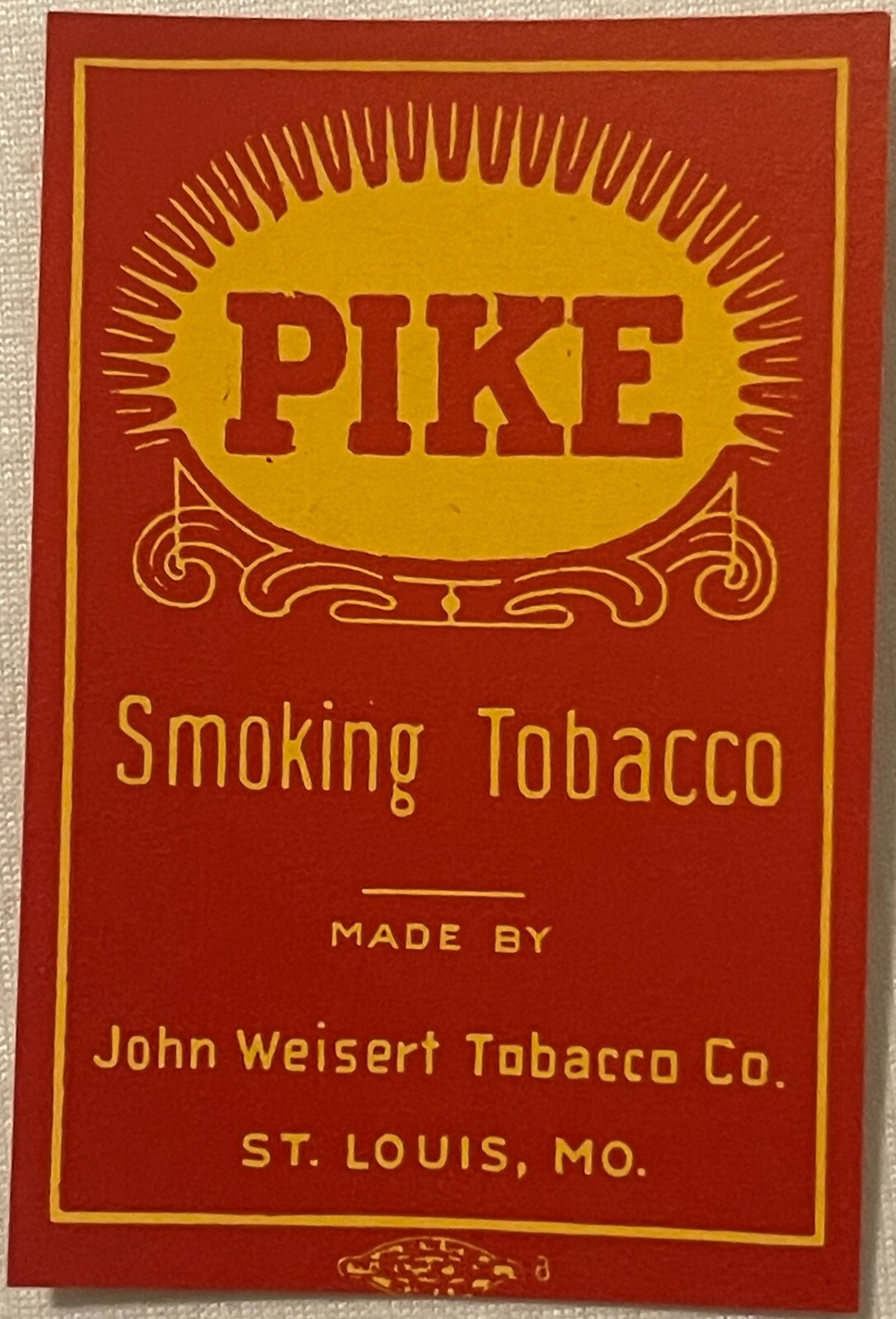
Antique Pike Smoking Tobacco Label — John Weisert Tobacco Co., St. Louis, MO, 1910s–1930s Era, New Old Stock! 🚬🏙️
---
There is a whole city's worth of history compressed into this small rectangle of printed paper. 🌆 The Pike Smoking Tobacco label — produced by the John Weisert Tobacco Company of St. Louis, Missouri — is a New Old Stock survivor from the era when St. Louis was the undisputed capital of American tobacco manufacturing, and John Weisert was one of the men who made it so.
This label measures 2 3/4" x 1 3/4", and every fraction of an inch of it earns its keep. 🟥 The face is printed in a bold brick red, with the brand name PIKE set large inside a glowing golden oval medallion at the top — the oval itself radiating a sunburst of fine lines outward in all directions, like a commercial sunrise pressed flat into paper. Below the medallion, ornamental scrollwork in the same warm gold frames the design before the text opens up into "Smoking Tobacco," followed by "Made By," and then the full company credit: John Weisert Tobacco Co., St. Louis, MO. The type is confident and period-correct, the gold-on-red palette unmistakably American and unmistakably of the early twentieth century. A small decorative printer's ornament sits centered near the bottom edge, the kind of detail that separates a label made with craft from one made with economy. 🎨
The colors are vivid. The paper is clean and flat. This is New Old Stock condition — old inventory that never made it onto a tobacco pouch, never saw the inside of a general store's back shelf in the traveling sense, and has come through the decades in the kind of shape that makes a collector stop mid-scroll. ✅
---
🏭 THE HOUSE THAT JOHN WEISERT BUILT
The John Weisert Tobacco Company was not a small operation and not a brief one. The company built its St. Louis factory in 1903 and did not close its doors until 1989 — a run that carried it from the streetcar era all the way through the Reagan administration. By the time it finally closed, it was the last remaining tobacco company in a city that had once been home to more than 400 of them. Let that sink in for a moment. 🏛️ Four hundred tobacco companies operating in a single American city, and Weisert was the one left standing when the era ended.
St. Louis's dominance in American tobacco manufacturing is one of the quietly remarkable chapters in the country's commercial history. Lore circulating among collectors and local historians holds that the city at its peak was responsible for an astonishing 40% of the nation's tobacco supply — a figure that, if accurate, makes St. Louis not just a regional hub but the literal engine of American tobacco culture for a generation or more. Whether the number is exactly right or slightly embroidered by decades of retelling, the underlying truth is not in dispute: the Mississippi River, the rail connections, the German and Central European immigrant workforce who brought precision craft traditions with them, and the proximity to Southern leaf growing regions combined to make St. Louis a place where tobacco was not just made but perfected. 🌿
John Weisert worked in that tradition with real ambition. The company built a portfolio of more than 100 brands — a staggering variety for a single manufacturer, and a sign of how competitive the early tobacco market was. If you wanted a customer's loyalty in 1915, you needed to give him something to be loyal to: a name, a label, a look he could recognize from across a general store counter. Pike was one of those names. So were Brilliant, Big John, Checkers, Rod and Gun, and Orphan Boy — each brand its own little world of commercial identity, each label its own piece of applied graphic art.
The business passed through the family, as these things did. John Weisert Jr. was born in St. Louis on March 1, 1887, and grew up inside the operation his father had built. He eventually became president of the company and was by all accounts a capable steward of the family enterprise — until he died suddenly in 1940, a loss that the company survived but that the people who knew the business felt for years afterward. 🕯️ The company outlasted him by nearly half a century, but the sudden departure of the man who had guided it through Prohibition, the Depression, and the first tremors of the modern cigarette era left a mark on the story.
---
🎨 A WORD ABOUT THE LABELS THEMSELVES
The story passed down in collecting circles — never fully verified in print, but persistent enough that it travels from table to table at tobacciana shows — holds that the commercial artists who designed the Weisert label portfolio were anonymous craftsmen, paid piece rates for their work and never credited by name on anything they produced. 🖌️ If that lore has any truth to it, then the Pike label in this listing is the work of someone whose name we will never know: a professional who understood color theory, understood what grabbed a buyer's eye across a cluttered shelf, and understood that a sunburst radiating from a golden oval on a field of brick red was going to do exactly what a label needed to do. He was right. It still works more than a hundred years later.
The lithographic printing technique used on paper tobacco labels of this era was not accidental craft. These were produced with multiple print passes, each adding a layer of color, building the final image the way a painter builds a canvas — except at commercial scale, under deadline, for a market that judged quality in fractions of a second. The gold is still warm. The red is still punchy. The lettering is still crisp. Whatever anonymous craftsman drew this up, he knew his business. 🏆
---
🌆 ST. LOUIS, 1903–1989: THE WHOLE ARC
The era this label comes from — the 1910s through 1930s — was a genuinely complicated moment for American tobacco. The cigarette was rising fast, and the old forms — loose smoking tobacco, chewing tobacco, snuff, hand-rolled cigars — were starting to feel the pressure from the packaged, mass-produced, machine-rolled cigarette. Weisert and companies like it were not blind to the shift. They watched the market change around them and adapted where they could. But they also kept producing the traditional forms, for the customers who had always bought them and had no particular reason to switch.
Prohibition ran from 1920 to 1933, and those years were stranger for the tobacco trade than they might seem at first. 🍺 With the saloon gone, men who had organized their leisure around a bar stool found new rituals, and tobacco was one of them. A pipe or a pouch of smoking tobacco filled some of the same quiet time that a beer or a whiskey had filled before. Weisert's portfolio of more than 100 brands gave the company something to offer every customer in that shifting landscape: a mild smoking blend, a fine cut, a roll-your-own option for the man who wanted to feel the craft in his hands.
The Depression years that followed were, paradoxically, not the worst years for affordable tobacco. Small luxuries held on. A man who could no longer afford a new suit or a dinner out could still afford a pouch of smoking tobacco, and that fact kept the mid-range producers alive through years that killed businesses in almost every other category. 💼 Weisert made it through. Pike made it through. The labels kept going out on the pouches, and the pouches kept going out the doors of the factory on the Mississippi.
---
🏺 THE COLLECTOR'S ANGLE
Paper tobacco labels from the Weisert portfolio have a demonstrated track record with collectors. The company's sheer output — more than 100 brands, across multiple decades, produced in enormous quantities and then simply forgotten in stockrooms and warehouses as the industry wound down — means there is real variety to pursue. No two Weisert labels look alike. Each brand had its own personality, its own color story, its own approach to the commercial graphic problem of stopping a customer's eye. 🎯
Pike is one of the bolder designs in the portfolio. The red-and-gold combination is high-contrast and visually assertive in a way that some of the more muted Weisert labels are not. The sunburst medallion device gives it an almost heraldic quality — it looks less like a commodity label and more like a personal seal, the kind of mark a confident manufacturer puts on a product he genuinely believes in.
Collectors of tobacciana, American graphic ephemera, paper Americana, and commercial art of the early twentieth century all have a legitimate claim on something like this. It sits comfortably in any of those categories and earns its place in all of them. 📜
---
✨ WAYS TO DISPLAY AND USE THIS LABEL
🖼️ Float it under glass in a small deep-set frame with a dark tobacco-brown or navy mat — the red and gold against dark matting is genuinely striking, and at 2 3/4" x 1 3/4" it has the presence of a miniature painting
🗂️ Mount it on archival card stock alongside its printed history notes for a study, den, or home library display that holds up to a close look
🏺 Group it with other Weisert labels — Orphan Boy, Brilliant, Rod and Gun — in a single shadowbox frame to tell the whole story of the St. Louis tobacco portfolio in one installation
🍂 Pair it with a vintage tobacco tin, a period trade card, and a piece of early advertising ephemera for a shelf display that covers the whole era of American commercial tobacco culture
🎁 Tuck it into a curated gift for the tobacciana collector, the St. Louis history enthusiast, the American graphic ephemera devotee, or the commercial art collector who wants something with a real story and a real manufacturing pedigree behind it
📚 Add it to a research collection alongside other documented examples of Weisert's label output — the Pike design is a strong representative of the company's peak commercial graphics work, and it documents a specific moment in the manufacturing history of American smoking tobacco
---
🌿 THE LAST MAN STANDING
There is an elegiac quality to the John Weisert Tobacco Company that the Pike label carries without even trying. Lore among St. Louis historians holds that the industry's final unraveling in the city was marked by the passing of Louis Applestein — said to have been the city's last cigar hand-roller, working into his eighties, the final living link between the craft era and the world that replaced it. The story, as it gets told, is less about one man and more about what his passing represented: the end of a specific kind of working knowledge that had been passed hand to hand in that city for more than a century, and that nobody had thought to write down while there was still time. 🕯️
Weisert kept going for decades after the human craft tradition wound down around it, running on institutional memory and family commitment well past the point where most tobacco manufacturers had folded or been absorbed into conglomerates. When the factory finally closed in 1989, it closed as the last one. Not one of the last few. The last one. In a city that had once held over 400. That is a remarkable ending to a remarkable run, and the Pike Smoking Tobacco label you are looking at was produced somewhere in the middle of that story — when the company was still vigorous, still innovative, still putting out new brands and new label designs for a market that rewarded craft and punished carelessness.
This is New Old Stock. 2 3/4" x 1 3/4". Brick red and warm gold. John Weisert Tobacco Co., St. Louis, MO. 🌆 The whole city in a label.
New Old Stock (NOS): unused old store inventory, preserved exactly as it was set aside decades ago.