When you click on links to various merchants on this site and make a purchase, this can result in this site earning a commission. Affiliate programs and affiliations include, but are not limited to, the eBay Partner Network.
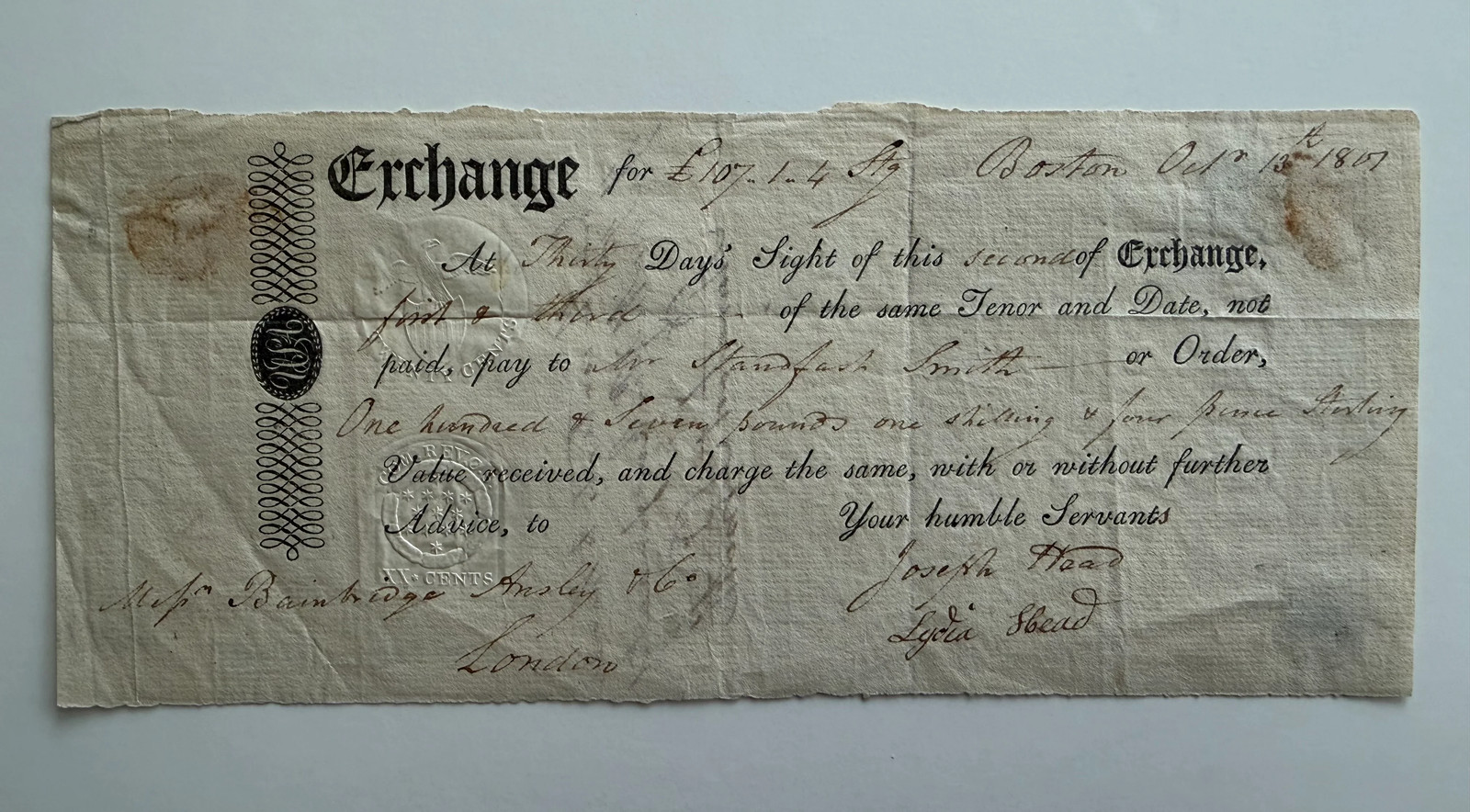
Completed entirely in period manuscript, the bill is signed by Joseph Head and Lydia Head and bears its original embossed 25-cent United States revenue stamp, together with period endorsements and banking notations on the reverse documenting its circulation. Issued only weeks before President Thomas Jefferson\'s Embargo Act transformed American overseas commerce, the document represents the sophisticated financial network that connected merchants in Boston and London during the Early Republic.
An outstanding original artifact of American banking, international trade, and Federal-period commerce. Ideal for collectors of early U.S. financial history, merchant manuscripts, Boston history, maritime commerce, Anglo-American trade, and banking ephemera.
- Boston, Oct. 13, 1807
- Amount: £107.1.4 Sterling
- Payable at thirty days sight
- Payable to Mr. Jeremiah Smith
- Drawn on Messrs. Baring Brothers & Co., London
- Signed by:
The document bears an embossed 25-cent U.S. revenue stamp, required under the federal stamp duties then in force.
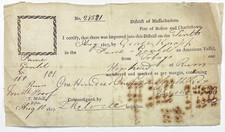
The reverse carries period endorsements and banking notations documenting negotiation of the bill.
Historical Importance
This is a fine example of early American international finance.
Rather than shipping coin across the Atlantic, merchants settled accounts through bills of exchange, which functioned much like negotiable checks drawn on established banking houses.
Several features make this document desirable:
- Early Federal period
- Boston commercial document
- Drawn on Baring Brothers & Co., one of the world\'s most important merchant banks
- Original embossed federal revenue stamp
- Shortly before Jefferson\'s Embargo Act of December 1807
- Original endorsements on reverse
Baring Brothers
Baring Brothers was Britain\'s leading merchant bank during the late eighteenth and early nineteenth centuries and handled enormous volumes of American trade financing.
Bills drawn upon Baring Brothers are collected as important artifacts of early Anglo-American commerce.
Condition
- Original printed form
- Strong manuscript entries
- Original embossed revenue stamp
- Reverse endorsements
- Light staining from former mounting
- Minor edge wear
- Very good condition