When you click on links to various merchants on this site and make a purchase, this can result in this site earning a commission. Affiliate programs and affiliations include, but are not limited to, the eBay Partner Network.
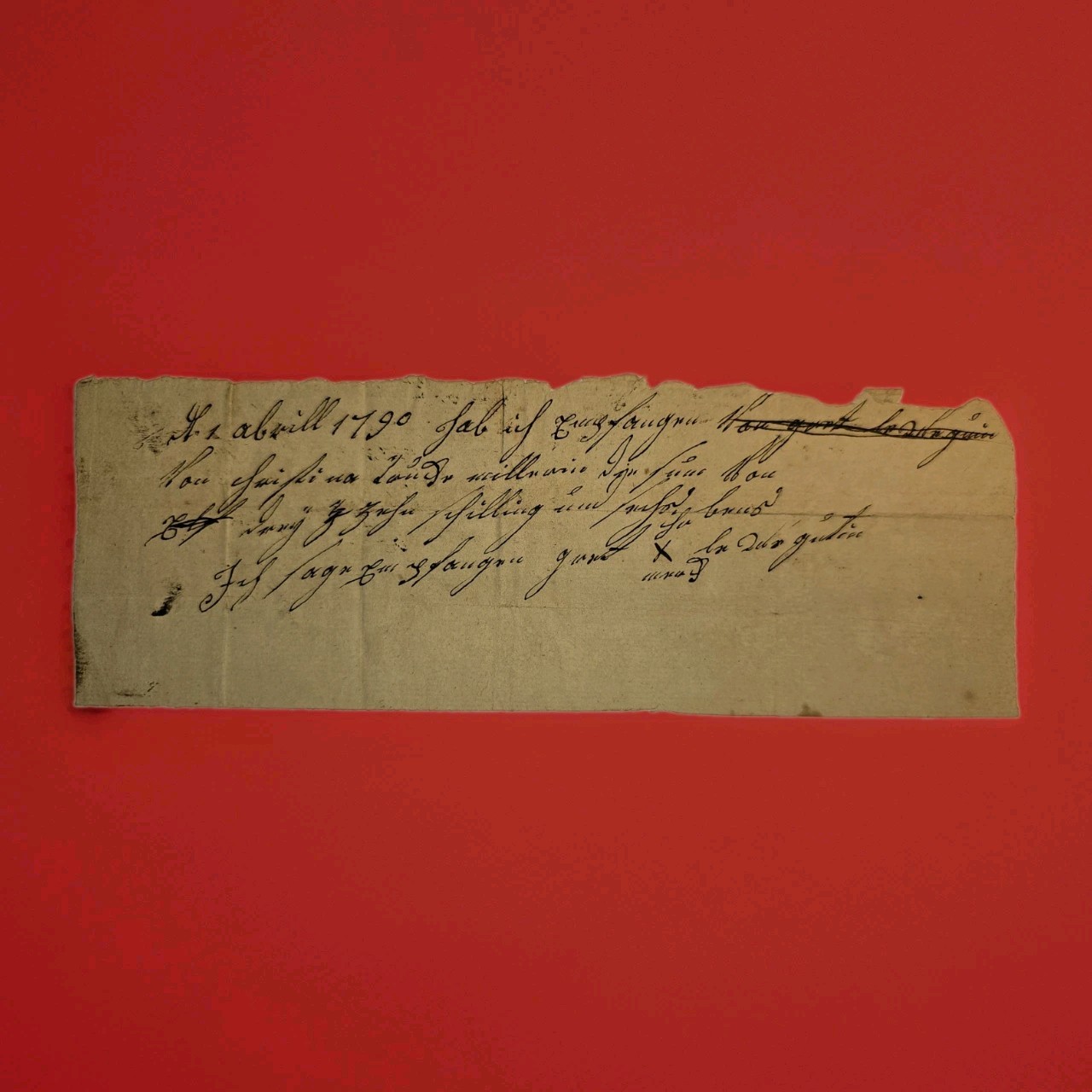
The document records the receipt of thirteen shillings and six pence, 13s. 6d., involving a woman named Christina Lander, possibly Dander, described as a “Millerin,” and an unidentified widow who authenticated the transaction with her X mark.
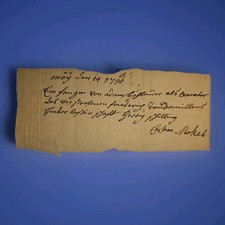
The reverse carries an English-language filing docket reading approximately:
Recd 13/6
Mar[y?] Languth
No 40
The combination of German text, English docketing, British colonial-style currency, and a woman executing a financial document by mark makes this an evocative survivor from the Pennsylvania German community during the first years of the United States.
Diplomatic Transcription
Recto
Am 1 Abrill 1790 hab ich Empfangen von [words struck through]
von Christina Lander [or Dander] Millerin der seine Frau von
Drey Zehen Schilling und sechs Pens
Ich sage zu Empfangen guth
X die Witwe
und
Verso / Filing Docket
Recd 13/6
Mar[y?] Languth
No 40
A separate faint inscription crossing the old folds appears to be later and is too indistinct to transcribe confidently.
English Translation
On 1 April 1790 I received from Christina Lander [or Dander], the miller’s wife, thirteen shillings and six pence. I acknowledge receipt as good.
X, the widow
The reverse records receipt of the same 13 shillings 6 pence and appears to associate the voucher with Mary Languth, although the given name and surname remain somewhat uncertain because of the handwriting.
Historical Context
The document dates from 1790, only fourteen years after the Declaration of Independence and less than a year after the new federal government began operating under the Constitution.
Large portions of Pennsylvania remained culturally and linguistically German at this time. Everyday legal and commercial transactions among German-speaking families were often written in German, while probate courts, county officials, and other government offices increasingly maintained records in English.
This receipt illustrates that transition particularly well. The principal text is written in vernacular German, while the reverse was docketed in English:
“Recd 13/6”
That bilingual treatment is characteristic of the administrative world in which Pennsylvania German families conducted private business in German while interacting with an English-speaking legal system.
The spelling is also of interest. Forms such as “Abrill,” “Drey Zehen,” “Pens,” and “Empfangen” reflect the mixture of conventional German, local pronunciation, and phonetic spelling frequently encountered in handwritten Pennsylvania German records.
The Widow and Her X Mark
One of the most appealing features is the large X mark beside the words:
die Witwe
meaning:
the widow
Rather than simply being mentioned in the document, the widow appears to have personally participated in its execution.
Women frequently appear less prominently than men in surviving eighteenth-century financial papers, particularly when their legal identities were absorbed into those of husbands or estates. Widows occupied a somewhat different legal position and could administer property, settle accounts, collect debts, and participate in probate matters.
The mark therefore gives the receipt an additional women’s-history and social-history dimension. It preserves the actual physical act by which an eighteenth-century Pennsylvania woman authenticated a financial transaction despite apparently not signing her name conventionally.
Christina Lander / Dander
Christina Lander, whose surname may instead read Dander, is specifically identified by the German word:
Millerin
Literally, Müllerin can mean a female miller, but in eighteenth-century usage it could also identify the wife or widow of a miller.
Mills were among the most important businesses in rural Pennsylvania. Grain mills converted local wheat, rye, and corn into usable flour and meal and often became important centers of settlement and commerce. A miller\'s household could therefore occupy a significant economic position within a rural community.
The language of the receipt appears to associate Christina with such a household, although the document alone does not establish whether she personally operated a mill or was identified through her husband\'s occupation.
No attempt has been made here to attach Christina to a specific modern genealogical individual without additional documentary evidence. The surname should be researched under both Lander and Dander, as eighteenth-century spelling frequently varied between clerks and languages.
Mary Languth
The reverse appears to read:
Mar[y?] Languth
Earlier possible readings include Martha or Margaret, but Mary is a plausible interpretation of the abbreviated given name.
Her relationship to the transaction is not explicitly explained by the surviving docket. She may have been the widow who made the X mark, a claimant, a payee, or simply the individual under whose name the accounting voucher was filed.
The surname itself may be spelled Languth, although eighteenth-century German names were frequently rendered differently by German- and English-speaking clerks.
For that reason, this listing preserves the name as it appears rather than attempting to force it into a modern standardized surname.
Possible Estate or Probate Connection
The filing number:
No 40
is noteworthy.
This suggests that the receipt was probably once part of a larger organized body of accounts. Numbered receipts were commonly retained as vouchers supporting:
- estate settlements
- executor or administrator accounts
- guardianships
- probate filings
- debt settlements
- household accounts
The English docket would have allowed a clerk or administrator to identify the German-language voucher quickly without translating the full document.
While an estate or probate origin cannot be proven from this sheet alone, the format is consistent with such archival accounting practices.
Currency
The amount is written both in German words and in English shorthand:
Drey Zehen Schilling und sechs Pens
and
13/6
meaning:
13 shillings and 6 pence
The survival of British-style £/s/d monetary accounting after American independence was entirely normal. Pennsylvania and other states continued using pounds, shillings, and pence in bookkeeping for years after the Revolution, even as the federal dollar system gradually became dominant.
Biographical NotesChristina Lander / Dander
Christina was an adult woman living within the Pennsylvania German economic world in 1790. The receipt identifies her as a “Millerin,” connecting her to a milling household. Whether she herself managed the mill, was the wife of its operator, or was a widow associated with it remains uncertain. Her appearance in a monetary receipt demonstrates her direct involvement in a household financial transaction.
Mary Languth
Mary, whose first name may alternatively be read Martha or Margaret, appears in the English filing docket on the reverse. The entry associates her name with the payment of 13s. 6d. The precise relationship between Mary and the widow who made the X mark remains unresolved, but the document provides direct evidence of a woman named Languth participating in the financial or estate-accounting network represented by the voucher.
The Unnamed Widow
The strongest personal statement in the manuscript may be the simplest:
X die Witwe
The widow was sufficiently involved in the transaction to authenticate it personally. Her use of a mark rather than a written signature reflects literacy patterns common in eighteenth-century rural America and makes the sheet a particularly tangible piece of women\'s social and economic history.
Condition
Original eighteenth-century manuscript on laid paper with expected age toning, old folds, edge wear, staining, and minor handling consistent with a document more than 235 years old. There are several contemporary corrections or struck-through words on the recto. English filing notation remains visible on the reverse.
Please examine the photographs carefully as they form an important part of the condition description.
Significance
A compelling original 1790 Pennsylvania German financial document combining several collectible areas:
Pennsylvania German history, early American manuscripts, women\'s history, milling history, vernacular German language, colonial currency, probate and estate history, genealogy, and eighteenth-century Americana.
The widow\'s X mark, bilingual German-English content, and clearly expressed 13s. 6d. payment make it considerably more interesting than a routine unsigned account slip.
Guaranteed original and period, not a reproduction.