When you click on links to various merchants on this site and make a purchase, this can result in this site earning a commission. Affiliate programs and affiliations include, but are not limited to, the eBay Partner Network.
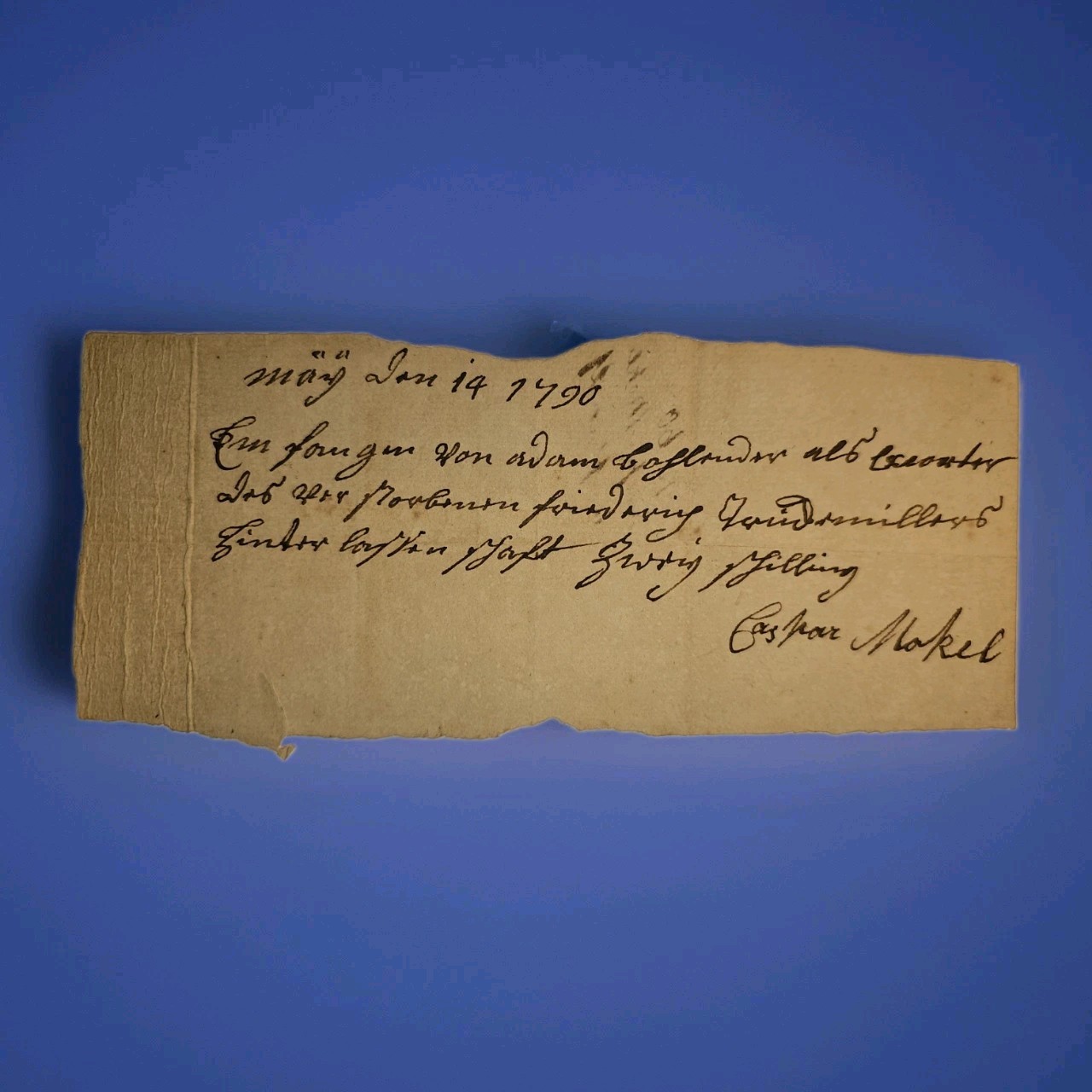
Written in period German script on handmade paper, the receipt records a payment by Adam Bolender acting as executor. The amount appears on the front as “Zwey Schilling” — two shillings.
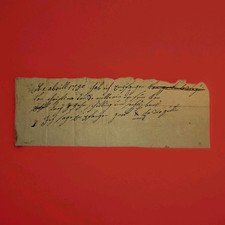
The reverse is docketed:
No. 60
Casper Mokel
Recpt for 2/
The numbered docket strongly suggests that this was preserved as one voucher within a larger estate or probate accounting file.
Approximate Transcription
May den 14 1790
Ein Empfang von Adam Bolender als Executor
… Friederig Haundsmillers …
… letztes Jahr Zwey Schilling
Caspar Makel
Some of the middle wording remains difficult to interpret because of the German handwriting and phonetic Pennsylvania German spelling, but the principal names and estate context are legible.
Adam Bolender
The Adam Bolender named in the receipt is very likely connected with Johann Adam Bolender Sr. (1735–1820), a prominent Pennsylvania German settler in the area of Northumberland County, in territory that later became part of Snyder County.
Bolender was born in Germany in 1735 and immigrated to Pennsylvania during the colonial period. He became established within the German-speaking farming communities of central Pennsylvania.
He is particularly notable as a Revolutionary-era Patriot. Bolender is documented in connection with a local Committee of Safety and appears in Revolutionary-period tax and supply records. Committees of Safety played an important role in local government during the American Revolution, helping organize defense, collect supplies, enforce Patriot measures, and support the revolutionary administration.
By the late 18th century, Bolender also appears in records involving property, estates, and financial affairs, making his appearance here as an executor entirely consistent with his position in the community.
His son, Adam Bolender Jr., was also an adult by 1790, so additional research may eventually establish which Adam Bolender appears on this particular document.
Casper Mogle / Caspar Mokel
The signer can now be identified with considerably greater confidence as Casper Mogle (1762–1822), whose surname appears in German-American records under variants including Mogle, Mokel, Mochel, Makel, and related spellings.
Casper was born in Pennsylvania in 1762 and later lived in what became Centre County, Pennsylvania. He died in 1822.
Of particular importance to this identification, his surviving gravestone reportedly spells his name:
CHASPER MOKEL
That period spelling is remarkably close to the Caspar Makel / Casper Mokel appearing on this 1790 receipt and its reverse docket.
This provides unusually strong evidence that the signer of the receipt was the same man later known in anglicized records as Casper Mogle.
He was approximately 28 years old when this receipt was written.
Friedrich Haundsmiller
The document also references Friedrich, or Frederick, Haundsmiller, another member of Pennsylvania’s German-speaking population.
The surname appears to have been recorded under multiple phonetic forms in early records. Variants may include forms such as:
Haundsmiller, Hantsmiller, Handsmiller, Hansmiller, and other related spellings.
A Friedrich Haundsmiller or similarly rendered individual appears in Pennsylvania records surrounding the period of the 1790 United States Federal Census, the first federal census taken in the new nation.
German surnames were frequently spelled according to sound by English-speaking census takers, clerks, and court officials, so a single family can appear under dramatically different spellings in surviving census, tax, church, land, and probate records.
The exact nature of Haundsmiller’s connection to the estate remains a subject for further research.
Historical Importance
This is an excellent example of the everyday legal and financial life of the Pennsylvania German community during the early Federal period.
The document dates from 1790, only seven years after the Treaty of Paris ended the American Revolution and the same year in which the United States conducted its first federal census.
It preserves:
- Original Pennsylvania German handwriting
- An identified Revolutionary-era Pennsylvania figure
- An identifiable central Pennsylvania German signer
- An estate/probate transaction
- Original 18th-century accounting notation
- A numbered probate-style docket
- Multiple early Pennsylvania German family names
Documents such as this provide an unusually intimate look at how German-speaking Pennsylvanians continued using their language, handwriting, naming conventions, and community financial networks after the American Revolution.
Condition
Original 1790 manuscript with expected age toning, folds, staining, edge wear, and handling consistent with an authentic paper document more than 235 years old.
Writing remains visible on both sides.
Please inspect the photographs carefully, as they form an important part of the condition description.
Ideal For Collectors Of
Pennsylvania German / Pennsylvania Dutch history, Revolutionary War-era Pennsylvania, early American manuscripts, probate and estate documents, Northumberland and Centre County history, German-American genealogy, Adam Bolender family material, Casper Mogle / Mokel genealogy, and early Federal-period Americana.
Guaranteed original period manuscript, not a reproduction.