When you click on links to various merchants on this site and make a purchase, this can result in this site earning a commission. Affiliate programs and affiliations include, but are not limited to, the eBay Partner Network.
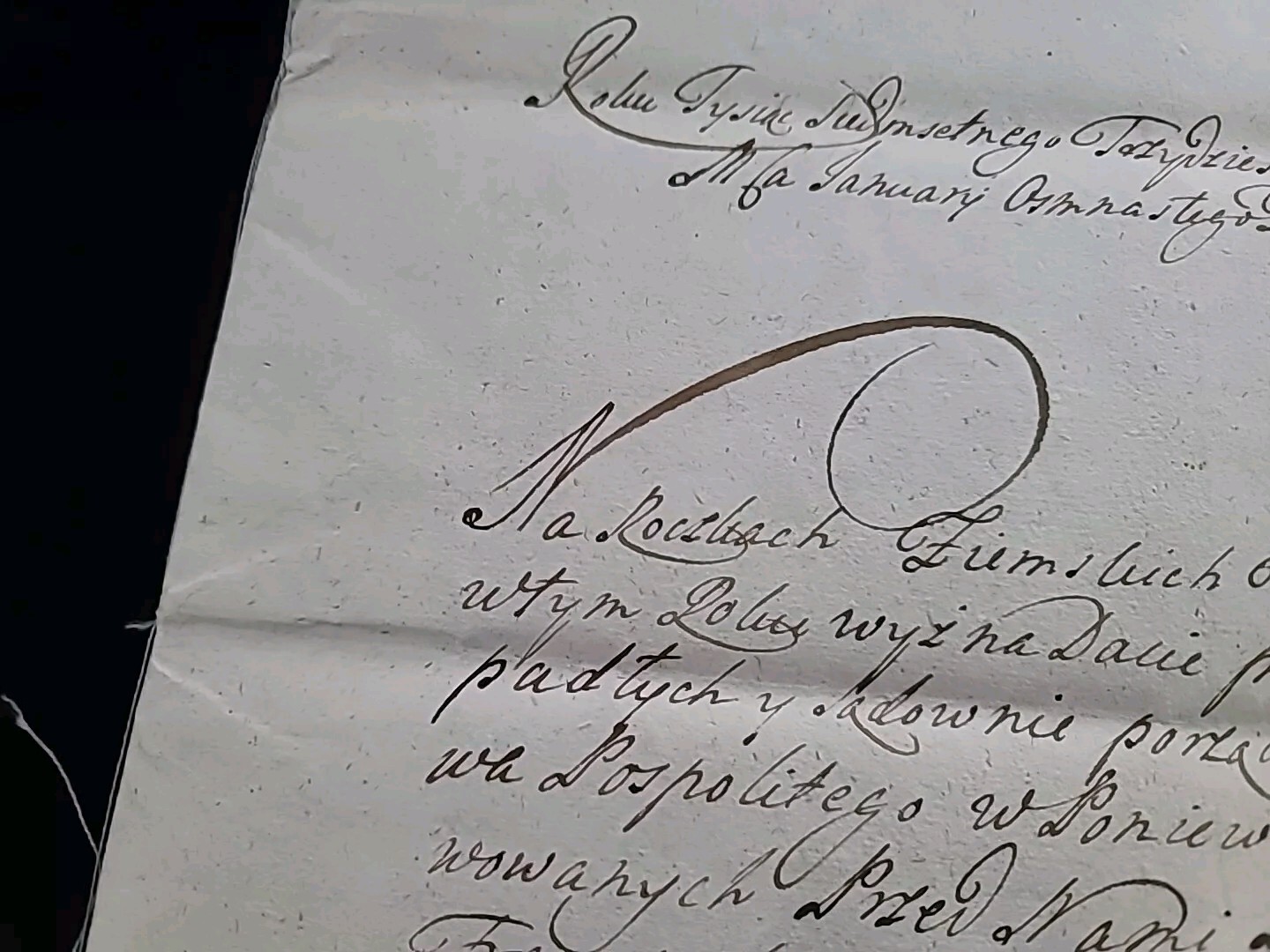
For your consideration, an important and unusually substantial 1732 PolishLithuanian Commonwealth authenticated legal instrument, or vidimus, concerning the Mciski landed interests at Dziaoszyn and associated ecclesiastical and financial obligations, comprising approximately twelve manuscript pages in Polish with extensive Latin legal formulae, written in iron-gall ink on handmade laid paper. The contemporary exterior docket is expressly dated 1732 and appears to identify the instrument as a vidimusan authenticated reproduction or confirmation of earlier legal acts intended to possess evidentiary force. The manuscript repeatedly addresses property, sums of money, obligations, endowed capital, succession, testamentary provisions and enforcement, showing that it is neither devotional correspondence nor a routine monastic memorandum, but a formally executed legal settlement preserving rights and liabilities intended to bind the parties and their successors.
The document belongs to the legal and economic world of the Mciski family of Dziaoszyn, one of the principal landholding families of the Wielu region. Archival evidence independently confirms the survival of extensive Polish-and-Latin property and legal papers of Micha Mciski, podstoli wieluski, spanning 17081737, including financial accounts through precisely 17301732, documents relating to Dziaoszyn, and even a 1708 receipt involving the Jews of Dziaoszyn. The wider family history also places Wojciech Mciski and Anna Gogowska within this generation and records the birth at Dziaoszyn in 1732 of their son Stanisaw Mciski, later one of the familys most important eighteenth-century representatives. The present manuscript therefore falls at a documented moment of estate succession, consolidation and financial administration within the Mciski patrimony.
The ecclesiastical-financial context is particularly significant. Dziaoszyns Jewish community, which formed an important component of the privately owned towns economy, accumulated substantial obligations to Catholic institutions during the first half of the eighteenth century. Contemporary historical evidence records a 5,000-zoty loan in 1716, a further 2,700 zotys in 1726, and additional borrowing from religious funds connected with Krzepice; the Mciski proprietor facilitated or guaranteed elements of this credit system, while defaults eventually produced litigation and, by 1740, intervention by Archbishop Krzysztof Antoni Szembek. The vocabulary visible throughout this 1732 instrumentsumy, obligations, funds, inheritance, testamentary rights, performance and penaltiesis entirely consonant with that environment. The manuscript should not yet be identified categorically as the specific Krzepice debt settlement, because an explicit matching principal sum or unequivocal textual reference to the Krzepice house has not been securely resolved; nevertheless, it belongs unmistakably to the same documented network of noble estate finance, ecclesiastical credit and enforceable local obligations.
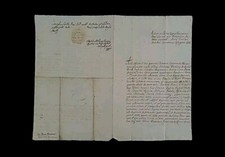
The manuscript survives as an original executed legal instrument, authenticated by two applied paper-covered wax seals, sealing cords, manuscript attestations and official signatures, rather than as a later archival transcript. The concluding Latin clauses invoke evidentiary authority and formal confirmation, while at least one subscribing official appears to bear a ziemski, or land-court, title, consistent with the judicial machinery of the Wielu region. No single recipient should therefore be assigned: this is a multilateral legal act involving noble, ecclesiastical and administrative interests, with named parties, successors and officials. Preserved with its contemporary folds, filing docket, seals and complete multi-page text, it represents a particularly rich primary source for eighteenth-century Polish property law, Mciski estate administration, ecclesiastical finance, Jewish communal indebtedness and the documentary culture of the PolishLithuanian Commonwealth.