When you click on links to various merchants on this site and make a purchase, this can result in this site earning a commission. Affiliate programs and affiliations include, but are not limited to, the eBay Partner Network.
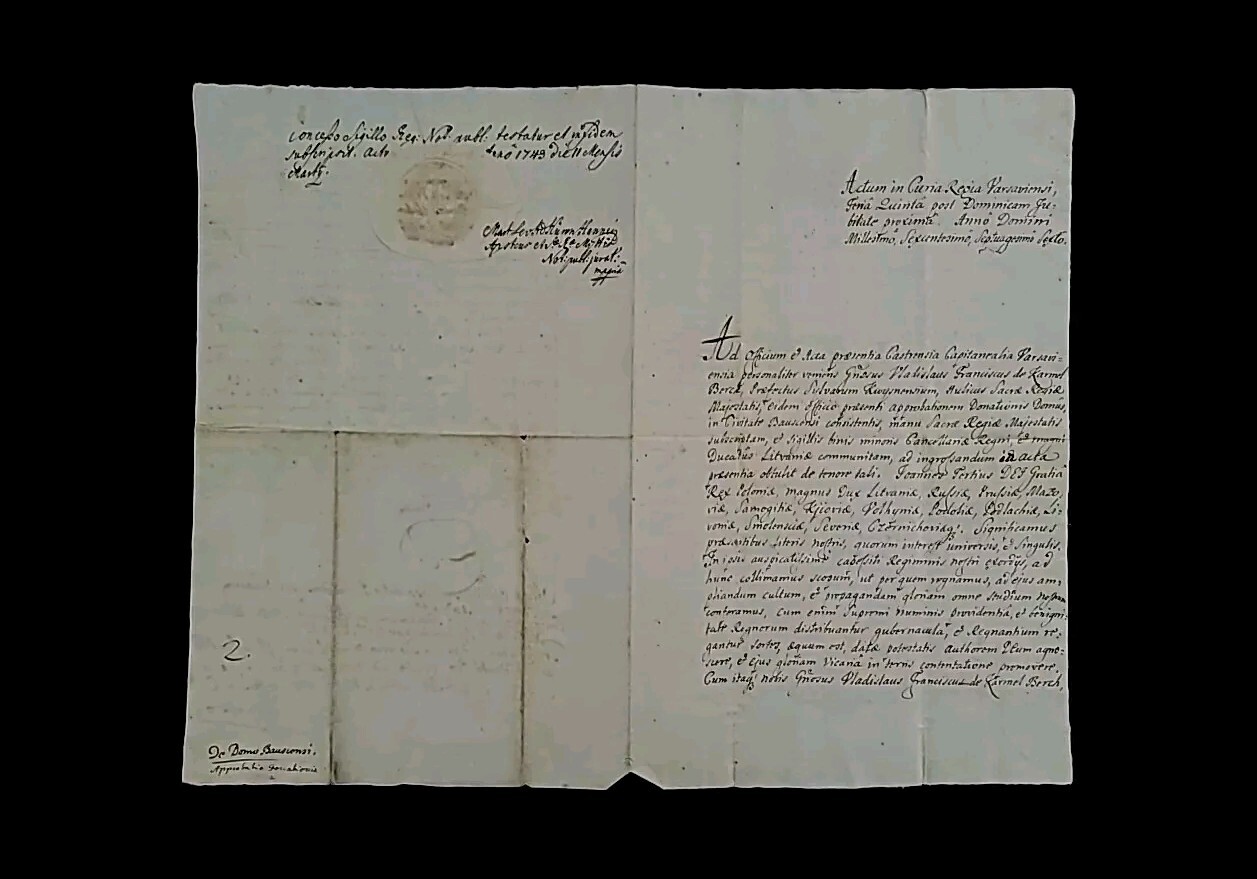
For your consideration is an exceptionally important 1732 Polish-Lithuanian judicial and ecclesiastical manuscript, being an authenticated vidimus, or officially certified transcript, issued through the land-court administration of the Upyt district in the Grand Duchy of Lithuania. Written in formal Polish legal hand with Latin chancery terminology upon original handmade laid paper, the manuscript preserves a noble foundation and property arrangement concerning the Catholic Jesuit establishment at Szenberg, historically Schnberg and modern Skaistkalne, Latvia. The exterior docket explicitly identifies the instrument as a Widimus, while the concluding certification bears the original autograph of Krzysztof Dmbski (Dbski), Pisarz Ziemski Upicki, Land-Court Scribe of Upyt, one of the senior judicial officials of the district.
The instrument records the foundation established by Stanisaw Sankowski and his wife Elbieta Helena, ne Meynert, Sankowska, and traces the legal history of landed and pledge rights connected with the estate or folwark of Korejwiszki/Koreywiszki. Among the persons recited within the earlier chain of title and obligation are Gotthard Meynert, Andrzej Korejwo, and Krzysztof Dominik Puzyna, with the transaction specifically involving a capital sum of 220 talarw bitych, or 220 specie thalers. The manuscript establishes that these proprietary rights were to support the Catholic church at Szenberg, the operative clause providing that aby przy Szenberskim Katolickim Kociele Kapelia albo Muzyka konserwowana byain translation, that at the Catholic Church of Szenberg a chapel or musical establishment should be maintained. The ecclesiastical side of the transaction is represented in the text by Jegomo Ojciec Piotr residentiae Mitaviensis, a Father Piotr of the Jesuit Residence at Mitau, modern Jelgava, who formally accepted the benefaction; his surname remains difficult to resolve from the surviving hand and is therefore conservatively left unattributed.
The document is particularly significant as direct evidence of the cross-border financial and landed-property mechanisms employed by the Jesuits of Courland and Livonia during the early eighteenth century. Because Catholic religious institutions in Courland faced legal restrictions upon direct landed ownership, Jesuit missions at Mitau and Szenberg relied upon estates, mortgage rights, and pledged properties situated within the neighboring Grand Duchy of Lithuania to sustain their churches, clergy, schools, and musical foundations. This manuscript records precisely such an arrangement, linking the Lithuanian noble and judicial world of Upyt with the Jesuit mission at Szenberg during the reign of Augustus II the Strong, King of Poland and Grand Duke of Lithuania. Its signatory, Krzysztof Dmbski, was himself a member of the regional noble and judicial elite, serving as Land-Court Scribe of Upyt and participating in the broader legal administration of the Commonwealth, making his autograph an integral part of the documents institutional significance.
The manuscript survives as a substantial multi-page legal instrument, extensively written in brown ink across folded sheets of handmade laid paper, with contemporary docketing, corrections, marginal notations, original signatures, and two surviving papered seals secured with blue thread. The paper retains characteristic eighteenth-century texture, deckled edges, fold lines, handling wear, localized staining and minor edge losses consistent with age and archival use; the text remains extensively legible and the principal legal and ecclesiastical content is preserved. As a whole, this is a rare and highly specific survival of Grand-Ducal Lithuanian judicial practice, noble patronage, Jesuit institutional finance, and Catholic musical foundation history, preserving in one original 1732 certified instrument the legal machinery by which landed wealth in the Polish-Lithuanian Commonwealth supported a Jesuit Catholic establishment in neighboring Courland.