When you click on links to various merchants on this site and make a purchase, this can result in this site earning a commission. Affiliate programs and affiliations include, but are not limited to, the eBay Partner Network.
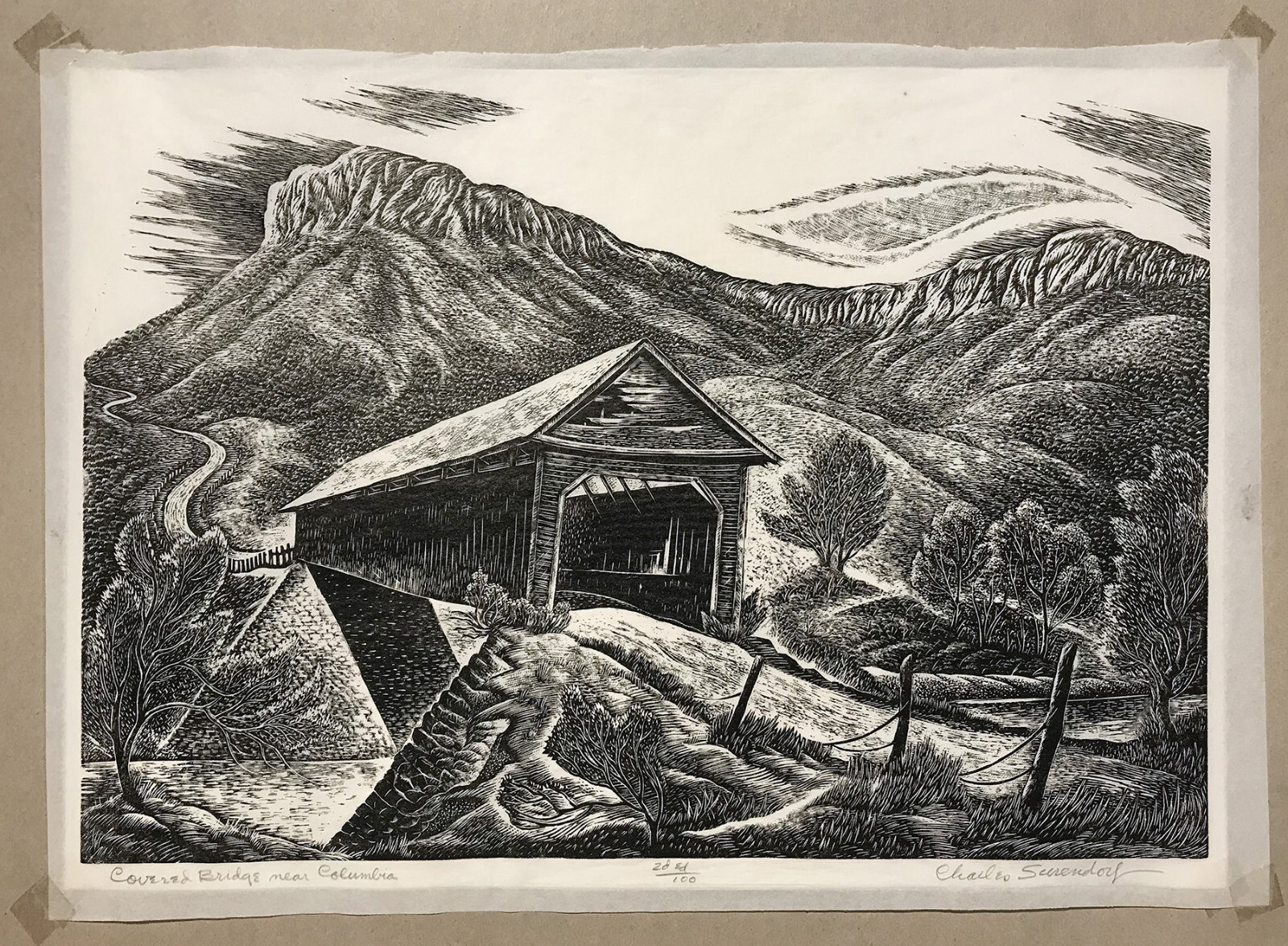
Covered Bridge Near Columbia, Linocut print by CharlesSurendorf. Edition #2. Signed, numbered, and titled in pencil by the artist. 12.5high x 17.5 wide inches. Printed ontranslucent paper, backed with a white board to enhance brightness and contrast. This print is in excellent condition.Attached to a cardboard backing by small tape squares at the corners, easilyremoved. A lovely and rare example ofthe artists work, and an great representation of an important California historicallandmark.
Charles Frederick Surendorf (1906-1979) was born onNovember 9, 1906 in Richmond, Indiana. Following graduation from Ohio StateUniversity, he studied at the Art Institute of Chicago and Art Students Leaguein New York City. In 1935 he moved to the San Francisco Bay area and furtherstudied at Mills College. Active in the local art scene, he was director of thefirst San Francisco Art Festival. In the 1930s he worked for the WPA. Hispaintings and prints depict the landscapes and architecture of California goldrush country in a regionalist style similar to Thomas Hart Benton. At the height of his career he was consideredone of the most significant printmakers of the time. His exhibition historyincludes venues in San Francisco, Philadelphia, Chicago, Richmond, and NewOrleans. In 1946 he settled in the townof Columbia in the Sierra foothills where he produced many prints and paintingsof the area. There he served as directorof the short-lived Mother Lode Art School (1956) and produced works with anhistoric California theme. He died of cancer in Columbia on May 28, 1979.
Member: California Society of Etchers; San Francisco ArtAssociation; Mother Lode Art Association; Bay Region Art Association(Oakland).Exhibition: Foundation of Western Art (LA), 1936-41; Los AngelesCounty Museum of Art, 1936; SFMA, 1936, 1946; California Society of Etchers,1938-54 (awards); Golden Gate International Exposition, 1939; De Young Museum,1946.Collections: San Francisco Museum of Modern Art; Mills College (Oakland);Monterey Peninsula Museum; Library of Congress; Wichita Art Museum. Sources:Edan Hughes, \"Artists in California, 1786-1940\"; Who\'s Who inAmerican Art 1936-62; Who\'s Who on the Pacific Coast; Artists and People.
Charles Surendorf\'s early prints were carved in wood(woodblock) and printed on a letter press. He soon began carving in linoleuminstead of wood, using a process he called \"linoleum engravings.\" Standardlinoleum block was too soft for his technique, so Charles used much harderbattleship linoleum, which he then further hardened by freezing. The hardnessclosely approximated wood end-grain block. He used steel engraving tools toengrave his work rather than cut the block. Block printing requires the artistto reverse the image when engraving it, so that, when printed, it is seencorrectly. Surendorf printed his blocksusing an old fashioned letter press. His skill was learned through many trialsand errors of the correct type and amount of ink, pressure, and roomtemperature. While he was printing, the workshop room door always remained closedto maintain the correct temperature and humidity until the printing wascomplete. All prints were signed with the print number out of a group ofprintings done at one time. He never printed more than five sets of 100 prints.
The story of the Covered Bridge -
As one of only two ferries that crossed the StanislausRiver in the mid 1800s, O’Byrnes Ferry was an integral link in mining andranching transportation. Different sources offer different accounts of how theferry got its name. One tells a tale of an industrious entrepreneur namedPatrick O. Bymes, of Bymes and Co., who had the wherewithal to build his ferryon the Stanislaus at a site that made travel between Stockton and Sonoraeasier. Another source tells of a P.O. Byrne as conductor of the strategicallyplaced ferry. Either way, the name eventually morphed into O’Byrnes Ferry. Butthe name of the ferry is only the beginning. This bridge was to see its demisewhen the picturesque setting was inundated in 80 feet of water by the advent ofthe new TriDam project – the Tulloch Dam.
The bridge made headlines in many local and valleynewspapers in 1957 as multiple campaigns were launched to save the oldlandmark. Discussions regarding the fate of the beautiful covered bridge ranthe gamut from burning it where it stood to freeing it from its moorings andfloating it downstream. A suggestion to ask the United States Navy Seabees toutilize pontoons to float the bridge as a training exercise was quickly doused,as were other propositions. A decision was finally made to cut it free andfloat it downstream.
A public sale of the bridge was held on October 21,1957. On November 9, 1957 dynamite set at the south pier exploded with littleimpact. A second charge was placed, to no avail. The stringers measuring 18inches wide by 18 inches thick were cut. Still the bridge would not budge. Finally a truck with a winch and cable priedloose the supports. As darkness fell the south end of the bridge slowly loweredinto the water below. As the night wore on the supports of the north pier,which had been scorched earlier, smoldered until they burned loose and thebridge slowly drifted downstream under a night sky, the end of an era. The newbridge, located upstream from the old covered bridge, opened for trafficNovember 10, 1957. - Wikipedia