When you click on links to various merchants on this site and make a purchase, this can result in this site earning a commission. Affiliate programs and affiliations include, but are not limited to, the eBay Partner Network.
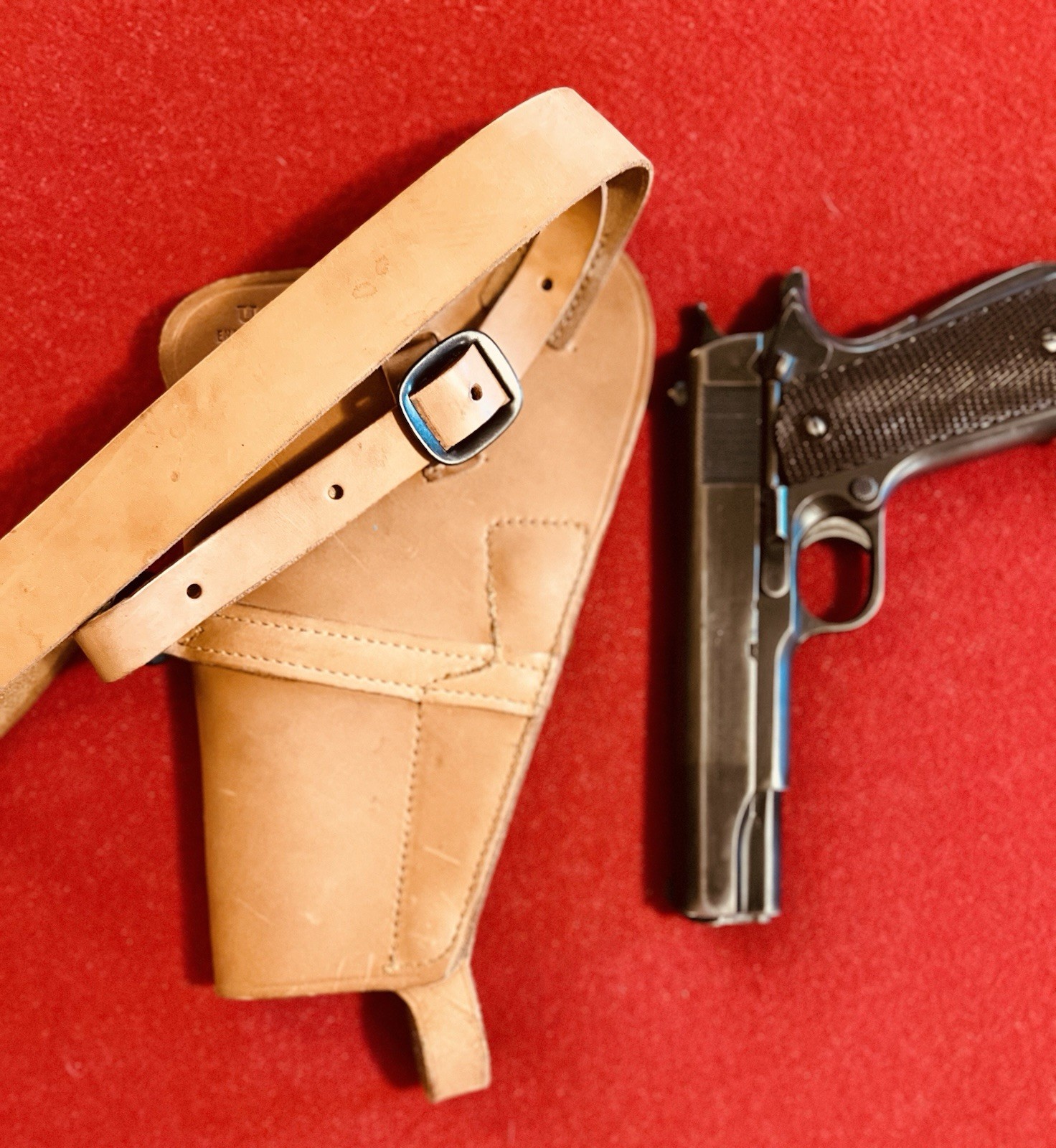
WWII M3 SHOULDER HOLSTER
"ENGER-KRESS"
of West Bend, Wisconsin
circa 1944
(for the M1911 and the M1911A1 .45 ACP)
Paratroopers, Airborne, Pilots/Aviators, Tankers, USMC, Officers.
ORIGINAL!
NOS (New Old Stock) Unissued!
+ Far, far fewer contracts of the M3 Shoulder Holster were than awarded that for the M1916 Holster worn on the belt. And even far fewer survive today in ANY condtion, let alone in NOS Unissued condition. In such demand during the war, whole units of USMC aviators had "parachute riggers" fashion custom-made shoulder holsters. Photos exist of these being worn with.38 and .45 cal. Revolvers stuffed in them, and the Flaps cut off. Photos also exist of the M3 Shoulder Holster being worn on the hip with the Strap around the waist.
+ This piece is still 'folded' exactly as it left the Enger-Kress Pocketbook factory in West Bend, Wisconsin in 1944! A .45 ACP has NEVER been placed inside of this example! There are no personalized markings or any signs of use!
Other than a Dura-Snap Fastener"stud" that has pulled loose on the short Belt Loop, this example is a museum-grade "stone cold" mint specimen of an M3 Shoulder Holster!! This occurs more often than not on these aged, but otherwise PRISTINE M3 Shoulder Holsters, especially when a collector starts pulling on old Snaps! In most photographs the Marine/soldier/aviator is shown NOT using the 'Belt Loop' at all. The stud could be re-seated... or the base of stud could simply be glued down with Weldwood or Super Glue by its next owner. I have left this New Old Stock, Unissued piece exactly as I acquired it.
+ The M3 Shoulder Holster --at the request of aviators for an 'open holster' to be worn at chest height,' -- was adopted by the armed services in 1942, even more than the M1916 hipholster was preferred by paratroopers, officers (of both the Army,the USN, and the USMC -- in addition to the MarineCorps' later modified M7 model with the perforated waiststrap and wire snap hook, introduced in late 1944), fighter pilotsand USMC aviators, crew members of B-17 Flying Fortresses,B-24 Liberators, etc., as well as tank crews, armored personnel,and other ground troops with crew-served weapons. Some pilots andofficers wore the M3 Shoulder Holster around the waist as a"hip holster" -- see the photo of CPT John Myers ofthe 386th Bomb Group (9th Air Force) taken in St. Trond,Belgium, in early 1945, in Jeffrey Ethel's excellent reference, AIRCOMMAND,(Lowe & B. Hould Publishers, page 76).
+ The natural russet M3 Shoulder Holster was made by onlythree companies: Enger-Kress Pocketbook Company, theBoyt Harness Company, and Sears Saddlery. Contracts were awarded to Enger-Kress in the 1944 and 1945 production years. The Enger-Kressholsters are found both undated, but the dated Holsters are stamped"1945"on thereverse top edge.. This one may have been manufactured in either 1944 or 1945,but being 'undated,' most probably 1944.
NOTE: The photograph BG J.T. Dalby and his BG Ridgely Gaither of the First Allied Airborne Army,wearing the newly introduced M1943 Field Jacket and Trousers, visiting the paratroopers of the 17th Airborne Division before the Rhine jump, both arewearing an M3 Shoulder Holster, with the Belt Loop unattached, appears on p. 254 of LTC John Angolia's exceptionalHEROES IN OUR MIDST, Vol. 1,(R. James BenderPublishing, 2013).
This is an undated wartime ORIGINAL!
+ NOTE: This is NOT to be confused with modern reproductions withthe intentionally altered spelling of the company's name!
+ As with many of the Enger-Kress M3 Holsters,this was manufactured without a date on the reverse, which isentirely correct for the Enger-Kress contracts for 1944 -- or possibly early 1945.
+ True LINEN thread with a slight orange-cast is used for thestitching throughout, not white nylon as seen on more recent andcommercial models..
+ The single wide SHOULDER STRAPis attached to the body of the holster withthe rectangular "V" stitching on theedge closest to the border, not a simple rectangular stitching asseen on more recent and commercial models...
+ The adjustable "Conway" BUCKLEwith the single stud is "oval" not rectangularas seen on more recent and commercial models..
+ All of the hardware is blackened BRASS, not plastic.
+ The leather is made of undyed Top Grain Cowhide, not Asian"water buffalo" hide (as in the current imports), or dyedor painted black (as was done in the 1960s when all of theservices switched from "brown shoe" leather accessories to "black" as the uniform color for shoes, visors, sword knots, holstersand and any other leather accessories.
+ The U.S.M.C. introduced the modified M7 with thesecondary perforated waist strap and the sliding shoulder pad in1945, but the U.S.M.C. also used the M3 throughout itsPacific Campaigns from Guadalcanal through Okinawa.
PARTICULARS OF CONDITION:
+ ZERO breaks in the Original natural light colored leatherBODY and STRAP. It has never been oiled, marked,stenciled, dyed or treated with 'neatsfoot' oil! The leather issomewhat dry but unstained and still strong and supple!
+ Deeply embossed "U.S." surcharge within theoval on the front, and the "U.S." surchargein serif font repeated and the contractor's name in san serif font onthe reverse:
U.S.
ENGER-KRESS
+ ZEROverdigris build-up.
+ ZERO corrosion. Excellent finish on the oval "Conway"BUCKLE, the "Lift-the-Dot"FASTENER, and the GLOVE SNAP on the shorter BELT LOOP,typical of the M3 Holsters..
+ The only 'blemish', as noted, on this "New Old Stock" Unissued example is that the 'male' stud of the Dura-SnapGLOVE SNAPfor the short BELT LOOP at bottom of the Holster has been 'reattached' at some point in this M3 Shoulder Holster's 82-year history with a permanent adhesive. As often occurs with so many of these Shoulder Holsters, the 'male' studpulls loose which due toverdigris build up beneath the stud over the decades! As savvy collector's have learned, to their sorrow, Lift-the-Dot FASTENERS and Dura-Snap FASTENERS, set in either canvas web or leather should be very carefully pried open with a thin blade rather than "tugged" open, stressing aged cotton or leather, both of which being organic material tend to fail over time
*****
The Enger-KressPocketbook Company
The Enger-Kress Pocketbook Company of West Bend,Wisconsin, began business in America in 1882 by two Germanimmigrants, George Enger and August Kress.
Imagine two Germans owning a companyproducing war materials for Americans. Their original factory was inMilwaukee, but it burned to the ground. The city of West Bend offeredthem $20,000 to move the factory there.
The history of the company is quiteinteresting in that they were among the first to hire women duringthe war. They also permitted the women to carry work home, whichproved convenient for families at the time. The company also providedtwo beer breaks per day in which young boys brought cold beers on thefactory floor. Quite innovative.
DuringWWII, Enger-Kress manufactured 800,000 pistol holsters,500,000 machine gun cases, 1.7 million helmet liners, and 1.3 millionhelmet chin straps. The company finally closed in 2006 havingsuccumbed to foreign products flooding the marketplace.
*****
From the TOWER HERITAGE CENTER(The Washington County Historical Society)
The Enger-Kress Pocketbook Co.
One of the most prominent earlyindustries of Washington County, the Enger-Kress PocketbookCompany, vastly impacted the local economy and overallprosperity of the community. In a region chiefly devoted toagriculture, industries claimed less than a tenth of the population’spursuit. This made the Enger-Kress Pocketbook Co. allthat more significant.
The Enger-Kress Pocketbook Co.was at one point one of the largest pocketbook factories in theworld. And rather, the business resembled more of a park than afactory. Clearly successful, the Enger-Kress Pocketbook Co.is known for reliable manufacturing and honest business. This postwill explore the unique workplace of the Enger-Kress PocketbookCo. while depicting how it came to be in West Bend.
A DYNAMIC PARTNERSHIP &EFFECTIVE MANAGEMENT
In 1884, the Enger-KressPocketbook Co. was established in Milwaukee, Wisconsin. Itwas a small-scale, factory-driven industry. George Enger was thefirst president of the Enger-Kress Pocketbook Co. Hewas known to be intellectual and apt in sales and management. Becauseof these traits, he often traveled for business. The first secretaryand treasurer was August Kress, whose vast technical understanding ofthe business complimented Enger’s skills. Enger and Kress made adynamic pair, working together to efficiently manage the business. Indoing so, they earned a reputation as reliable manufacturers, honestbusinessmen, and effective managers.
DANCE HALL TURNED FACTORY
In 1894 the Enger-KressPocketbook Co. moved from its starting factory in Milwaukeeto West Bend through the persuasion and initiative of localbusinessmen, Mr. Andrew Pick and Mr. E. Frankburg. At first, theindustry was stationed in an unused school building. Later, theypurchased Moser’s Dance Hall. As real estate prices weresubstantially lower outside of Milwaukee, the company could affordthe nice park-like property. Once they moved, the dance hall wasrenovated and refurbished into a functional factory which sufficeduntil 1910 when a fire damaged the building beyond repair. In itsplace, a similarly beautiful factory was built. Only this timefireproof.
The same building remains theretoday, repurposed into senior citizen apartments. From the exterior,the Enger-Kress Pocketbook Co. appears to be more of apark than a factory. Cement walkways careen across the manicured lawnand geranium garden. The factory, three stories high, is built ofbricks in an L-shaped manner. There are ample windows and threeentrances, one of which is centered in stone, beneath the carvedwords ‘Enger Kress.’
Inside are spacious workrooms withabundant windows, often opened for a fresh breeze. Equipment wasefficient, with most machines being electric. Down the first floorwere offices, storage for countless models of pocketbooks, theriveting room, and a shipping center. The second floor was designatedfor machine work and finishing. Glazing machines, button machines,sewing machines, and thinning machines filled the space. Each productmade its way through the rooms as workers strove to complete it.
PRODUCTION
The Enger-Kress Pocketbook Co.manufactured pocketbooks of all kinds. Some include wallets,briefcases, bill books, card cases, cigar cases, and advertisingnovelties. The materials ranged from leather to cowhide and evenalligator skin. It is estimated that the factory maintained $200,000worth of leather in stock. Most of it came from the Hartfordtanneries.
Each product was thoughtfully createdand intentionally planned. Most are original designs aimed toconstruct quality pieces that are equally attractive and practical.This approach is noticeably one of the company’s keys to success.
LABOR CONQUERS EVERYTHING
Labor omnia vincit arethe words displayed in the main hall of the factory. It is Latin for‘labor conquers everything.’ The motto of both the workmen whotoiled to build the place and those who continued to work earnestlyfor the company. Passing down that hall, people notice the industry’sreason for success. It is the 400 dedicated employees of theEnger-Kress Pocketbook Co. that worked together,creating quality products. And as they supported each other, theyuplifted their community by bringing business into Washington County,providing career opportunities, and promoting a diverse economy. Andso, it is undoubtedly true that labor conquers everything. Thisphrase perfectly captures the ethics and the reason for the successof the Enger-Kress Pocketbook Co.
PARTING WORDS
The Enger-Kress Pocketbook Co.was a place of reputable manufacturing, effective management,and most importantly, honest hard work. Their efforts impacted theearly economy and environment of Washington County, and we aregrateful to them for it.
*****THE G.I. .45 IN WORLD WAR IIbyBruce Canfield, appearing inAmericanRifleman,April6, 2010"...ahandgun was essentially a supplemental sidearm and was generallyemployed in actual combat action only when the more effective riflesand automatic arms were unavailable, out of ammunition or damaged. AnOct. 23, 1943, Marine Corps document titled “Reporton Infantry Weapons in Combat” gavea brief synopsis of the various arms used by a Marine RaiderBattalion on New Georgia Island. The section pertaining to the.45ACPsimplystated: "Held up very well, but used very little.”
"Aleather hip holster, theModelof 1912,wasstandardized soon after theM1911’sadoption.This holster had a swivel attachment to make it better adapted tocavalry use. Just before America’s entry into World War I,theModelof 1916holsterwas adopted, which differed from theM1912primarilyin the deletion of the swivel feature. Both were fitted with wirehooks that attached to the grommets on the bottom of the standardwebbed pistol belt or cartridge belt. There were sufficient numbersof World War I-vintageM1916holsterstomeet the demand until the U.S. became actively involved in World WarII. TheM1916holsterwasput back into production and almost 3 million were made by 16different commercial firms between 1941 and 1945. These holsters wereembossed with a large“U.S.”onthe cover flap, with the name of the maker and year of production onback.
"Aleathershoulder holster for the .45 pistol,designated as the“M3,”wasadopted in 1942 for use by aviators, tankers and others who preferredcarrying the pistol over the hip holster.Animproved shoulder holster design was standardized in 1944 as the"M7." The pistol was secured in the shoulder holster bymeans of leather strap with a snap fastener. The shoulder holsterswere also embossed with a large “U.S” on the front, with theidentity of the manufacturer and year of production on the back.
"...Itwas not uncommon for soldiers and Marines to be armed with bothcarbines and .45 pistols. Nevertheless, the desire to replace thepistol with the carbine continued throughout the war. This wasevidenced in a Jan. 26, 1943, Marine Corps document...
"Despitethis official stance, pistols were issued in ever-increasing numbersduring the war. As an example, the U.S. Marine Corps’ TOE(Tableof Organization and Equipment)in1942 authorized 798 .45 pistols for a Division but, by 1945, theauthorized figure had been increased to 1,707. So much for efforts toget rid of the pistol. The situation was much the same in the U.S.Army where the carbines and .45s were procured and issued side byside in large numbers. The total number of M1911A1 pistolsmanufactured during World War II was 1,878,742. Clearly, the .45 wasan integral part of America’s World War II infantry small armsarsenal!"