When you click on links to various merchants on this site and make a purchase, this can result in this site earning a commission. Affiliate programs and affiliations include, but are not limited to, the eBay Partner Network.
WWIIM1910 Pick Mattock, Handle, and M1910 Carrier
ScarceContractors!
Early-MidWar example!
HARTWELL1942 & WARWOOD 1943
"Transitional" Carrier of mixed Shades!
MintNOS Unissued!!
RARE in this UNTOUCHED condition!
This M1910 Pick Mattock was manufactured contemporaneously (and would have been available for issue to troops) with OPERATION TORCH in Tunisia, North Africa; to the paratroopers of the 82d AIRBORNE DIVISION that jumped over Sicily behind the 1st, 3d, and 45th INFANTRY DIVISIONS in OPERATION HUSKY; and to the soldiers of the Army's 163th INF. REGIMENT and the MARINES of the 1st MARINE DIVISION “Old Breed” dispatched to Guadalcanal and the Southern Solomons for OPERATION WATCHTOWER.
M1910PICK MATTOCK:
+M1910 Pick Mattocks appear on the P1941 Haversacks of Marines in thePacific for digging defensive fighting position is hard coral wherethe M1910 Shovel was almost useless as an entrenching tool. Italso appear on the M1928 Haversacks of soldiers in every squadin every theater of the war.. Distribution was not limited to one inten combat infantrymen. Many soldiers elected to carry this heavierM1910 Pick Mattock rather than the Shovel
+The vast number of surviving M1910 Pick Mattocks on the markettoday are marked in raised lettering beneath the blade DIAMONDCALK HORSESHOE CO. of Duluth, Minnesota. This example is fromthe rarely encountered the WARWOOD TOOL CO. ofWheeling, West Virginia. Like the earlier WWI Pick Mattocks it isdeeply stamped of the side of the Pick with a very large san serif "US”surcharge and the manufacturer name and the mid-wardate,
US
WARWOOD43
+The M1910 Pick Mattock Head of rough forged steel retains itsoriginal O.D. paint.
+The razor-sharp Cutting Edge has never been dulled by use orre-sharpened. The dangerously sharp Pick Point has never beenblunted by use or re-pointed. This piece is has remained untouchedsince leaving the WARWOOD TOOL CO. factory in Wheeling,West Virginia in 1943.
+WARWWOOD TOOL CO., still in business!
WarwoodToolis a hand tool company focused on 100% American sourced andmanufactured products, where small town roots meet a global platform.Since 1854, WarwoodToolhas helped shape our nation’s history. From coal mining tools thathelped fuel the Industrial Revolution to railroad and other toolsused to build the US transportation infrastructure, to our famousentrenching mattock used extensively in World Wars I and II fordigging fox holes and trenches, WarwoodTool hasbeen trusted by generations of hard-working Americans.
*****
M1910HANDLE:
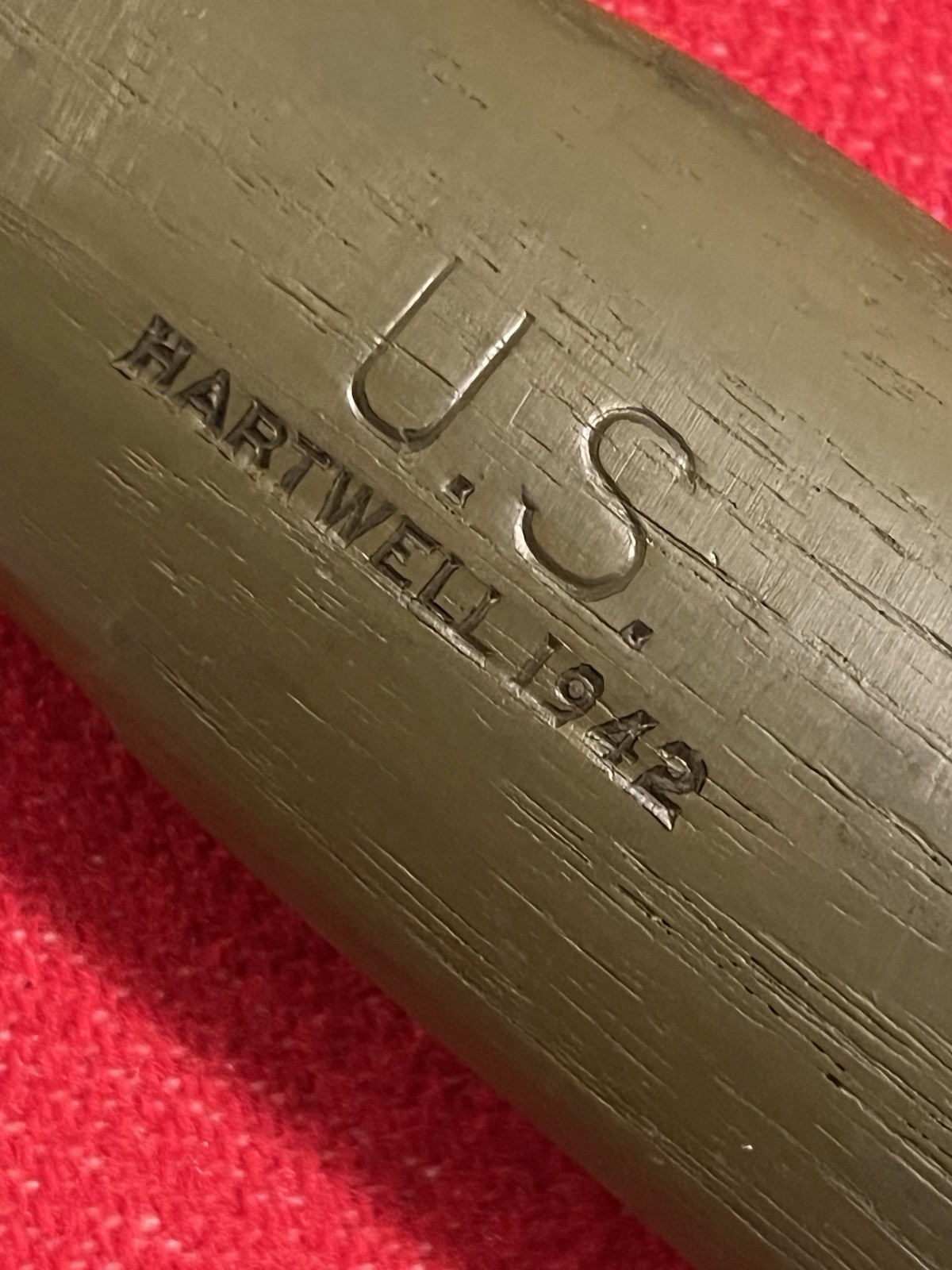
+ThisEARLY-WAR M1910 Handle is in pristinecondition and has never been slid on a Pick Mattock head. It isdeeply and legibly stamped in san serif font parallel to the shaftwith the large U.S.” surcharge and the manufacturer and date.
U.S.
HARTWELL1942
+ZERO scrapes, gouges, splits, or warping.
+ZERO blemishes to the ORIGINAL Olive Drab paint, 100% orwhich survives.
+The shaped hickory Handle is handsomely and legibly stamped with thename of another rarely encountered contractor: HARTWELLBROS. OfMemphis, Tennessee and Chicago Heights, Illinois. The HARTWELLBROTHERS werea prominent tool handle and manufacturer known for their high qualityash and hickory handles for striking tools, especially axe handles.The company suppliedHandles for axes, shovels, pick mattocks and hammers during WWII.
Hartwellalso had a Laurel, MS plant. In addition to handles, they producedbaseball bats and sold the Grey Gorge line of axes. One uniquefeature that Hartwellusedon some hammer and hatchet handles was the "Vacuum Cup",intended to increase the grip.
M1910CARRIER:
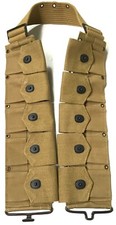
+This "Transitional"M1910 Carrier/Cover is made ofLight Shade OD#3 Canvas, Edge Binding, and Webbingas well as Dark Shade OD#7 2-inch Webbingfor the portion that secures the top of the Handle and the M1910Belt Hook.
+Other than printed 'guidemarks' for the seamstress, this original M1910 Carrier/Cover is markedonly with the serif font U.S. surcharge,but no contractor data. Due to the mix of different shades is issuspected that this was manufactured circalate-1943 or 1944.
+ZEROcuts, fraying, holes, stains, loose stitching, sun-fading, or mildewspots.
+ZERO rust on the painted steelM1910 Belt Hook, theAdjustable Buckle, orthe Ball Tip on thenarrow Strap.
*****
"Holes,Shovels, and Picks"
(excerptedfrom the handsome, carefully researched work by Denis Hambucken, AG.I. IN THE ARDENNES: The Battle of the Bulge,Pen & Sword Military Books, Ltd.,2020).
"Secondonly to his rifle, the infantryman's most important tool ishis ENTRENCHINGTOOL. TheM1943 entrenching shovel features a swiveling head that can be fullyextended, angled as a hoe, or folded back forstorage. The M1943 graduallyreplaces the M1910Shovel,although many soldiers prefer the T-handle over the older model.Wherever a unit stops, the first order of business is usually diggingin for concealment and protection against shelling and small arms. Ifthey are only stopping for a few hours or to bivouac for the night,soldiers dig individual slit trenches about two foot wide, two footdeep and as long as the soldier is tall. Remembers William Campbellof the 28thInfantry Division:"It was like digging a grave."
Ifthe position is to be held, one or two-men foxholes are dug aboutfour to five feet deep, usually with a step at the bottom, upon whichsoldiers can sit down, or stand to stay out of pooling water or tofire their rifles. According to army manuals, a foxhole with two feetof clearance above a crouching soldier protects him from tankspassing overhead, but German tankers learn to skid their treads overfoxholes to collapse them and bury occupants alive.Thelonger they remain in a defensive location the more elaborate theirunderground "homes" become. Foxholes are improvedwith roofs made of logs, doors or corrugated steel taken from nearbybuildings and covered with earth for protection against tree burstsand mortar shells. The floor is lined with hay or pine boughs.Soldiers carve out shelves for supplies, candles andammunition.Frank Mareska of the 75thInfantry Division recalls thatthe much-dreaded German 88 guns left no time to duck:
“Youonly venture out of your foxhole if it was necessary. Pissing orshitting had to be done either in a K or C-ration box, period!Renderings could then be thrown out over the parapet of yourfoxhole.”
Largerholes are dug for machine guns and mortar positions, sometimes,entire vehicles are entrenched. When visibility is limited by fallingsnow, fog or obscurity, companies dig listening slit trenches somedistance outside their perimeter to post sentries.
Hard-frozenground is doubly murderous for the infantry: It makes shells moredeadly as they explode on the surface, rather than penetrate theground, and it also makes it much more difficult to dig in. JohnMcAuliffe of the 87th InfantryDivision recalls that settingup a mortar position involves digging a large, two to three-foot deepcircular entrenchment in addition to individual foxholes for thecrew: "Sometimes we were digging a hole and we were almost doneand they'd say: 'OK, we’re moving out!'“.Aftera long day of fighting, many are too exhausted to dig. In someplaces, the frozen ground is simply too hard for the entrenchingshovel and few men carry the cumbersome M1910 pick-mattock.
Mostvehicles carry full-size shovels, axes and pickaxes. John Di Battistaof the 4th Armored Division recalls: "The mattocks were heavyenough to go through the crust of ground. Once the crust was brokenout, entrenching tools could do the job.[...] We were desperatehugging the ground waiting for our turn at a pick."
Someunits are provided with half-pound blocks of TNT with pull-type fuselighters, fuses and blasting caps to blast through therock-hard crust of the frozen ground. An obvious disadvantage of theTNT method is the attention it draws. Rocco Moretto of the 1stInfantry Division recalls:"Everything was going beautifully but the TNT threw up heavyblack smoke in the explosion areas. The enemy observing this quicklybegan to rake our positions with heavy concentrations of fire and webegan to sustain heavy casualties."
Naturally,soldiers do not bother to fill their foxholes as they leave,consequently, Europe is riddled with millions of holes. It is notunusual for a foxhole to be occupied alternatively by American andGerman soldiers. After the war, It falls to landowners and farmers tofill in hundreds of thousands of foxholes and shell craters which aretroublesome for machinery and hazardous to livestock. A post warsurvey of the grounds of the Castle of Rolley, an area of about 730acres near Bastogne, counts no less than 2,490 foxholes to fill in.
*****
NOTE: Any overage in postage will be refunded!