When you click on links to various merchants on this site and make a purchase, this can result in this site earning a commission. Affiliate programs and affiliations include, but are not limited to, the eBay Partner Network.
Payment | ShippingW H BULLOCH CHICAGO ANTIQUE BRASS BINOCULAR MICROSCOPE STAND "D" SN-93, 1877
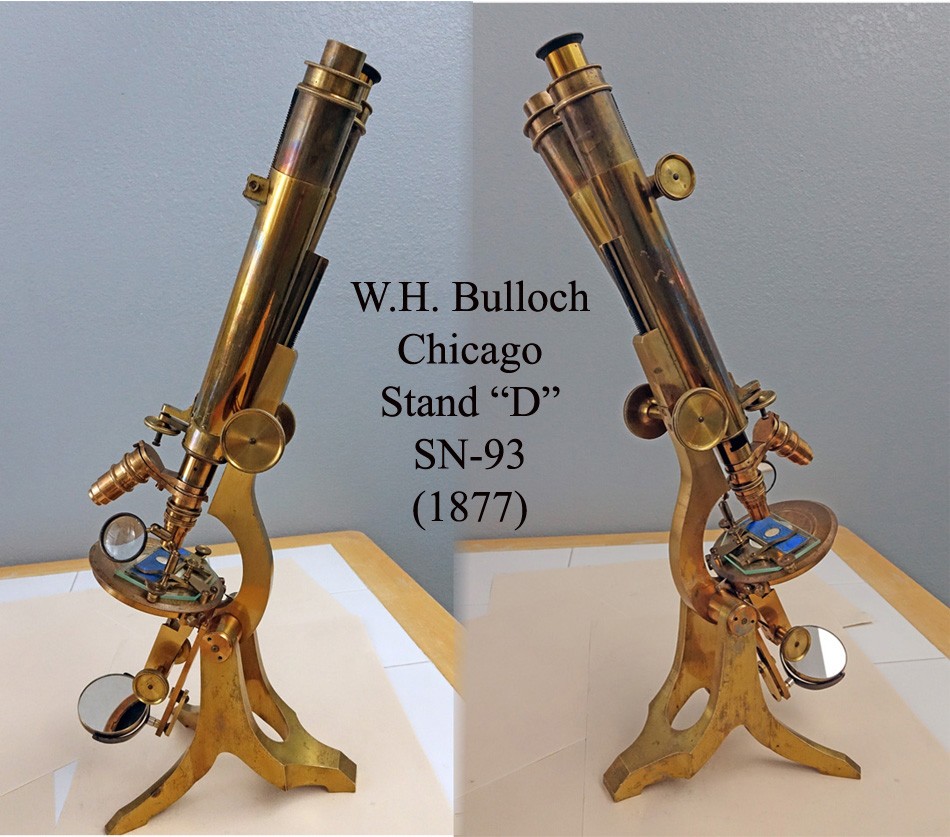
W.H. BULLOCH CHICAGO ANTIQUE BRASS BINOCULAR MICROSCOPE STAND "D" SERIAL NUMBER 93, 1877You are invited to purchase an exceptionally rare antique brass binocular microscope made by Walter H. Bulloch of Chicago, Illinois in the latter part of the 19th Century. His limited microscope productions do not appear that often in today's world, so this particular instrument should be of special interest to serious collectors of Bulloch's microscopes.
The manufacturer of this instrument is identified by an engraving in block letters on the top rear of this instrument's foot, "W.H. BULLOCH, CHICAGO." The instrument also bears the engraved serial number, "93," also found on the rear of the microscope's foot. This relatively low serial number dates the instrument to the year 1877, relatively early in Bulloch's career (See accompanying close-up image of these engravings).
NOTE: For more information on W.H. Bulloch and his history as a very talented American microscope maker, please see below.This microscope model is identified as his Stand "D," which was featured in Bulloch's very first printed Catalogue of Microscopes that he published in the year 1878. However, it was not found in Bulloch's subsequent microscope catalogue published in the year 1890. So it appears to be a model that he only built relatively early in his career. It was also featured in J. Edward Smith's book entitled, "How to See with the Microscope" published in the year 1880. I have included a copy of an engraving of that model from my personal copy of Smith's book for comparison with the instrument featured here (See accompanying image of the engraving).
The image of the engraving from Smith's publication shows a monocular version of this microscope model, which featured an "English" or "Crouch" type foot. It also featured a Lister limb, a rotatable glass covered circular stage with moveable gliding slide carrier, a yoke mounted mirror on a swinging tailpiece in the substage and a nosepiece fine focus mechanism on the front face of the body tube. All of these distinguishing features of Bulloch's Stand "D" are found on the instrument featured here (See accompanying images).
Note: I was unable to find any images of the binocular version of Bulloch's Stand "D" in any available Internet based antique microscope collections or from published engravings in historical microscope publications or periodic journals. So the current example of a Bulloch binocular Stand "D" appears to be a relatively rare new appearance, which can be likened to a physical resurrection from the dusts and mists of microscope history.
Bulloch is known to have made two other microscope models that featured the English or Crouch type foot - His Stands "E" and "F." The "E" stand closely resembled the "D" Stand, but featured a fixed rectangular stage rather than a rotating circular one. It also had a movable slide carrier on top of the stage. His Stand "F" was similar to his "E" Stand, but featured a relatively plain rectangular stage with only a pair of conventional slide clips mounted thereon. This latter stand was later labeled as his "Student" Stand mainly because of its relatively simple design. Thus, the D, E, and F Stands are evidently the only models that Bulloch made that featured the English or Crouch type foot. He also appears to be the only American microscope maker that used this type of foot design for some of his instruments.
DETAILED DESCRIPTION:
This instrument is built upon an iconic "English" or "Crouch" foot, named as such because it was first invented by the English microscope maker, Henry Crouch. Rising from each side of the foot are dual trunnion plates that terminate in a trunnion joint that also captures the lower end of the Lister limb of this microscope and thereby supports the rest of this instrument. The trunnion joint also allows the instrument to incline to various angles from the vertical that permits the comfortable viewing of slide preparations mounted atop the stage.
Mechanically attached to the leading edge of the lower end of the Lister limb is a circular brass stage support ring. Mounted on top of this ring is a 105mm diameter rotating brass stage with a 35mm central aperture. The edge of the stage is graduated in individual degrees with every 10 degree increment marked. A pointer found at the rear of the stage and attached to the right side of the limb points to the exact degree of rotation of the stage (See close-up image that shows this pointer). A dual set of push-pull brass set screws found on either side of the limb, attached to the underlying brass support ring and impacting the underside of the stage plate allow the upper stage plate to be precisely centered to the optical axis of the instrument - a very clever arrangement.
Mounted atop the upper brass stage is a glass stage plate with a 30mm diameter central aperture. In turn, mounted on top of the glass plate and clipped to its sides is a gliding brass slide carrier with control handles on either side and including a pair of slide clips. An adjustable pressure screw mounted at the end of a small triangular brass bar at the rear of the stage holds the slide carrier to the glass stage plate and also allows it to move smoothly within the confines of a 22mm by 22mm square brass frame (See close-up images of the stage top). Thus, all directions of slide movement are possible with this arrangement in addition to the fact that the stage itself can be rotated to any degree. This is another brilliant invention by W.H. Bulloch.
Also attached to the left side of the gliding slide holder is a 30mm diameter articulating bullseye condenser. This unit can be used to provide illumination to any opaque specimens mounted on slides held in the slide carrier (See close-up images that show this feature).
Attached to the lower end of the Lister limb under the stage is a 105mm long swinging brass tailpiece at the end of which is affixed a yoke mounted 55mm diameter plano-concave mirror mounted in brass. The mirror can be rotated to any angle within its mounting and the swinging tailpiece itself can be moved laterally from side to side to provide either direct or oblique illumination to the stage above (Please see the accompanying composite image that shows the flexibility of movement of the swinging tailpiece). Also attached to the lower limb and above the tailpiece is a rack and pinion assembly that would normally accommodate an additional substage apparatus such as a condenser with iris diaphragm or a rotating disc of apertures. However, these additional substage features are missing from this instrument.
Turning our attention to the upper end of the Lister limb above the stage one finds the coarse and fine focusing apparatus for the instrument and the binocular body tube attached to the forward edge of the limb.
Coarse focus is by rack and pinion controlled by a pair of oversized brass milled heads found on either side of the upper limb. The rackwork on this instrument is horizontal rather than angled as is the case for all of the instruments made by Bulloch (See close-up image of the rackwork).
Fine focus is by a nosepiece fine focus apparatus found on the front face of the lower end of the body tube. This system consists of a finely threaded micrometer screw with a brass milled head acting on a lever device attached to a spring-loaded brass sleeve located inside the distal end of the body tube. As the milled head is turned it activates a lever that moves the internal brass sleeve very slightly up or down within the body tube allowing for the fine focus of an objective lens that is screwed into the lower open end of the brass sleeve.
The binocular body tube of this microscope includes a pair of 60mm long drawtubes that are simultaneously moved up or down by a rack and pinion system found on the top front face of the body tube. At the top of each of the drawtubes is a brass ocular holder. A pair of unmarked "top-hat" style oculars are provided with this instrument. The ocular associated with the longer right tube is complete with both lenses and an eyecup. The other ocular for the other tube is incomplete, missing the upper internal lens and eyecup assembly. The lower end of the body tube is threaded for RMS objectives. In this case, two (2) objective lenses are provided with this instrument on a brass dual position rotating objective holder that is threaded into the end of the body tube: A Bausch & Lomb Co. 4/10-inch objective and an R&J Beck 1/10-inch "uncovered" adjustable objective. NOTE: Bulloch did not manufacture his own objective lenses. Thus, he and/or his representatives including the Meyrowitz Brothers supplied objectives with his microscopes that were made by others including Wales, Tolles, Spencer, B&L, Gundlach, or, in this case, R&J Beck of England.When this instrument is set up for observations with the binocular drawtubes fully extended, it stands about 21 inches tall, making for a relatively large antique brass microscope (please see the accompanying image which compares the size of the microscope to a standard bottle of wine). When the drawtubes are fully nested into the body tubes with the oculars and objectives are removed for storage, the instrument stands about 16 inches tall in its collapsed state. The microscope weighs 9 pounds. There is no wood case or other accessories included with this microscope.
STATEMENT OF CONDITION:NOTE: The accompanying images that were captured under ambient light conditions are to be considered to be an integral part of this listing and a part of this statement of condition. Please click on the images for a larger view. Also, please take the time to view each of the images so you can confirm the condition of the instrument and so you will know in advance what you will be getting should you prove to be the proud new owner of this superbly designed and engineered American made microscope.In summary, this Bulloch microscope is in very good to excellent cosmetic, optical and mechanical condition, but with the following detailed caveats as noted below:The cosmetic condition of this instrument is relatively good for an instrument of its age now 149 years old and counting. Not all of the original lacquer is still present on the brass elements. All of the elements have some level of spotty tarnish present especially on the sides of the foot and limb, the front and sides of the body tube, on the stage and on the drawtubes. I would estimate original lacquer retention at around 40 to 45%. The only treatment we have given this instrument was to clean it of dust and grime with Windex and then to give it a coating of Renaissance Wax to protect it from additional tarnish.NOTE: WE MAKE IT A GENERAL PRACTICE NOT TO DEEP CLEAN AND POLISH ANTIQUE BRASS MICROSCOPES.Both of the objective lenses associated with this instrument are in very good to excellent condition with no internal defects. However, the adjustment mechanism on the R&J Beck objective does not work and we did not try to force it. One of the top hat oculars is missing its upper lens and eyecup assembly and so does not provide an image. However, it remains useful for display purposes. A future owner may be able to find a suitable replacement to make the instrument complete with two working oculars. Unfortunately, this microscope is missing the Wenham prism that would normally be present in the compartment at the lower end of the body tube (See image that shows its normal location). In its absence, the microscope cannot be used as a functional binocular microscope. On the other hand, it can still be used as a functional monocular microscope. Finding a replacement Wenham prism for this instrument will be difficult, but a collector may have an extra prism available to add to the instrument to make if functionally complete. However, it is unlikely that this instrument will be used for microscopic investigations, but will be placed in display in a collection. Thus, the absence of the Wenham prism will not be of particular concern in its acquisition by a collector.
Both sides of the plano-concave mirror are in excellent optical condition. It provides excellent illumination to the stage. However, the mirror is not original to the microscope but is a more modern replacement.The articulating Bullseye condenser associated with the gliding slide holder has a small defect in the glass near the edge of the lens (See the accompanying image that shows this defect). This defect does not significantly impair its use to provide illumination for opaque specimens or for its display with the instrument.
The mechanics associated with this instrument are in relatively good condition overall. The coarse focus mechanism works smoothly and perfectly. The nosepiece fine focus mechanism also works as designed.
The top stage plate rotates freely, but its arrest mechanism is missing from this instrument. The swinging mirror tailpiece works smoothly.As is noted above, the rack and pinion substage assembly lacks a condenser or other substage apparatus.
All of the aforementioned caveat issues will likely be academic for serious antique microscope collectors as this instrument will most likely be placed into a collection on display and will not be used on a day to day basis in a laboratory setting where 100% optical and mechanical precision of all parts would be absolutely required.All in all, this instrument is a very well preserved example of a Bulloch Binocular Stand "D." It is certain to command a prominent place in any antique microscope collection, especially one with an emphasis on American made instruments. A word of advice though: All W. H. Bulloch instruments are "very rare birds" and in high demand by collectors, so you will need to act quickly to make this microscope your own!
ABOUT W.H. BULLOCH, MICROSCOPE MAKER:Walter Hutchison Bulloch (1835 - 1891) was born in 1835 in Glasgow, Scotland where he lived until age 17. About the year 1852, he and his family immigrated to New York City in the United States. Here young Walter learned the trade of a tailor from his father. However, his innate fondness for mechanical pursuits made him dissatisfied with his future prospects as a tailor. He soon became apprenticed to Messrs. Pike & Sons, then a leading firm of opticians and scientific instrument makers/retailers located on Broadway in New York City.After serving for a time as an apprentice with the Pike firm, he decided to open his own optical-mechanical workshop in the City. But, not long after this, the US Civil War broke out and Bulloch decided to enlist as a private in the 12th New York Volunteers on the Union side of the conflict. However, his term of service in the Union Army was quickly cut short, as he contracted a severe cold, which developed into rheumatism that rendered him incapacitated and unable to carry out his duties as a soldier.
After he was mustered out of the service for medical reasons, he returned to New York City to continue his career as an optician and microscope maker. Back in New York City he formed a business partnership with William Wales, a well-known maker of objective lenses. He continued in business with Wales until the year 1866, when Bulloch moved to Chicago, Illinois.In Chicago, Bulloch proved to be very successful and had accumulated considerable monetary means over the period of 1866 to 1871. During this time frame his business address was listed at 126 Clark Street in Chicago. This proved to be his most productive period when it came to microscope design and production. Then, on October 8 & 9, 1871, a disastrous fire completely consumed his workshop and tools as well as some microscopes that he had under construction at the time. As a result of this misfortune, Bulloch suffered a significant financial and psychological loss from which he never fully recovered.In an attempt to rise from his misfortunes, he moved to Boston and was for a time associated with another famous American optician, Robert B. Tolles of Boston Optical Works. He then returned to Chicago and reestablished his business of manufacturing microscopes at 99 and 101 West Monroe Street in the City. Another address listed for his business in 1876 was at 102 Madison Street.However, in 1889, still suffering financially from the losses associated with the unfortunate Chicago fire and his subsequent moves, he accepted a position with the Bureau of Weights and Measures in the U.S. Coast and Geodetic Survey in Washington, D.C. But, he soon chafed under the bureaucratic restraints associated with working for a US government agency. After only 6 months of service in Washington his health began to fail and so he returned to Chicago in the fall of 1890. Even though he continued to suffer from poor health his perseverance led him to struggle on with his microscope business. He opened a new place of business at No. 303 Dearborn Street, a very advantageous business address, and began to work again. However, it was not for long. After struggling with ill health for about six months, he was forced to stop work.
Bulloch died on November 5, 1891 at Elgin, Illinois where he had gone for treatment.In the meantime, E. B. Meyrowitz Brothers of New York City, who had acted as Bulloch's agents for some years before his death, announced in the introduction to their 1894 "Illustrated Catalogue of Optical, Meteorological Instruments and Projection Apparatus" that they had purchased the entire manufacturing plant of the late Mr. W. H. Bulloch, including all his patents, models, drawings, etc. They continued to manufacture his microscopes under the Bulloch name for a time. They used residual parts left by Bulloch to assemble the instruments and evidently started a new set of serial numbers unrelated to the numbers used by Bulloch. They also made some modifications to Bulloch's original designs including the addition of diagonal racks/spiral pinions for coarse focus along with an improved substage apparatus and other minor design changes. Some of these latter instruments were signed variously as "Bulloch's Patent, Meyrowitz Maker" or "E.B. Meyrowitz - Maker - New York - Bulloch's Patent 1879." The Meyrowitz firm likely ceased manufacturing operations completely before the year 1900, producing relatively few of Bulloch's instruments in total.During his on again off again career as a microscope manufacturer, Bulloch was an active member of the Illinois State Microscopical Society, which he founded in 1869, the Chicago Academy of Sciences, the American Academy of Sciences, the American Society of Microscopists, and the Royal Microscopical Society of London. Due in part to combinations of misfortunes and ill health, Bulloch produced less than perhaps 750 total microscopes over his lifetime. Note: As of 2026, serial numbers 32 (made in c1868) to 675 (made in 1891) plus a scant few without any serial numbers are documented by the antique microscope collection community. But each of his instruments reflects his rapt attention to detail and his ardent desire to achieve a high level of perfection in terms of optical and mechanical performance. He constantly experimented with new enhancements and made continual improvements to his instruments over time. As a result, his surviving microscopes, which rarely surface today, are in extremely high demand by collectors.PURCHASE:THE MONTANA LOGGER is very pleased to offer this W. H. Bulloch Antique Brass Binocular Microscope Stand "D" Serial Number 93 for a very reasonable Buy It Now cost. We will also entertain reasonable offers for this very rare instrument.NOTE: WE WARMLY WELCOME INTERNATIONAL buyers / BUYERS. WE SHIP WORLDWIDE.PAYMENT: Payment is due within 3 days of purchase. Prompt payment is always very much appreciated. PaymentBack to Top
I accept the following forms of payment:
Shipping & HandlingBack to Top
US Shipping
$45.00 FedEx Ground®
$45.00 FedEx Home Delivery®
International Shipping
$125.59 USPS Priority Mail International (Worldwide)
$87.50 USPS Priority Mail International (Canada)FREE scheduling, supersized images
and templates. Get Vendio Sales Manager.Make your listings stand out with
FREE Vendio custom templates!
FREE scheduling, supersized images
and templates. Get Vendio Sales Manager.
Over 100,000,000 served. Get FREE counters from Vendio today!