When you click on links to various merchants on this site and make a purchase, this can result in this site earning a commission. Affiliate programs and affiliations include, but are not limited to, the eBay Partner Network.
🐰 Two Sealed Boxes, One Petty Girl Story
Size: Cards 2 1/2\" x 3 1/2\" (standard trading card)
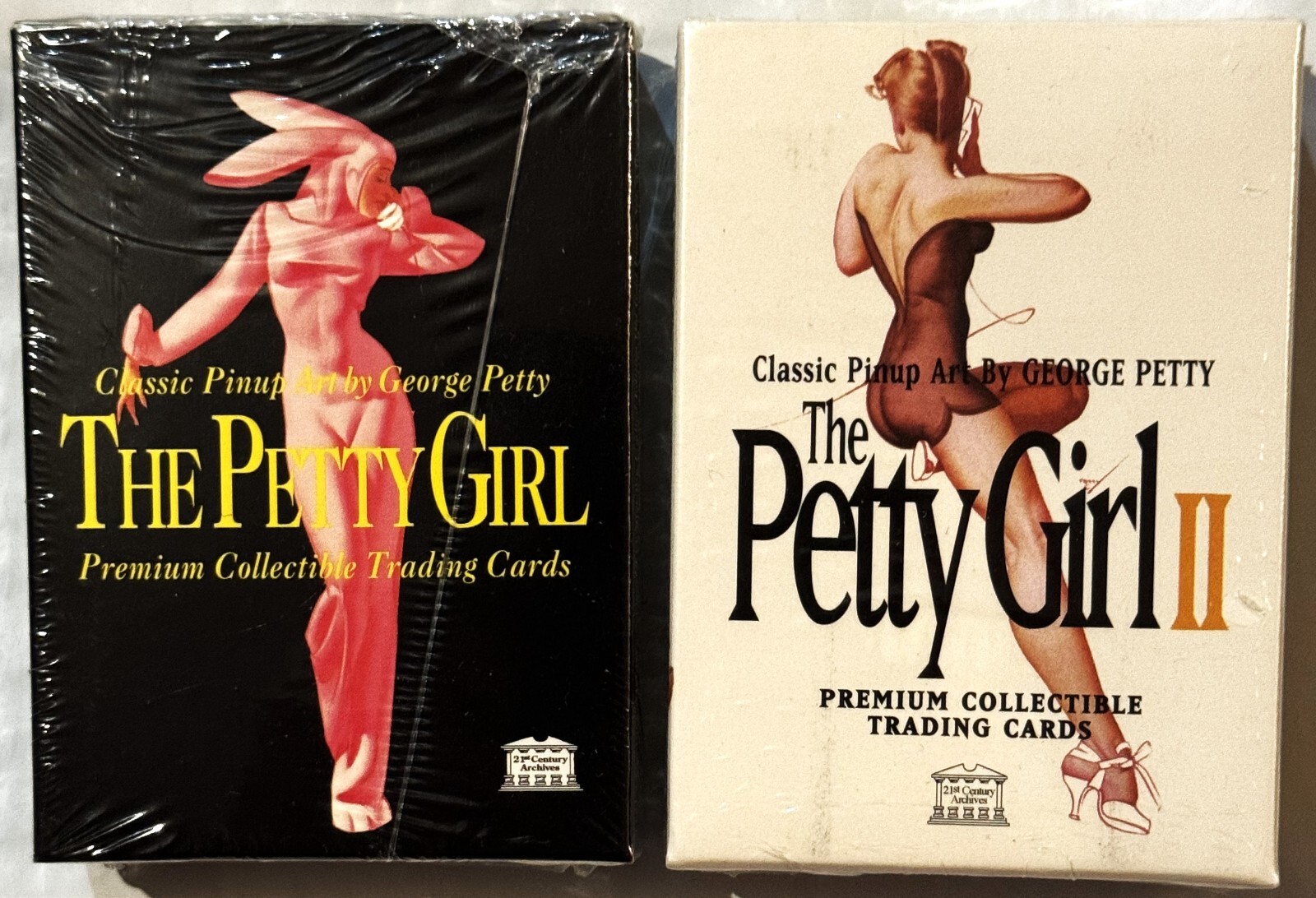
Petty Girl I and Petty Girl II make up the complete boxed run from 21st Century Archives, offered here as a pair: two New Old Stock 50-card boxes, each in its factory shrink wrap, and neither has ever been opened. Between them they hold 100 cards of George Petty\'s pin-up art, all of it taken from his original commercial work of the 1930s, \'40s and \'50s. I love having the two side by side, since they\'re really one story in two boxes.
📅 Dating the Two Sets
The Trading Card Database catalogs the pair as a single 1994–95 set, cards 1–50 in Series I and cards 51–100 in Series II, and like PSA\'s population report it places Series I in 1994. The Series I box shows no year. Flip Series II over and the back panel prints ©1995 The Petty Family — the only copyright date either box actually carries, and COMC files that series under 1995 as well.
✏️ Reading the Boxes
Reid Stewart Austin wrote the card backs on both series, and the box credits him as a \"world-renowned authority\" on pin-up art. His Series I back panel opens with the line \"The Petty Girl was to print what Harlow and Grable were to film.\" Series II starts with how Petty worked, praising the design and \"technical achievement\" behind the Petty Girl.
The box copy also ranks Petty with Norman Rockwell: to the American woman, it says, he was what Rockwell was to the family. It credits him with the entire concept of the magazine pinup, adding that without the Petty Girl there would have been neither a Varga Girl nor a Playboy Playmate. It follows her from the first issue of Esquire in 1933 up a \"heady climb\" past college boys and corporate heads. A big 1997 book of Petty\'s pin-ups has a foreword by Hugh Hefner. Series I also prints a caption in which she reports a phone out of order because she hasn\'t had a call all evening.
🖌️ George Petty, Briefly
Born in 1894 in Abbeville, Louisiana, Petty learned to work an airbrush in his father\'s photo shop when he was a boy. He was freelancing by 1926 and contributed to Esquire\'s very first issue in October 1933. He remained with the magazine until 1956 and worked for True too. Credit for the fold-out centerfold as a magazine feature goes to his Esquire gatefolds: magazines had been putting a girl on the cover, and Petty moved her inside as a regular feature. He also painted calendar art for Esquire, True and the Ridgid Tool Company, and he gave his women a little more leg and a smaller head than the real models had — an exaggeration that became his signature. Petty died in 1975 in San Pedro, California.
His work travelled far from the newsstand. Painted reproductions of his pin-ups appeared as nose art on WWII aircraft, including the B-17 Memphis Belle. A Petty Girl rendered on a SAGE computer in 1959 is sometimes called the earliest known figurative computer art. Petty\'s daughter posed for the \"Flying Lady\" ornament on early-1950s Nash automobiles. Two of his images later turned up on the cover of the Beatles\' Sgt. Pepper\'s Lonely Hearts Club Band. Collectors also tell two more stories about him: he judged Miss America in the late 1930s, and a 1939 campus poll at Princeton put him ahead of Rembrandt as favorite living artist.
🔧 The Insert Cards
Each series carries a one-of-five special insert, seeded at random through the print run: Ridgid Tool in Series I and Jantzen in Series II. That is down to the luck of the draw in a sealed box; no box is guaranteed to hold one.
Ridgid Tool dates to 1922 and North Ridgeville, Ohio, where Carl Ingwer Sr., William Thewes and Arthur Smith built the business around one product, a heavy-duty pipe wrench that is still its signature tool. The company relocated a few miles away to Elyria, Ohio, in 1943 and became an Emerson Electric subsidiary in 1966. Petty painted calendar art for Ridgid, and the Series I insert nods to that connection.
Jantzen began in Portland, Oregon, in 1910 as the Portland Knitting Company, making wool sweaters and hosiery; its founders were John and C. Ray Zentbauer and Carl Jantzen. A Portland Rowing Club member asked for a rib-stitch rowing trunk with no sagging, even on a chilly morning out on the Willamette River, and by 1916 the swimwear line was sold under the Jantzen name. The \"Diving Girl\" logo, a red one-piece bathing figure caught mid-dive, arrived in 1920, and a 1931 independent trade survey put it seventh among the nation\'s best-known trademarks.
Ridgid and Jantzen both once had Petty\'s brand of glamour art working for their own advertising — which is why each series carries its own randomly seeded chase card honoring one of them. Jantzen\'s insert is the swimwear side of that story, from a company leaning on the airbrushed glamour Petty was already known for.
📇 The Companion Line
21st Century Archives paired these two Petty sets with a Vargas line of its own. Alberto Vargas\'s Pin-Up Girls came out in 1992 and 1993.
📦 Condition
Both boxes are Factory sealed, New Old Stock, and neither has been opened.
📋 Specifications
- Set: The Petty Girl (Series I, 1994) and The Petty Girl II (Series II, 1995)
- Manufacturer: 21st Century Archives
- Cards: 50 per box, 100 total
- Artist: George Petty
- Card back text: Reid Stewart Austin
- Condition: Factory sealed, New Old Stock