

|
Site Categories |
|
Featured Items |

Poodle, Spaghetti Trim, Ucagco


|
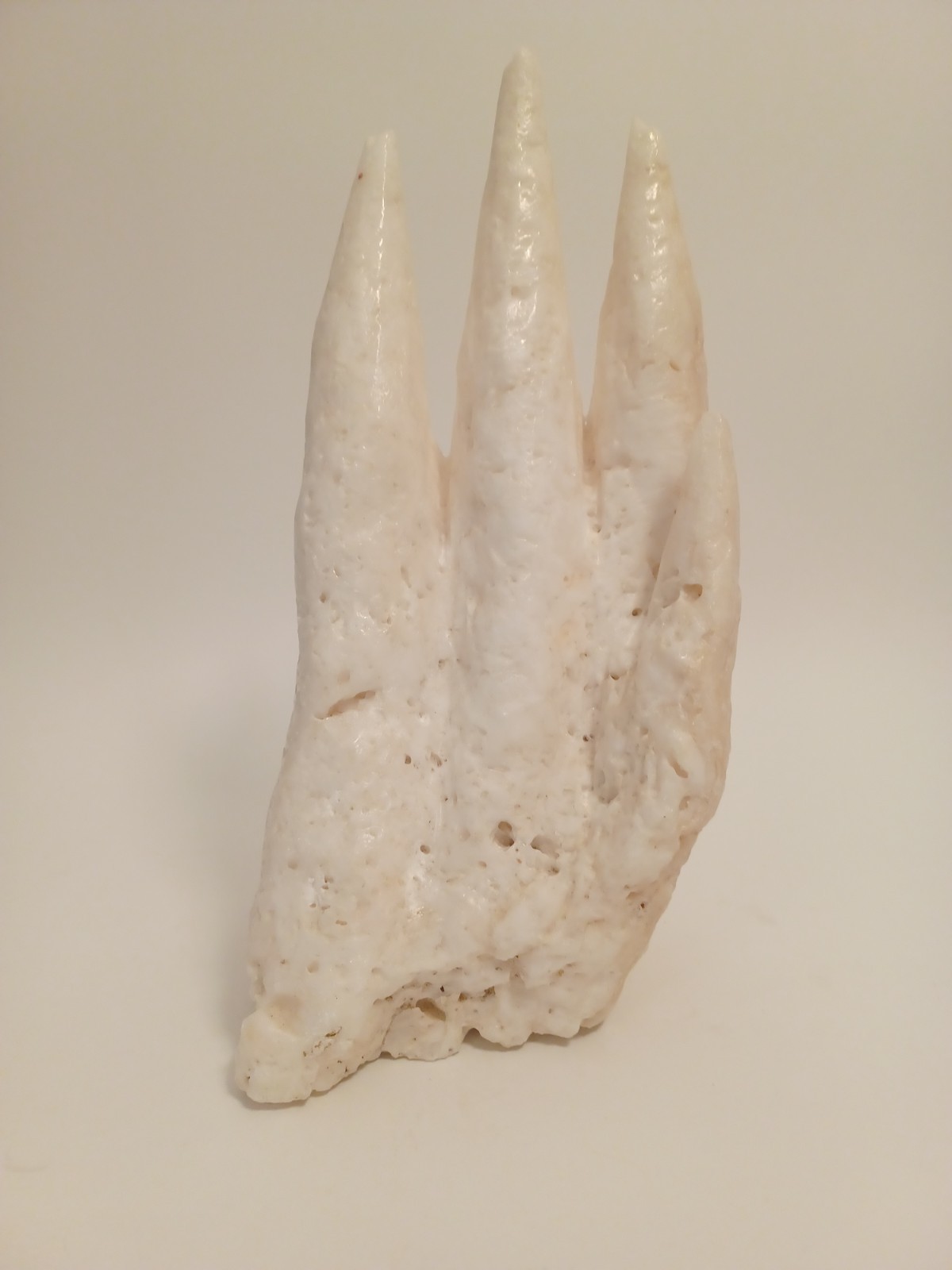
Vintage 12" White Calcite Cave Stalactite 4-Point Dripstone Cluster Mineral Rock For Sale

When you click on links to various merchants on this site and make a purchase, this can result in this site earning a commission. Affiliate programs and affiliations include, but are not limited to, the eBay Partner Network.

Vintage 12" White Calcite Cave Stalactite 4-Point Dripstone Cluster Mineral Rock:
$299.69
Originally Purchase in Northern Kentucky (OH, KY, IN Tristate) By Me.Pure white, non-transparent (opaque) cave calcite is a beautiful material that indicates the stalactite grew under pristine environmental conditions.Because it is entirely white, the water feeding it was perfectly filtered by the overlying limestone, leaving behind no iron or organic soils. Because it is completely opaque rather than glassy or translucent, the micro-crystals grew tightly packed together in a dense matrix, which scatters light instead of letting it pass straight through.Visual Sub-Types of Opaque White Calcite - Smooth, Chalky "Bone" Texture: If the surface looks completely matte like a piece of chalk, it likely dried out over a long period. This is incredibly common in older, inactive sections of massive limestone cave systems like those in Kentucky (Mammoth Cave) or Indiana.
That specific smooth, chalky, matte "bone" texture strongly suggests that the stalactite is an inactive, weathered fossil formation that has been dry for a very long time.When a cave chamber is active, a constant film of water coats the stalactite, keeping it glassy, translucent, or sparkly. When the water source shifts or dries up completely—often due to changing climate or shifting surface rivers over thousands of years—the calcite stops growing. The surface molecules begin to microscopicly weather and dehydrate, creating that flat, light-scattering matte finish that looks like chalk or ancient bone.This specimen almost certainly came from a well-aerated, completely dry upper tier of a massive, multi-level karst system. - The Kentucky/Indiana Karst Plain: The region containing Mammoth Cave (Kentucky) and the limestone caverns of Southern Indiana (like Bluespring Caverns or Wyandotte Cave) is famous for this. These systems have older, completely dry upper passages that have been dry for hundreds of thousands of years, sitting far above the modern active water table.
- The Ozark Plateau (Missouri/Arkansas): This region contains thousands of ancient, deeply carved limestone caves. Many have dry, abandoned upper chambers where old formations have taken on a ghostly, matte-white bone appearance.
Legal and Historical ContextBecause it is bone-dry and chalky, this piece has likely been out of a live cave environment for quite a while. - Historical Souvenirs: In the 19th and early 20th centuries, before cave conservation laws were enacted, it was highly common for tourists and landowners to break off stalactites from dry, easily accessible upper chambers in places like Kentucky to sell as curiosities or keep as keepsakes.
- Excavation/Mining: It could also have originated from limestone quarrying or highway blasting, which frequently cuts open old, dry, sealed-off cave pockets that have been dead for millennia.
This is a substantial and geologically fascinating specimen,not just a single stalactite; it is a cluster formation, often referred to by geologists and collectors as a "stalactite plaque" or "dripstone cluster." The fact that the points are merged and unmerged tells a vivid story about how it grew over thousands of years:What this Tells Us About Its OriginGiven the dramatic 12-inch and 11-inch main spires, the dense clustering, and the chalky matte texture, this cluster was a major focal feature of its environment.A large, multi-pointed white cluster like this is highly characteristic of "pendant clusters" found in high-ceilinged chambers. When a large block of limestone overhead starts to slowly separate along a bedding plane, it creates a wide linear crack. These heavy, multi-pointed, chalky-white daggers are famous in the massive, ancient cave systems of the Interior Low Plateaus (specifically the Mammoth Cave system in Kentucky and the historic cave districts of Southern Indiana)Estimating Its AgeTrue limestone cave stalactites of this scale grow at a painfully slow average rate of about 0.005 inches (0.13 mm) per year For a single spire to reach 12 inches long, it requires roughly 2,400 to 3,000 years of continuous dripping under perfectly stable conditions.Given the complexity of many different points merging and unmerging, the shared 8-inch base, and the time it took to completely dry out into that chalky texture after the water stopped, the entire geological lifecycle of your specimen likely spans tens of thousands of years.
|
|
Related Items:
Vintage 12" White Calcite Cave Stalactite 4-Point Dripstone Cluster Mineral Rock $299.69

VINTAGE 1960'S WARNING GRIZZLY BEAR PORCELAIN SIGN 12" X 8" $139.00

VINTAGE 1950'S SINCLAIR TROPIC GASOLINE PORCELAIN ENAMEL DEALERSHIP SIGN 12" $176.36
|
|
|
Shopping Cart  |

|
Recently Viewed |
|
Latest Items |
|
Facebook |
Secure Websites

|
