When you click on links to various merchants on this site and make a purchase, this can result in this site earning a commission. Affiliate programs and affiliations include, but are not limited to, the eBay Partner Network.
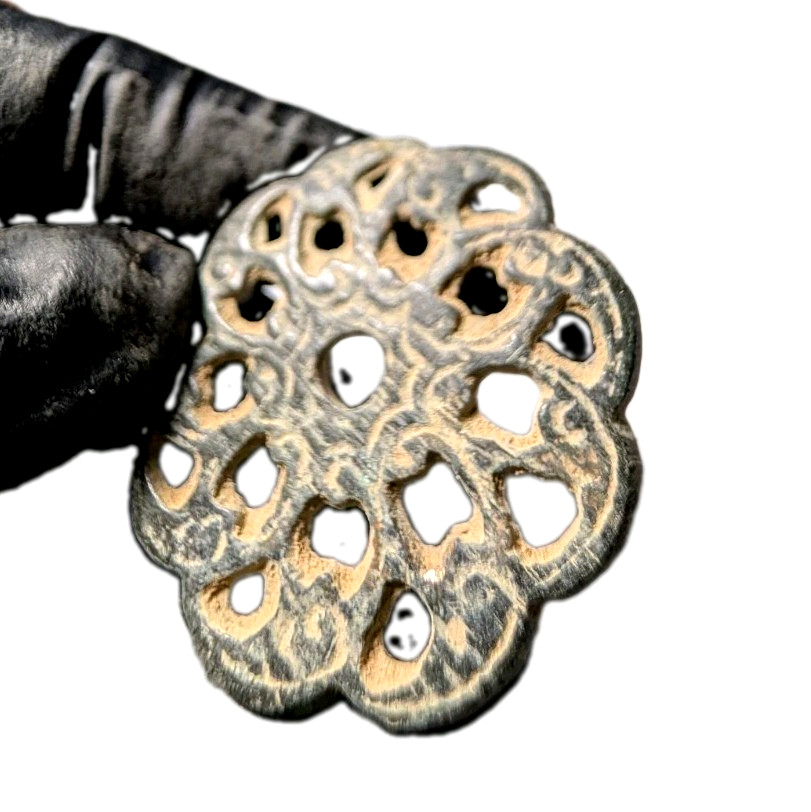
Ancient Viking Age Cast Bronze Openwork Amulet Pendant (Approx. 40mm — c. 9th–11th Century AD)
Authenticity & Guarantee
Certification: Certified Authentic — includes signed Certificate of Authenticity (COA) with full provenance documentation.
Provenance: Ex-private European collection, legally acquired from international sales; Viking / Early Medieval Scandinavian & Rus Sphere.
Item Specifications & Estimated Dimensions
Object: Cast Bronze Openwork Amulet Pendant / Disc
Culture / Period: Viking Age / Early Medieval Scandinavian & Kievan Rus\' Sphere
Date Range: Circa 9th Century AD – 11th Century AD (c. 800 – 1050 AD)
Estimated Dimensions: Approx. 4.0 – 4.5 cm diameter (40 – 45 mm) (Extrapolated from hand scale)
Material: Cast Bronze (Copper Alloy)
Form & Architecture: Circular scalloped/lobed disc featuring intricate pierced openwork (opus interrasile) depicting stylized interlocking zoomorphic beasts and tendril scrolls in high relief; engineered with balanced openwork voids for suspended wear as a protective amulet or status ornament
Condition: Exceptional, complete ancient condition. Crisp intricate openwork detailing, solid structural bronze frame, preserved under an authentic dark charcoal-olive bronze patina with contrasting light pale sandy-cream burial encrustations across the pierced recesses. Free of modern restoration or tooling.
HISTORICAL CONTEXT & TYPOLOGICAL LORE
Viking Age Openwork Metalwork & Zoomorphic Styles
During the 9th to 11th centuries AD, Scandinavian metalsmiths and eastern Rus\' artisans excelled in lost-wax casting of complex openwork (pierced) ornaments. These pendants incorporated elements of traditional Scandinavian animal styles—including Borre, Jelling, and Urnes designs—featuring interlocking gripping beasts, ribbon-shaped serpents, and stylized vine tendrils representing the World Tree (Yggdrasil) or protective animal spirits (fylgjur).
Amuletic Significance & Trade Route Distribution
Openwork disc pendants were highly valued personal ornaments worn across Scandinavia, the Baltic, and the riverine trade routes of Kievan Rus\'. Suspended from woven silver chains or leather cords, these openwork discs functioned as protective talismans symbolizing status, spiritual protection, and regional identity among traders and noble households.
Typological Analysis & Exact Classification
Primary Class: Early Medieval / Viking Age Jewelry & Personal Amulet
Sub-Class: Openwork Zoomorphic / Tendril Disc Pendant Class
Manufacturing Technique: Lost-wax cast copper alloy openwork with hand-finished interior cutouts.
Comparable Archaeological Examples & Museum Accession Numbers
British Museum (Accession No. 1852,0329.13): Viking Age bronze openwork disc pendant with zoomorphic ornamentation.
National Museum of Denmark (Copenhagen): 10th-century Viking bronze openwork pendants recovered from silver hoard deposits.
State Historical Museum (Moscow): Kievan Rus\' / Scandinavian openwork bronze amulets from Gnezdovo excavation layers.
A4