When you click on links to various merchants on this site and make a purchase, this can result in this site earning a commission. Affiliate programs and affiliations include, but are not limited to, the eBay Partner Network.
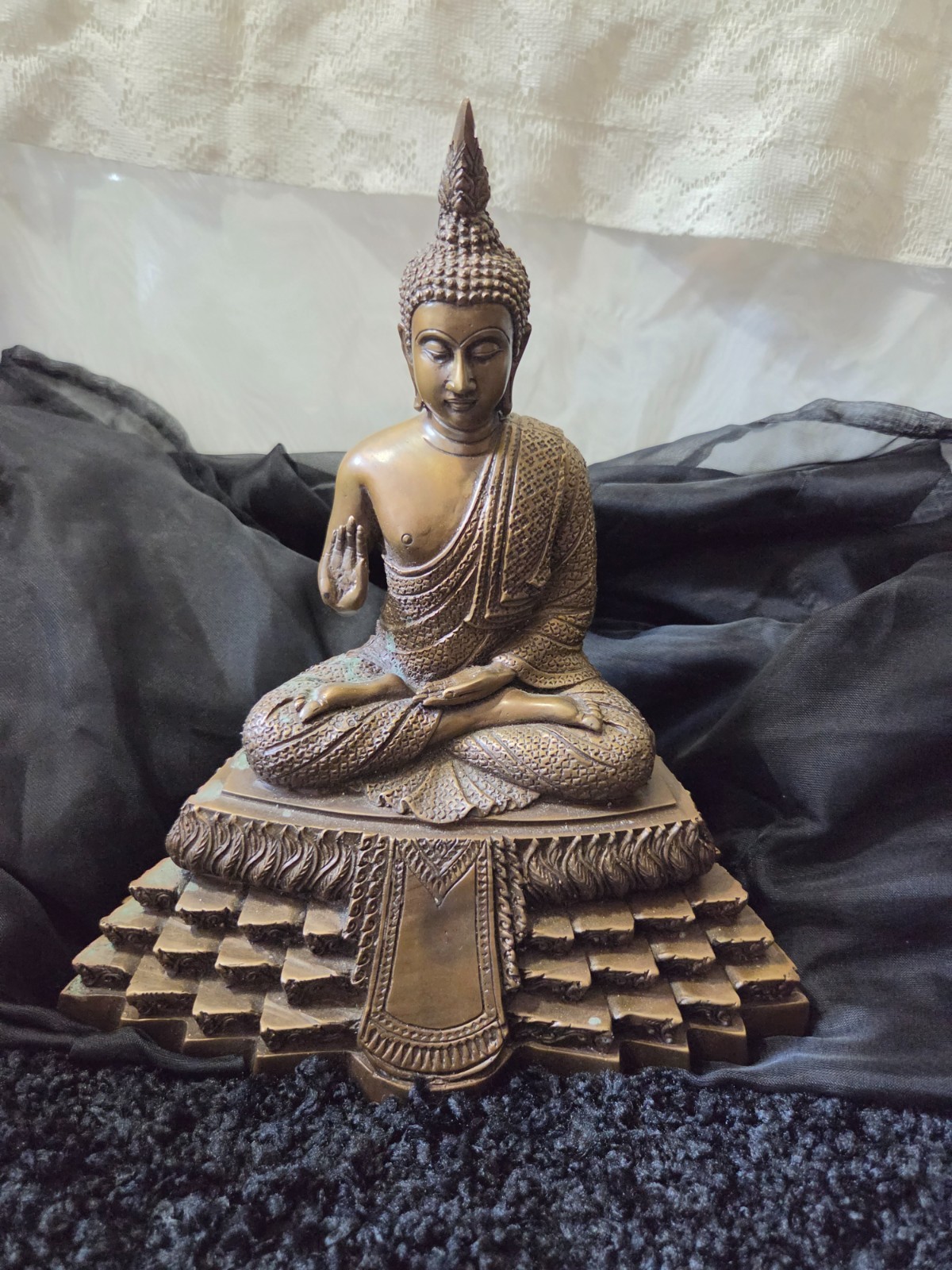
Look closely along the inner edge of the stepped pedestal in this new photo. The exposed bronze edge is comparatively smooth while the interior immediately behind it is coarse and uneven. That looks much more like an object whose visible exterior was deliberately finished after casting while the inaccessible interior was simply left as-cast. That\'s exactly what I\'d expect of a traditionally produced sculpture.
I would give roughly 60% probability to 1880–1925, 25% to 1925–1950, and 15% to post-1950.
The base is clearly open and hollow, with thick, irregularly finished metal walls. The interior surface is rough rather than smoothly machined, and there appears to be substantial dark material or accretion in the center. Traditional Southeast Asian copper-alloy figures were commonly cast around clay cores; the British Museum even documents an early Thai cast-bronze Buddha with its clay core still present. So this kind of interior construction is entirely compatible with an older hand-cast figure.
What I find more significant than the black center is the rim itself. The wall thickness varies, the internal contour does not precisely mirror the outside, and the recesses have an irregular granular texture. Those are characteristics I would expect from a hand-prepared core and investment casting rather than a modern thin-shell decorative casting. The 6.4-pound weight reinforces that interpretation.
Investigated with ChatGpt - see above - please ask any questions before offerding or buying. Measures approx 10\" tall and 9\" wide weighs approx 6.4 pounds.
Thanks for your interest and your business-
Sidewinders Crew