When you click on links to various merchants on this site and make a purchase, this can result in this site earning a commission. Affiliate programs and affiliations include, but are not limited to, the eBay Partner Network.
FAIRBAIRN–SYKES WWII BRITISH COMMANDO DAGGER
World War II Military Heritage | British Commando Design | Historical Collector\'s Knife
HISTORY OF THE FAIRBAIRN–SYKES KNIFE
The Fairbairn–Sykes Fighting Knife is among the most celebrated military dagger designs of the Second World War. Associated with the British Commandos and Allied special operations forces, it represents an important chapter in military equipment history.
The design takes its name from William Ewart Fairbairn and Eric Anthony Sykes, two British close-combat instructors who gained extensive experience while serving with the Shanghai Municipal Police in China during the 1920s and 1930s.
Their practical experience influenced the development of a specialized military fighting knife. Working with the renowned British manufacturer Wilkinson Sword, the design was refined in 1940 and introduced into British military service during World War II.
WORLD WAR II MILITARY SERVICE
The Fairbairn–Sykes dagger became closely associated with British Commando units, whose operations included raids, reconnaissance, and special missions throughout the war.
The knife was also associated with several other Allied formations, including:
British Army Commandos
British Airborne Forces
Special Air Service (SAS)
Special Operations Executive (SOE)
American Office of Strategic Services (OSS)
The dagger became particularly recognizable during the European campaigns of 1944, including the Normandy landings.
HISTORICAL KNIFE DESIGN
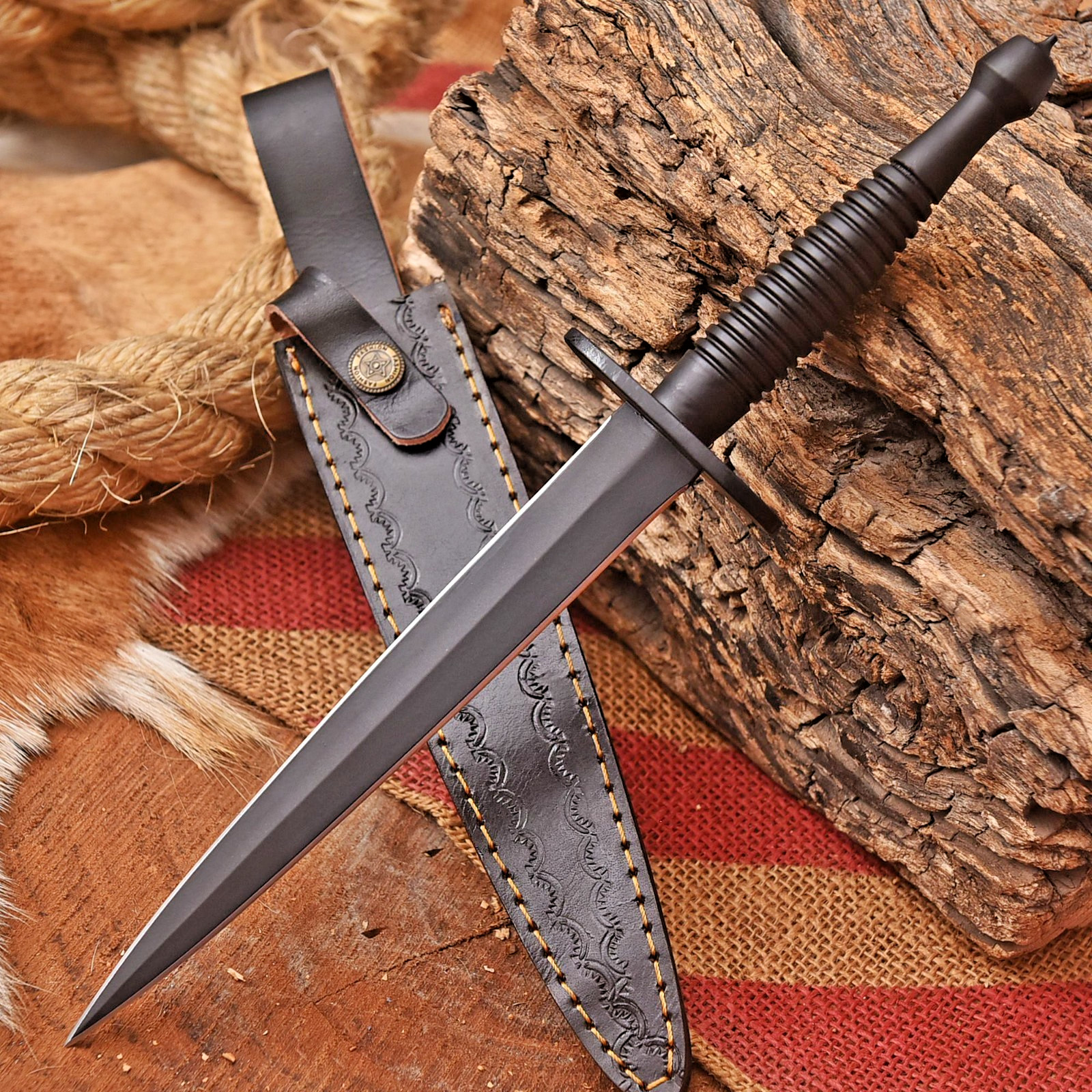
The traditional Fairbairn–Sykes dagger features a slender, symmetrical double-edged blade, a sharply tapered point, a compact crossguard, and a distinctive contoured handle.
Its elegant, balanced silhouette distinguishes it from conventional military utility knives and larger combat blades.
The original design evolved through three principal wartime production patterns:
First Pattern (1940–1941)
Early Wilkinson Sword production featuring a distinctive S-shaped crossguard and finely finished handle.
Second Pattern (1941–1943)
A revised design featuring a straighter crossguard and changes intended to simplify wartime manufacturing.
Third Pattern (1943 onward)
A more economical production design recognizable by its distinctive ringed metal handle. This became one of the most widely recognized variations.
COLLECTOR\'S SIGNIFICANCE
Today, the Fairbairn–Sykes design remains an important subject among collectors of British military history, World War II memorabilia, Commando equipment, and historical edged weapons.
Its distinctive appearance and connection to Allied military heritage have made it an enduring symbol of British Commando history.
PRODUCT DETAILS
Historical Design: Fairbairn–Sykes Fighting Knife
Historical Period: World War II
Origin of Design: Great Britain
Knife Classification: Military Dagger
Blade Profile: Symmetrical Spear Point
Blade Edge: Double Edge
Knife Construction: Fixed Blade
Historical Association: British Commandos and Allied Special Forces
Collectible Category: WWII Military Knife Reproduction
IMPORTANT PRODUCT INFORMATION
This listing is for a modern reproduction inspired by the historic Fairbairn–Sykes design, not an authenticated World War II military-issued artifact.
The historical information describes the original wartime design and should not be interpreted as a claim that this individual knife was manufactured or issued during World War II.
\"MEASUREMENTS\"
Total Length : 12.00\" inches
Blade Length : 7.50.00 inches
Hardness (HRC) : 58 to 60 Hrc
\"PAYMENT\"
MANAGED PAYMENT