When you click on links to various merchants on this site and make a purchase, this can result in this site earning a commission. Affiliate programs and affiliations include, but are not limited to, the eBay Partner Network.
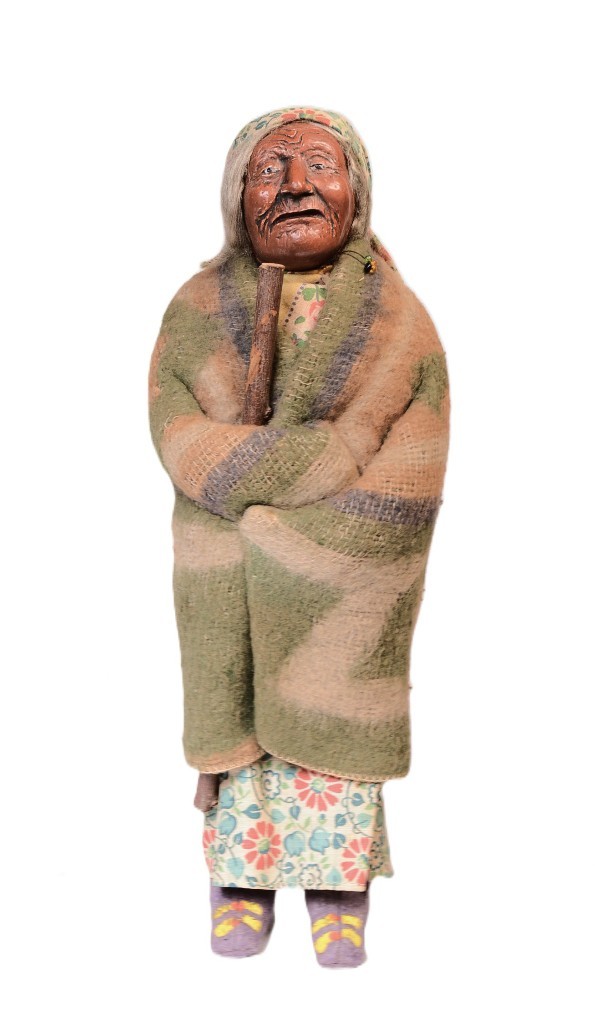
Offered byAntique American Indian Art, LLC---AAIA---Skookum Granny Doll
Early/Mid 20th Century
11.25" H x 3.375" L x 4" W
Hand Crafted Doll Adorned with Flannel, Hide Leather, Felt, Fabric, Plastic Head and Hair
with a Glass Beaded Necklace and Holding a Wood Stick from Temple TX
In Very Good Condition
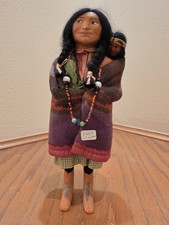
Skookum dolls are mass-produced souvenir dolls from the early 20th century, styled after Native American figures but created and manufactured by non-Native people. They became popular collectibles, often sold at tourist spots in the western United States.
231012-137
About Skookums
A very early and rare example. The earliest dolls tend to be apple headed dolls with pin eyes, but the apple almost always turns black over time. . The body is wood and feet are painted wood. The beads are late 19th to early 20th century.
A Skookum doll was a Native American themed doll, sold as a souvenir item in the early 20th century. Although considered collectible, they are not authentic Native American dolls, as they were designed and created by a white woman, and quickly mass-produced. Mary Dwyer McAboy (1876-1961), who was from Missoula, Montana, learned to carve apple head dolls as a child from her mother. According to an account by McAboy, her mother had sold apple dolls at church socials and sewing circles.
Mary Dwyer had worked as a schoolteacher before marrying Frank E. McAboy in 1909. Her husband died of tuberculosis four years later, in 1913.
Later that year, Mary McAboy began to market apple head dolls dressed in Indian costumes, and achieved rapid commercial success. According to McAboy, her career as a doll maker began when she made an Indian village which she displayed in the window of a grocery store. Vaudeville actress Fritzi Scheff was performing in Missoula at the time, saw the display, and purchased it for "actual money". McAboy duplicated the display, which also sold quickly, and she then began selling increasing numbers of the dolls. She publicized her growing business through western newspapers, and arranged a display at a women's suffrage office in New York City, gaining press coverage there.
She registered the skookum name as a trademark in 1919, as well as the “Bully Good” trademark. Through this time, the dolls were produced as a cottage industry and were individual in nature. As demand grew, she had difficulty processing large numbers of apples, as excessive moisture led to rotting. She consulted with chemists at Montana State University in an attempt to control the problem. But demand grew so rapidly that she moved to mass production techniques within a year, and soon almost all of the doll heads were made out of composition.
The Arrow Novelty Company took over the manufacturing of the dolls in 1920.Composition heads were painted with life-like facial features.They represented Indians of various tribes and were used for educational purposes in schools throughout the United States.
A product that began as women's handicraft had rapidly shifted to factory production with mostly male workers. In 1929, the H. H. Tammen Co. of Denver and Los Angeles took over production. with the distribution in the east by the Arrow Novelty Company in New York City. Starting in the 1940s, the faces were made of plastic. McAboy supervised production of the dolls until she retired in 1952.
One method of determining the production date of the dolls is by studying the footwear. For example, the earliest dolls from around 1913 had moccasins made of leather. By 1918, the mocassins were simulated with suede applied to wood, and painted designs. By 1924, they were molded of composition material, and by the 1950s, the dolls had plastic feet. Production of the dolls ended in the early 1960s.
Welcome to Matt Wood's Antique American Indian Art, LLC (AAIA) items
Please HIT "SAVE THIS SELLER" in top-right corner of listing if you want notifications of our new listings.
As the nation’s leading gallery of Antique North American Indian Art and Artifacts, we invite you to consider the beautiful art and artifacts that we list on with full confidence in the authenticity and legality of the item, in the accuracy of the listing, and in the professionalism that we demonstrate in processing each transaction.
Celebrating over 45 years in business, Matt Wood and Len Wood are founding members of ATADA (Antique Tribal Arts and Dealers Association), and we provide you, the collector, a unique opportunity to buy directly from our gallery inventory via . We offer Certificates of Authenticity, a 7-day home inspection period allowing returns for full refunds (less shipping/insurance costs), and a lifetime trade-back policy (call for details). We are confident that you will be pleased with the value, service and peace-of-mind that our gallery can offer you. Thank you for looking!
SHIPMENT
We package all items for shipment in the utmost professional manner, and all shipments are fully insured. Please read our Store Policies for all of our shipping information.
PLEASE FOLLOW US on - If you hit the FOLLOW THIS SELLER link on the top right of this listing under the Seller Information button, you will be able to get the early notices of our new additions and sales. We will be adding lots of quality Antique American Indian Art over the next few months.