When you click on links to various merchants on this site and make a purchase, this can result in this site earning a commission. Affiliate programs and affiliations include, but are not limited to, the eBay Partner Network.
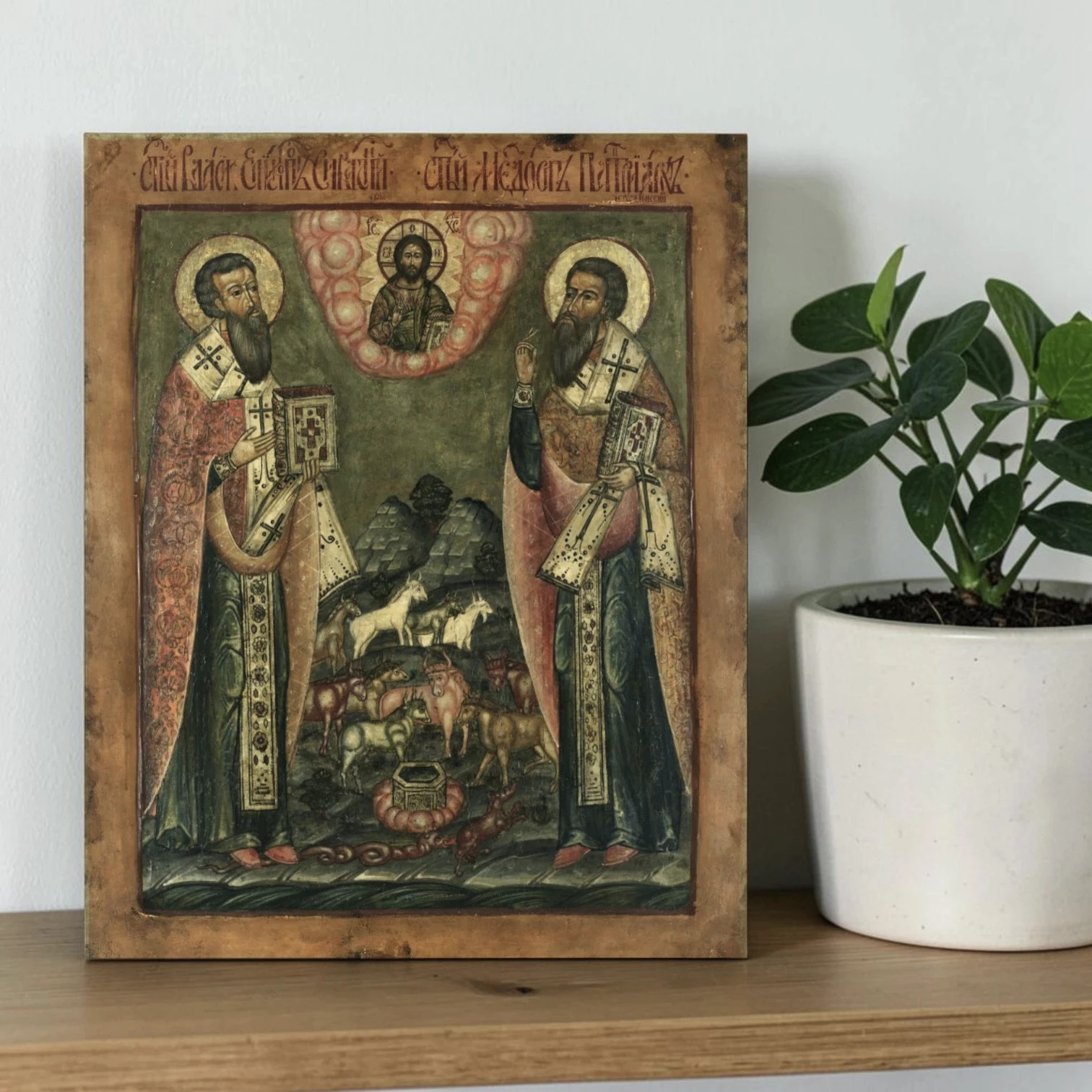
Icon of Saint Blasius (Blaise) and Saint Modestus
30x39 cm (12"x15") | Orthodox Christian Icon | Wooden Wall Hanging
🕊
Venerate this rare and deeply beloved double icon depicting two of the greatest healer-saints of the Christian tradition: Saint Blasius (Blaise), Bishop and Martyr of Sebastea, and Saint Modestus (Modest), Patriarch of Jerusalem — two holy men whose lives were united by an extraordinary compassion for all of God's creation, both human and animal, and whose powerful intercession the faithful have sought for centuries in times of illness, danger, and need.
Together on this sacred icon, these two saints form a uniquely powerful pair of intercessors — one revered in East and West as the healer of human throats, the other beloved throughout the Orthodox world as the miraculous protector and healer of animals. Their shared presence on a single icon is a profound testimony to the fullness of God's mercy, which extends over all living creatures.
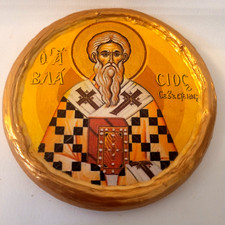
Saint Blasius (Blaise) — Bishop, Martyr & Healer of Throats
Blaise studied philosophy as a young man and was a respected physician in Sebaste, Armenia, his hometown. Following the death of the city's bishop, he was elected as his successor by the popular acclaim of all the people.
Although the Edict of Toleration, granting freedom of worship in the Roman Empire, was already five years old, persecution still raged in Armenia. Blaise was apparently forced to flee to the back country. There he lived as a hermit in solitude and prayer, but he made friends with the wild animals. One day a group of hunters seeking wild animals stumbled upon Blaise's cave. The bishop was kneeling in prayer, surrounded by patiently waiting wolves, lions, and bears.
As the hunters hauled Blaise off to prison, a mother came with her young son who had a fish bone lodged in his throat and was near death. At Blaise's command the child was able to cough up the bone, and the boy's life was saved.This single miraculous act established Saint Blasius forever as the supreme intercessor for all who suffer from ailments of the throat.
According to tradition, after being torn with wool combers' irons, Blaise was beheaded around the year 316. He is venerated as the patron saint of sufferers from throat diseases and of wool combers, and as one of the Fourteen Holy Helpers — a group of saints conjointly revered for the power of their intercession.
Blaise's cult spread throughout Christendom from the 8th century, and many churches — such as the famous church in Dubrovnik, Croatia, of which he is the patron saint — are dedicated to him.In iconography, Saint Blasius is typically depicted holding two crossed candles — the symbol of his most beloved tradition.
The Blessing of Throats — A Living Tradition
In many places on the day of his feast, the Blessing of St. Blaise is given: two candles, blessed on the feast of the Presentation of the Lord (Candlemas), are held in the form of a cross by a priest over the heads of the faithful, or the people are touched on the throat with them, while the following blessing is given: "Through the intercession of Saint Blaise, bishop and martyr, may God deliver you from every disease of the throat and from every other illness."
Saint Blaise said that anyone who lit a candle in his memory would be free of infection — thus candles became the enduring symbol of his intercession and his feast day celebration.
Saint Modestus — Patriarch of Jerusalem & Protector of Animals
Saint Modestus was only five months old when his parents died, but, by God's Providence, he was brought up in a Christian spirit. When he was grown up, he was sold as a slave to a pagan in Egypt, but he succeeded in bringing his owner to the Christian faith, and was freed by him. He withdrew to Mount Sinai, where he lived in asceticism.
He became head of the monastery of St. Theodosius the Great in Palestine. At this time, in the year 614, military forces of the Persian ruler Chosroes fell upon Syria and Palestine, killing ninety thousand Christians and destroying Christian churches. Patriarch Zacharias of Jerusalem and a multitude of Christians were taken into captivity along with the Cross of the Lord.
St. Modestus was entrusted to govern the Jerusalem Church temporarily. With the help of Patriarch John the Merciful of Alexandria, St. Modestus set about restoring devastated Christian shrines, among which was the Sepulchre of the Lord. He reverently buried the murdered monks from the monastery of St. Sava the Sanctified. After fourteen years, Patriarch Zacharias returned from captivity with the Cross of the Lord, and after his death St. Modestus became Patriarch of Jerusalem. St. Modestus died at age 97 in the year 634.
His great love extended to all of creation, to all the creations of God, which is why he wrote prayers for the protection of animals and for their healing from various illnesses. These prayers are available in the Small Euchologion of the Church and are read by priests when they are invited by farmers for this purpose.
The Miracle of the Oxen — Why St. Modestus Is the Patron of Animals
When the oxen belonging to a poor widow became ill, she asked the holy unmercenaries Saints Cosmas and Damian to heal them. They appeared to her in a dream and told her that it wasn't given to them to heal animals, but that she should seek help from Bishop Modestus of Jerusalem.
While she was seeking Bishop Modestus, she encountered him in a dream. He told her to have a cross made from a portion of iron taken from her tools. The next day, when the Divine Liturgy was being served, she must dip the cross in oil and anoint her oxen in the name of Christ. She followed the saint's instructions, and her oxen were healed.It is for this miracle that Saint Modestus has been venerated as the supreme patron and healer of animals throughout the Orthodox world for more than thirteen centuries.
Saint Modestus prayed that whoever celebrated his memory would have God's blessing and that diseases would not touch their animals.
What Do Christians Pray for Through This Icon?
This double icon unites the gifts of both saints into one powerful act of prayer. The faithful turn to Saints Blasius and Modestus for:
- 🤒 Throat illnesses, tonsillitis, laryngitis, and choking — Saint Blasius is the supreme intercessor for all diseases of the throat, neck, and voice
- 🐄 Sick or injured livestock, farm animals, and pets — Saint Modestus is the great Orthodox protector of all animals; farmers, shepherds, and pet owners invoke him fervently
- 🐾 Protection of animals from evil, disease, and accident — both saints are known to have healed and protected animals through miraculous intervention
- 🏥 General healing and recovery from illness — as physicians of body and soul, both saints intercede for the gravely ill
- 🌾 Blessing of farms, homesteads, and agricultural work — on the feast of St. Modestus, priests are invited by farmers to read the saint's prayer and the faithful take holy water from the celebrated church to sprinkle upon their animals
- 💪 Courage in persecution and adversity — Saint Blasius faced torture and death with unshakeable faith, making him a patron of all who suffer for the truth
- 🙏 Protection of children — Saint Blasius saved a dying child; parents invoke him for the health and protection of their little ones
- ⛪ Restoration and rebuilding — Saint Modestus rebuilt the Holy Sepulchre and the churches of Jerusalem; he is invoked for the renewal and protection of sacred places
Feast Days
- 🗓️ Saint Blasius (Blaise): February 3 in the Western (Catholic) Church; February 11 in the Eastern Orthodox Church
- 🗓️ Saint Modestus: December 17 in the Catholic Church; December 16 in the Eastern Orthodox Church (Palestinian-Georgian calendar)
🖼 ProductFeatures
Each icon in our workshop is made to last a lifetimeand beyond. The image is printed with rich, fade-resistant pigment inks on apremium solid-core wood panel — then hand-finished with a natural beeswaxcoating that deepens the colors, protects the surface, and gives each piece thewarm, reverent quality of a traditionally crafted sacred object. A metalhanging hook is included on the back, so your icon is ready to display themoment it arrives.
- Craftedon a premium wood panel — 1.6 cm (0.6") thick, sturdy yet print — rich, true-to-life colors that last for generations
- Naturalbeeswax finish — hand-applied for depth, protection, and a traditional feel
- Readyto hang — metal hook pre-attached on the reverse
- Hand-finished byOrthodox Christian artisans in Portugal
AVAILABLE SIZES — CHOOSE YOUR PERFECT FIT Small — 12 × 15 cm / 5" × 6" — ideal for a personal prayer corner, desk, or gift
Medium — 23 × 30 cm / 9" × 12" — the most popular choice for home display
Large — 30 × 39 cm / 12" × 15" — a statement piece for any wall or altar spaceTHE PERFECT GIFT FOR ANY SACRED OCCASIONAn Orthodox icon is not simply a decorative object — it is a blessing for the home and a window into the Kingdom of Heaven. This icon makes a deeply meaningful gift for: Baptisms and Chrismations
Name days and feast days
Weddings and anniversaries
Housewarmings and new home blessings
Christmas, Easter, and other major Orthodox feasts
Anyone in need of comfort, prayer, or heavenly intercessionWORLDWIDE DELIVERY FROM PORTUGALEvery order is carefully packed to protect the icon during transit and shipped worldwide with full tracking. We take great care with every package — your icon will arrive safely and ready to treasure.MADE WITH FAITH, CRAFTED WITH CAREOur icons are made in Portugal by Orthodox Christian artisans who approach each piece as an act of devotion as much as craft. From the selection of the wood panel to the final application of beeswax by hand, every step is carried out with the intention that this icon will become a lasting blessing — in your home, or in the home of someone you love.We are proud to bring the living tradition of Orthodox Christian iconography to homes around the world.💬 Have a question? Feel free to reach out!
🕊️ Visit our shop for more icons and devotional pieces. The name of this icon in different languages⬅️
- Chinese (Simplified):
- Czech: Ikona svatého Blažeje (Blaise) a svatého Modesta
- Danish: Ikon af den hellige Blasius (Blaise) og den hellige Modestus
- Dutch: Icoon van de heilige Blasius (Blaise) en de heilige Modestus
- English: Icon of Saint Blasius (Blaise) and Saint Modestus
- Estonian: Püha Blasiuse (Blaise) ja püha Modestuse ikoon
- Finnish: Pyhän Blasiuksen (Blaise) ja pyhän Modestuksen ikoni
- French: Icône de saint Blaise (Blaisius) et saint Modeste
- German: Ikone des heiligen Blasius (Blasius/Blaise) und des heiligen Modestus
- Greek: Εικόνα του Αγίου Βλασίου και του Αγίου Μοδέστου
- Italian: Icona di san Biagio (Blaise) e san Modesto
- Japanese:
- Latvian: Svētā Blāzija (Blaise) un svētā Modesta ikona
- Lithuanian: Šventojo Blazėjaus (Blaise) ir šventojo Modesto ikona
- Norwegian: Ikon av den hellige Blasius (Blaise) og den hellige Modestus
- Polish: Ikona świętego Błażeja i świętego Modesta
- Portuguese: Ícone de São Brás (Blaise) e São Modesto
- Romanian: Icoana sfântului Vlasie (Blaise) și a sfântului Modest
- Russian: Икона святого Власия (Власия/Власия Севастийского) и святого Модеста
- Serbian: Икона светог Власија и светог Модеста
- Slovak: Ikona svätého Blažeja a svätého Modesta
- Slovenian: Ikona svetega Blaža in svetega Modesta
- Spanish: Icono de San Blas (Blaise) y San Modesto
- Swedish: Ikon av den helige Blasius (Blaise) och den helige Modestus
- Ukrainian: Ікона святого Власія та святого Модеста