When you click on links to various merchants on this site and make a purchase, this can result in this site earning a commission. Affiliate programs and affiliations include, but are not limited to, the eBay Partner Network.
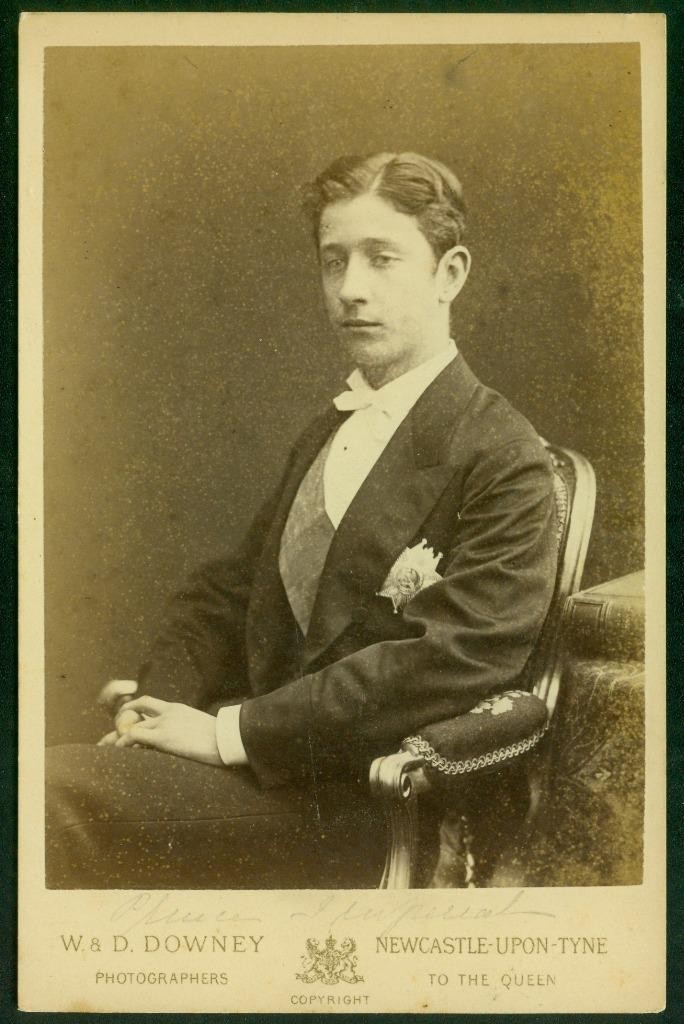
S11, 307-02, 1870s, Cabinet Card, Prince Louis Napoleon Bonaparte (1856-1879) S11, 307-02, 1870s, Cabinet Card, Prince Louis Napoleon Bonaparte (1856-1879)
Click images to enlarge
Description You are offerding on an original Antique 1870's Cabinet Card Photograph, Prince Louis Napoleon Bonaparte (1856-1879), about 17 years old.
See image 3 for the Prince's Family tree.
To see all of my "Stereoview Cards" click here.
To see all of my historical "Cabinet Cards" click here.
More Info:
Napoléon, Prince Imperial (Napoléon Eugène Louis Jean Joseph Bonaparte; 16 March 1856 – 1 June 1879), also known as Louis-Napoléon, was the only child of Napoleon III, Emperor of the French, and Empress Eugénie. After his father was dethroned in 1870, he moved to England with his family. On his father's death in January 1873, he was proclaimed by the Bonapartist faction as Napoléon IV.
In England, he trained as a British Army officer. Keen to see action, he persuaded the British to allow him to participate in the Anglo-Zulu War. In 1879, serving with British forces, he was killed in a skirmish with a group of Zulus. His early death caused an international sensation and sent shockwaves throughout Europe, as he was the last serious dynastic hope for the restoration of the House of Bonaparte to the throne of France.
Louis-Napoléon was born at the Tuileries Palace in Paris, and he was baptised on 14 June 1856 at Notre Dame Cathedral. His godfather was Pope Pius IX, whose representative, Cardinal Patrizi, officiated. His godmother was Eugène de Beauharnais's daughter, Josephine, the Queen of Sweden, who was represented by Grand Duchess Stéphanie of Baden. (ref. Wikipedia)
French honours
- Knight Grand Cross of the Legion of Honour
Foreign honours
- Austrian Empire: Grand Cross of the Order of St. Stephen, 1865
- Denmark: Knight of the Order of the Elephant, 11 March 1865
- Mexican Empire:
- Grand Cross of the Order of Guadalupe, 1864
- Grand Cross of the Order of the Mexican Eagle, 1865
- Kingdom of Portugal:
- Grand Cross of the Order of the Tower and Sword, 1861
- Grand Cross of the Sash of the Two Orders, 1865
- Russian Empire: Knight of the Order of St. Andrew the First-called, 30 May 1865.
- Kingdom of Sardinia: Knight of the Order of the Annunciation, 20 February 1859
- Kingdom of Saxony: Knight of the Order of the Rue Crown, 1857
- Spain: Knight of the Order of the Golden Fleece, 30 March 1856
- Sweden-Norway: Knight of the Royal Order of the Seraphim, 14 June 1856
Back has Photographer info.
Photographer: W. & D. Downey of London, England (1829-1915)
More Info:
William Downey (14 July 1829 in South Shields — 7 July 1915 in Kensington), who came to be known as the Queen's Photographer, was born in King Street in South Shields, a decade before commercial photography had become a reality. William, initially, was a carpenter and boatbuilder, but in about 1855 he set up a studio in South Shields with his brother Daniel Downey ( 1831 – 15 July 1881) and later established branches in Blyth, Morpeth and Newcastle. Their first Royal commission was to provide photographs for Queen Victoria of the Hartley Colliery Disaster in January 1862.
In 1863 they opened a studio at 9, Eldon Square in Newcastle, in a building that was demolished in 1973. The same year William set up a studio in the Houses of Parliament and produced portraits of every parliamentarian of the day. The resulting images' location is unknown to this day.
For more info, click here.
Card size: 4.25" x 6.5". #S11, 307-02
The Cabinet Card was a style of photograph which was widely used for photographic portraiture after 1870. It consisted of a thin photograph mounted on a card typically measuring 108 by 165 mm (4+1⁄4 by 6+1⁄2 inches).
The carte de visite was displaced by the larger cabinet card in the 1880s. In the early 1860s, both types of photographs were essentially the same in process and design. Both were most often albumen prints, the primary difference being the cabinet card was larger and usually included extensive logos and information on the reverse side of the card to advertise the photographer’s services. However, later into its popularity, other types of papers began to replace the albumen process. Despite the similarity, the cabinet card format was initially used for landscape views before it was adopted for portraiture.
Some cabinet card images from the 1890s have the appearance of a black-and-white photograph in contrast to the distinctive sepia toning notable in the albumen print process. These photographs have a neutral image tone and were most likely produced on a matte collodion, gelatin or gelatin bromide paper.
Sometimes images from this period can be identified by a greenish cast. Gelatin papers were introduced in the 1870s and started gaining acceptance in the 1880s and 1890s as the gelatin bromide papers became popular. Matte collodion was used in the same period. A true black-and-white image on a cabinet card is likely to have been produced in the 1890s or after 1900. The last cabinet cards were produced in the 1920s, even as late as 1924.
Owing to the larger image size, the cabinet card steadily increased in popularity during the second half of the 1860s and into the 1870s, replacing the carte de visite as the most popular form of portraiture. The cabinet card was large enough to be easily viewed from across the room when typically displayed on a cabinet, which is probably why they became known as such in the vernacular. However, when the renowned Civil War photographer Mathew Brady first started offering them to his clientele towards the end of 1865, he used the trademark "Imperial Carte-de-Visite." Whatever the name, the popular print format joined the photograph album as a fixture in the late 19th-century Victorian parlor. (ref. Wikipedia)
If you have any questions about this item or anything I am saleing, please let me know.
The Last 3 Images are for Information Only
Card Cond: VG-VG/EX (some wear), Please see scans for actual condition.
This Cabinet Card would make a great addition to your collection or as a Gift (nice for Framing).
Visit My store
Please checkout my newest Collections with FREE S&H
Please checkout my 1880's Baseball Victorian Trade cards in my store
Please checkout my 1870's Baseball Tintypes in my store
Please checkout my Movie Glass Slides in my store
Please checkout my NASA Items in my store
To see all my Postcards
To see all my Movie Items
To see all my Disney Items
To see all my Baseball Items
To see all my Boy Scout Cards
To see all my Stereoview Cards
Add me to your Favorite Sellers and Sign up for my NewsletterThis Item will be shipped securely. I will combine lots to save on the shipping costs and I use USPS Ground Advantage (the old 1st class) shipping (it gives both of us tracking of the package).
Please look at my other sales for more Collectibles of the 1800's-1900's. Get images that
make Supersized seem small.Showcase your items with Auctiva's
Listing Templates!
THE simple solution for sellers.
Track Page Views With
Auctiva's Counter