When you click on links to various merchants on this site and make a purchase, this can result in this site earning a commission. Affiliate programs and affiliations include, but are not limited to, the eBay Partner Network.
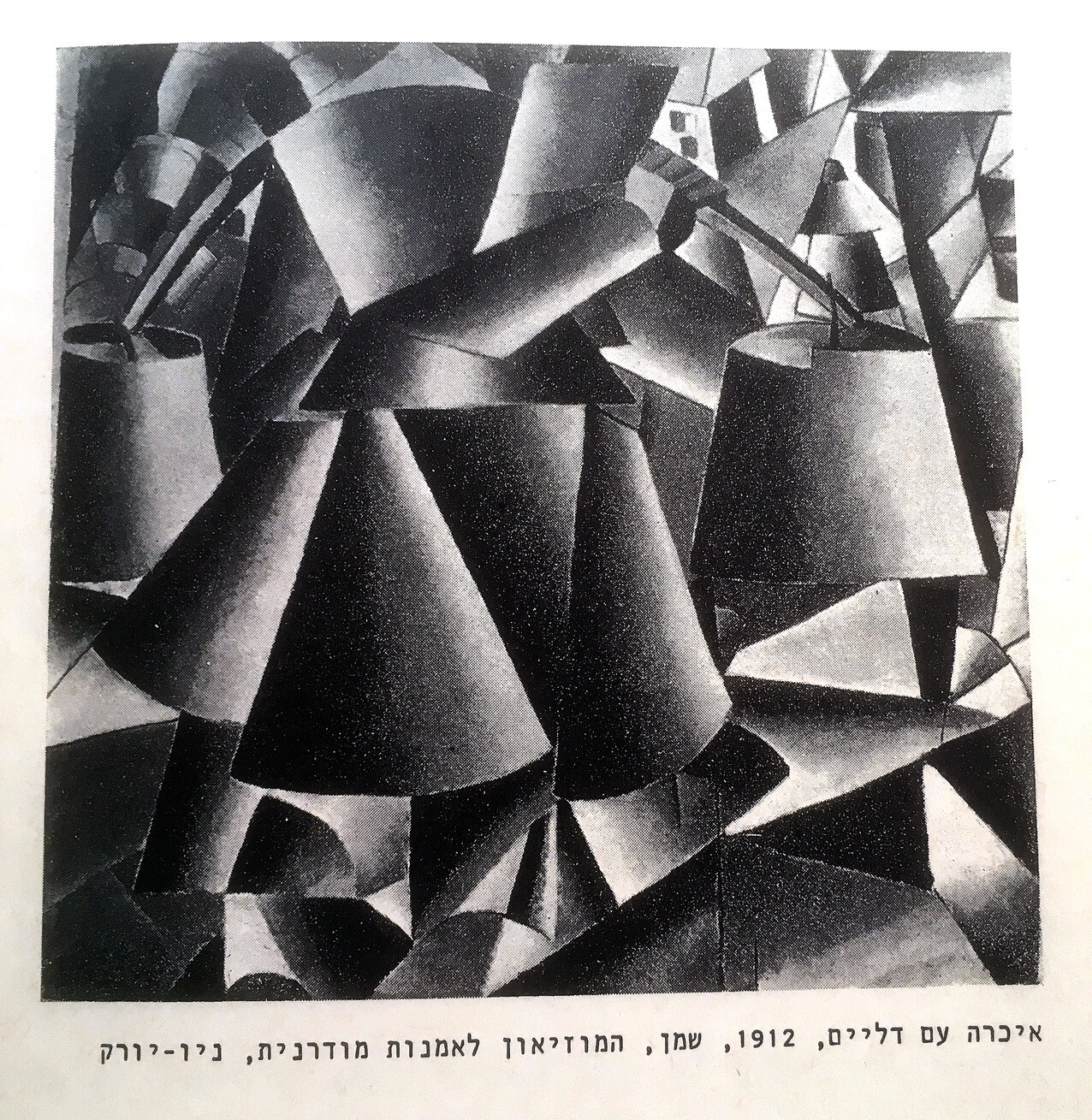
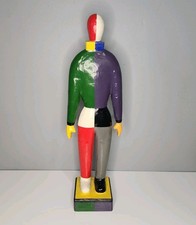
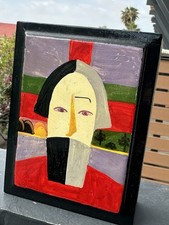
DESCRIPTION : Up for sale is an ILLUSTRATED CATALOGUE of an exhibition which was held in 1975 in the ISRAEL MUSEUM in Jerusalem Israel on the subjest : \" The GRAPHIC WORK of KAZIMIR MALEVICH 1913-1930\" . The HEBREW catalogue is RICHLY ILLUSTRATED with samples of MALEVICH Avant-Garde GRAPHIC ART . Original ILLUSTRATED WRAPPERS . 7\" x 8.5\". 24 throughout illustated unpaged pp of heavy stock. Very good used condition. Tightly bound. Cover slightly faded at margins( Pls look at scan for accurate AS IS images ) Will be sent inside aprotective packaging .
PAYMENTS : Payment method accepted : Paypal& All credit cards.
SHIPPMENT : SHIPP worldwide via registered airmail is $ 35 . Book will be sent inside aprotective packaging . Will be sent around 5-10 days after payment .
Kazimir Severinovich Malevich[nb 1](23 February[O.S.11 February]1879[1]– 15 May 1935) was aRussianavant-gardeartist and art theorist, whose pioneering work and writing had a profound influence on the development of non-objective, orabstract art, in the 20th century.[2][3][4][5]Born inKievto an ethnicPolishfamily, his concept ofSuprematismsought to develop a form of expression that moved as far as possible from the world of natural forms (objectivity) and subject matter in order to access \"the supremacy of pure feeling\"[6]and spirituality.[7][8]Malevich is considered to be part of theUkrainian avant-garde(together withAlexander Archipenko,Vladimir Tatlin,Sonia Delaunay,Aleksandra Ekster, andDavid Burliuk) that was shaped by Ukrainian-born artists who worked first in Ukraine and later over a geographical span between Europe and America.[9][10]Early on, Malevich worked in a variety of styles, quickly assimilating the movements ofImpressionism,SymbolismandFauvism, and after visiting Paris in 1912,Cubism. Gradually simplifying his style, he developed an approach with key works consisting of puregeometricforms and their relationships to one another, set against minimal grounds. HisBlack Square(1915), a black square on white, represented the most radically abstract painting known to have been created so far[11]and drew \"an uncrossable line (…) between old art and new art\";[12]Suprematist Composition:White on White(1918), a barely differentiated off-white square superimposed on an off-white ground, would take his ideal of pure abstraction to its logical conclusion.[13]In addition to his paintings, Malevich laid down his theories in writing, such as \"From Cubism and Futurism to Suprematism\" (1915)[14]andThe Non-Objective World: The Manifesto of Suprematism(1926).[15][16]Malevich\'s trajectory in many ways mirrored the tumult of the decades surrounding theOctober Revolution(O.S.) in 1917.[17]In its immediate aftermath, vanguard movements such as Suprematism andVladimir Tatlin\'sConstructivismwere encouraged byTrotskyitefactions in the government. Malevich held several prominent teaching positions and received a solo show at the Sixteenth State Exhibition in Moscow in 1919. His recognition spread to the West with solo exhibitions in Warsaw and Berlin in 1927. From 1928 to 1930, he taught at the Kyiv Art Institute, withAlexander Bogomazov,Victor Palmov,Vladimir Tatlinand published his articles in a Kharkiv magazine,Nova Generatsia(New Generation).[18]But the start of repression in Ukraine against the intelligentsia forced Malevich return to modern-daySaint Petersburg. From the beginning of the 1930s, modern art was falling out of favor with the new government ofJoseph Stalin. Malevich soon lost his teaching position, artworks and manuscripts were confiscated, and he was banned from making art.[19][20]In 1930, he was imprisoned for two months due to suspicions raised by his trip to Poland and Germany. Forced to abandon abstraction, he painted in a representational style in the years before his death from cancer in 1935, at the age of 56.Nonetheless, his art and his writing influenced contemporaries such asEl Lissitzky,Lyubov PopovaandAlexander Rodchenko, as well as generations of later abstract artists, such asAd Reinhardtand theMinimalists. He was celebrated posthumously in major exhibits at theMuseum of Modern Art(1936), theGuggenheim Museum(1973) and theStedelijk Museumin Amsterdam (1989), which has a large collection of his work. In the 1990s, the ownership claims of museums to many Malevich works began to be disputed by his heirs.[20]Contents1 Early life2 Artistic career3 Suprematism4 Post-revolution5 International recognition and banning6 Death7 Polish ethnicity8 Posthumous exhibitions9 Collections10 Art market11 In popular culture12 Selected works12.1 Gallery13 See also14 Footnotes15 Citations15.1 References16 External linksEarly life[edit]Kazimir Malevich, c.1900Kazimir Malevich[21]was born Kazimierz Malewicz to aPolishfamily,[22][23][24]who settled nearKyivinKiev Governorateof theRussian Empireduring thepartitions of Poland.[19]His parents, Ludwika and Seweryn Malewicz, wereRoman Catholiclike most ethnic Poles,[2]though his father attended Orthodox services as well.[25]They both had fled from the former eastern territories of the Commonwealth (present-day Kopyl Region ofBelarus) to Kyiv in the aftermath of the failed PolishJanuary Uprising of 1863against the tsarist army.[26]His native language was Polish, but he also spoke Russian,[27]as well as Ukrainian due to his childhood surroundings.[28]Malevich would later write a series of articles in Ukrainian about art.[25]Kazimir\'s father managed a sugar factory. Kazimir was the first of fourteen children,[19]only nine of whom survived into adulthood. His family moved often and he spent most of his childhood in the villages of modern-day Ukraine, amidst sugar-beet plantations, far from centers of culture. Until age twelve, he knew nothing of professional artists, although art had surrounded him in childhood. He delighted in peasant embroidery, and in decorated walls and stoves. He was able to paint in the peasant style. He studied drawing in Kyiv from 1895 to 1896.Artistic career[edit]Party, 1908The Knifegrinder, 1912Black Square, 1915, oil on linen, 79.5 × 79.5 cm,Tretyakov Gallery,Moscow[29]From 1896 to 1904, Kazimir Malevich lived inKursk. In 1904, after the death of his father, he moved toMoscow. He studied at theMoscow School of Painting, Sculpture, and Architecturefrom 1904 to 1910 and in the studio ofFedor Rerbergin Moscow. In 1911, he participated in the second exhibition of the group,Soyuz Molodyozhi(Union of Youth) inSt. Petersburg, together withVladimir Tatlinand, in 1912, the group held its third exhibition, which included works byAleksandra Ekster, Tatlin, and others. In the same year, he participated in an exhibition by the collective,Donkey\'s Tailin Moscow. By that time, his works were influenced byNatalia GoncharovaandMikhail Larionov, Russian avant-garde painters, who were particularly interested in Russian folk art calledlubok. Malevich described himself as painting in a \"Cubo-Futurist\" style in 1912.[30]In March 1913, a major exhibition ofAristarkh Lentulov\'s paintings opened in Moscow. The effect of this exhibition was comparable with that ofPaul Cézannein Paris in 1907, as all the main Russian avant-garde artists of the time (including Malevich) immediately absorbed thecubistprinciples and began using them in their works. Already in the same year, theCubo-Futuristopera,Victory Over the Sun, with Malevich\'s stage-set, became a great success. In 1914, Malevich exhibited his works in theSalon des Indépendantsin Paris together withAlexander Archipenko,Sonia Delaunay,Aleksandra Ekster, andVadim Meller, among others.[citation needed]Malevich also co-illustrated, withPavel Filonov,Selected Poems with Postscript, 1907–1914byVelimir Khlebnikovand another work by Khlebnikov in 1914 titledRoar! Gauntlets, 1908–1914, withVladimir Burliuk.[31][32]Later in that same year, he created a series of lithographs in support of Russia\'s entry into WWI. These prints, accompanied by captions byVladimir Mayakovskyand published by the Moscow-based publication houseSegodniashnii Lubok(Contemporary Lubok), on the one hand show the influence of traditional folk art, but on the other are characterised by solid blocks of pure colours juxtaposed in compositionally evocative ways that anticipate his Suprematist work.[33]In 1911, Brocard & Co. produced an eau de cologne calledSeverny. Malevich conceived the advertisement and design of the perfume bottle withcraquelureof an iceberg and a polar bear on the top, which lasted through the works by Malevich at the0.10 Exhibition, Petrograd, 1915Супрематизм» Suprematism, oil on canvas, 1915Russian MuseumIn 1915, Malevich laid down the foundations ofSuprematismwhen he published his manifesto,From Cubism to Suprematism. In 1915–1916, he worked with other Suprematist artists in a In 1916–1917, he participated in exhibitions of theJack of Diamondsgroup in Moscow together withNathan Altman,David Burliuk,Aleksandra Eksterand others. Famous examples of his Suprematist works includeBlack Square(1915)[35]andWhite On White(1918).Malevich exhibited his firstBlack Square, now at theTretyakov Galleryin Moscow, at theLast Futurist Exhibition 0,10in Petrograd (Saint Petersburg) in 1915.[30]A black square placed against the sun appeared for the first time in the 1913 scenic designs for theFuturistoperaVictory over the Sun.[30]The secondBlack Squarewas painted around 1923. Some believe that the thirdBlack Square(also at the Tretyakov Gallery) was painted in 1929 for Malevich\'s solo exhibition, because of the poor condition of the 1915 square. One moreBlack Square, the smallest and probably the last, may have been intended as a diptych together with theRed Square(though of smaller size) for the exhibition Artists of the RSFSR: 15 Years, held in Leningrad (1932). The two squares, Black and Red, were the centerpiece of the show. This last square, despite the author\'s note1913on the reverse, is believed to have been created in the late twenties or early thirties, for there are no earlier mentions of it.[36]In 1918, Malevich decorated a play,Mystery-Bouffe, byVladimir Mayakovskiyproduced byVsevolod Meyerhold. He was interested inaerial photographyandaviation, which led him toabstractionsinspired by or derived fromaerial landscapes.[37]Some Ukrainian authors argue that Malevich\'s Suprematism is rooted in the traditional Ukrainian Composition:White on White,1918,Museum of Modern Art, New YorkAfter theOctober Revolution(1917), Malevich became a member of the Collegium on the Arts ofNarkompros, the Commission for the Protection of Monuments and the Museums Commission (all from 1918–1919). He taught at theVitebskPractical Art School inBelarus(1919–1922) alongsideMarc Chagall,[40]theLeningrad Academy of Arts(1922–1927), the Kyiv Art Institute (1928–1930),[41]and the House of the Arts in Leningrad (1930). He wrote the bookThe World as Non-Objectivity, which was published inMunichin 1926 and translated into English in 1959. In it, he outlines his Suprematist theories.In 1923, Malevich was appointed director of Petrograd State Institute of Artistic Culture, which was forced to close in 1926 after a Communist party newspaper called it \"a government-supported monastery\" rife with \"counterrevolutionary sermonizing and artistic debauchery.\" The Soviet state was by then heavily promoting an idealized, propagandistic[42]style of art calledSocialist Realism—a style Malevich had spent his entire career repudiating. Nevertheless, he swam with the current, and was quietly tolerated by the Communists.[43]International recognition and banning[edit]Boy, oil on canvas, 1928/1929In 1927, Malevich traveled toWarsawwhere he was given a hero\'s welcome.[23]There, he met with artists and former studentsWładysław StrzemińskiandKatarzyna Kobro, whose own movement, Unism, was highly influenced by Malevich.[44]He held his first foreign exhibit in theHotel Polonia Palace.[45]From there, the painter ventured on toBerlinandMunichfor a retrospective which finally brought him international recognition. He arranged to leave most of the paintings behind when he returned to the Soviet Union. Malevich\'s assumption that a shifting in the attitudes of theSoviet authoritiestoward themodernistart movement would take place after the death ofVladimir LeninandLeon Trotsky\'s fall from power was proven correct in a couple of years, when the government ofJoseph Stalinturned against forms of abstraction, considering them a type of \"bourgeois\" art, that could not express social realities. As a consequence, many of his works were confiscated and he was banned from creating and exhibiting similar art.In autumn 1930, he was arrested interrogated by theKGBin Leningrad, accused of Polish espionage, and threatened with execution. He was released from imprisonment In early December.[28][46]Critics derided Malevich\'s art as a negation of everything good and pure: love of life and love of nature. The Westernizer artist and art historianAlexandre Benoiswas one such critic. Malevich responded that art can advance and develop for art\'s sake alone, saying that \"art does not need us, and it never did\".Death[edit]Sensation of an imprisoned man, oil on canvas,1930–31When Malevich died ofcancerat the age of fifty-seven, in Leningrad on 15 May 1935, his friends and disciples buried his ashes in a grave marked with a black square. They didn\'t fulfill his stated wish to have the grave topped with an \"architekton\"—one of his skyscraper-likemaquettesof abstract forms, equipped with atelescopethrough which visitors were to gaze atJupiter.[47]On his deathbed, Malevich had been exhibited with theBlack Squareabove him, and mourners at his funeral rally were permitted to wave a banner bearing a black square.[43]Malevich had asked to be buried under an oak tree on the outskirts ofNemchinovka, a place to which he felt a special bond.[48]His ashes were sent to Nemchinovka, and buried in a field near hisdacha. Nikolai Suetin, a friend of Malevich\'s and a fellow artist, designed a white cube with a black square to mark the burial site. The memorial was destroyed duringWorld War II. The city of Leningrad bestowed a pension on Malevich\'s mother and daughter.In 2013, an apartment block was built on the place of the tomb and burial site of Kazimir Malevich. Another nearby monument to Malevich, put up in 1988, is now also situated on the grounds of agated community.[48]Polish ethnicity[edit]Girl with a Comb in her Hair, 1933, oil on canvas,Tretyakov GalleryMalevich\'s family was one of the millions ofPoles who lived within the Russian Empirefollowing thePartitions of Poland. Kazimir Malevich was born nearKyiv[19]on lands that had previously been part of thePolish–Lithuanian Commonwealth[49]of parents who were ethnicPoles.[2]Both Polish and Russian were native languages of Malevich,[50]who would sign his artwork in thePolishform of his name asKazimierz Malewicz.[51]In a visa application to travel to France, Malewicz claimedPolishas his nationality.[49]French art historianAndrei Nakov, who re-established Malevich\'s birth year as 1879 (and not 1878), has argued for restoration of the Polish spelling of Malevich\'s name.In 1985, Polish performance artist Zbigniew Warpechowski performed \"Citizenship for a Pure Feeling of Kazimierz Malewicz\" as an homage to the great artist and critique of Polish authorities that refused to grant Polish citizenship to Kazimir Malevich.[52]In 2013, Malevich\'s family inNew York Cityand fans founded the not-for-profitThe Rectangular Circle of Friends of Kazimierz Malewicz, whose dedicated goal is to promote awareness of Kazimir\'s Polish ethnicity.[49]Russian art historianIrina Vakar[28][46][53]gained access to the artist\'s criminal case and found that in some documents Malevich specified his nationality asUkrainian.[28][46]Posthumous exhibitions[edit]Malevich,Portrait ofMikhail Matyushin, 1913Alfred H. Barr Jr.included several paintings in the groundbreaking exhibition \"Cubism and Abstract Art\" at theMuseum of Modern Artin New York in 1936. In 1939, theMuseum of Non-Objective Paintingopened in New York, whose founder,Solomon R. Guggenheim—an early and passionate collector of the Russian avant-garde—was inspired by the same aesthetic ideals and spiritual quest that exemplified Malevich\'s art.[54]The first U.S. retrospective of Malevich\'s work in 1973 at theSolomon R. Guggenheim Museumprovoked a flood of interest and further intensified his impact on postwar American and European artists.[54]However, most of Malevich\'s work and the story of the Russian avant-garde remained under lock and key untilGlasnost.[19]In 1989, theStedelijk Museumin Amsterdam held the West\'s first large-scale Malevich retrospective, including the paintings they owned and works from the collection of Russian art criticNikolai works are held in several major art museums, including theState Tretyakov Galleryin Moscow, and in New York, theMuseum of Modern Art[19]and theGuggenheim Museum. TheStedelijk Museumin Amsterdam owns 24 Malevich paintings, more than any other museum outside of Russia.[19]Another major collection of Malevich works is held by theState Museum of Contemporary Artin Thessaloniki.[19]Art market[edit]Suprematist composition 1916, sold for US$85,812,500Black Square, the fourth version of hismagnum opuspainted in the 1920s, was discovered in 1993 inSamaraand purchased byInkombankfor US$250,000.[55]In April 2002, the painting wassaleedfor an equivalent of US$1 million. The purchase was financed by the Russian philanthropistVladimir Potanin, who donated funds to the Russian Ministry of Culture,[56]and ultimately, to theState Hermitage Museumcollection.[55]According to the Hermitage website, this was the largest private contribution to state art museums since theOctober Revolution.[56]In 2008, theStedelijk Museumrestituted five works to the heirs of Malevich\'s family from a group that had been left in Berlin by Malevich, and acquired by the gallery in 1958, in exchange for undisputed title to the remaining pictures.[57]On 3 November 2008, one of these works entitledSuprematist Compositionfrom 1916, set the world record for any Russian work of art and any work sold at sale for that year, selling atSotheby\'sin New York City for just over US$60 million (surpassing his previous record of US$17 million set in 2000).In May 2018, the same paintingSuprematist Composition1916 sold at Christie\'s New York for over US$85 million (including fees), a record sale price for a Russian work of art.[58]Original Malevich-designedfrost glassbottle withcraquelurefor \"Severnyeau de cologne\" (1911–1922)In popular culture[edit]Malevich\'s life inspires many references featuring events and the paintings as players. The smuggling of Malevich paintings out of Russia is a key to the plot line of writerMartin Cruz Smith\'s thrillerRed Square.Noah Charney\'s novel,The Art Thieftells the story of two stolen MalevichWhite on Whitepaintings, and discusses the implications of Malevich\'s radical Suprematist compositions on the art world. British artistKeith Coventryhas used Malevich\'s paintings to make comments on modernism, in particular his Estate Paintings. Malevich\'s work also is featured prominently in theLars von Trierfilm,Melancholia. At the Closing Ceremony of the2014 Winter OlympicsinSochi, Malevich visual themes were featured (via projections) in a section on 20th century Russian modern art.Selected works[edit]1912 –Morning in the Country after Snowstorm1912 –The Woodcutter1912–13 –Reaper on Red Background1914 –The Aviator1914 –An Englishman in Moscow1914 –Soldier of the First Division1915 –Black Square1915 –Red Square†1915 –Black Square and Red Square††1915 –Suprematist Composition1915 –Suprematism (1915)1915 –Suprematist Painting: Aeroplane Flying1915 –Suprematism: Self-Portrait in Two Dimensions1915–16 –Suprematist Painting (Ludwigshafen)1916 –Suprematist Painting (1916)1916 –SupremusNo. 561916–17 –Suprematism (1916–17)1917 –Suprematist Painting (1917)1918 –White on White1919–26 –Untitled (Suprematist Composition)1928–32 –Complex Presentiment: Half-Figure in a Yellow Shirt1932–34 –Running Man† Also known asRed Square: Painterly Realism of a Peasant Woman in Two Dimensions.†† Also known asBlack Square and Red Square: Painterly Realism of a Boy with a Knapsack - Color Masses in the Fourth Dimension.Gallery[edit]Flower Girl, 1903Bathers, 1908Winter, 1909Taking in the Rye, 1911Self-portrait, 1912Head of a Peasant Girl, 1912-1913Bureau and Room, 1913Cow and Fiddle, 1913Englishman in Moscow, 1914Composition with the Mona Lisa, 1914Black Circle, motive 1915, painted 1924,State Russian Museum,St. Petersburg, RussiaSuprematist Composition, painted in 1915Red Square: Painterly Realism of a Peasant Woman in Two Dimensions, 1915Suprematist Composition, 1916Suprematist Painting: Eight Red Rectangles, 1915Suprematism, Museum of Art,Krasnodar1916Untitled (Suprematist Composition),Solomon R. Guggenheim Museum, New York City, c. 1919-1926Untitled (Suprematist Composition),Solomon R. Guggenheim Museum, New York City, c. 1919-1926Black Square, c.1923,State Russian Museum,St. Petersburg, RussiaBlack Cross, 1920s,State Russian Museum,St. Petersburg, RussiaSuprematism, 1921-1927Boy, 1928-1932Red-cavalry, 1928-1932Summer Landscape, 1929Mower, 1930Running man, 1932Complex Presentiment: Half-Figure in a Yellow Shirt, 1928-1932See also[edit]List of Russian artistsSergei Севери́нович Мале́вич[kəzʲɪˈmʲir sʲɪvʲɪˈrʲinəvʲɪtɕ mɐˈlʲevʲɪtɕ];Polish:Kazimierz Malewicz;Ukrainian:Казимир Северинович Малевич[kɐzɪˈmɪr seweˈrɪnowɪtʃ Сэвэрынавіч Малевіч[kazʲiˈmʲɛr sɛvɛˈrɪnavʲit͡ʂ maˈlɛvʲit͡ʂ];German:Kasimir Malewitsch.******Kazimir Malevich - Biography and LegacyRUSSIAN PAINTER, SCULPTOR, AND STAGE DESIGNERBorn:February 26, 1879 - near Kiev, UkraineDied:May 15, 1935 - Leningrad, Soviet UnionMovements and Styles:Suprematism,Constructivism,The Sublime in ArtKazimir MalevichMAINBIOGRAPHYARTWORKSBiography of Kazimir MalevichChildhood and Early TrainingMalevich was born in Ukraine to parents of Polish origin, who moved continuously within the Russian Empire in search of work. His father took jobs in a sugar factory and in railway construction, where young Kazimir was also employed in his early teenage years. Without any particular encouragement from his family, Malevich started to draw around the age of 12. With his mind set firmly on an artistic career, Malevich attended a number of art schools in his youth, starting at the Kiev School of Art in 1895.In 1904, Malevich moved to Moscow to attend the Stroganov School of Art. He also took private classes from Ivan Rerberg, an eminent art instructor. Malevich continued his training in the Moscow School of Painting, Sculpture, and Architecture, where such artists as Leonid Pasternak and Konstantin Korovin taught of painting. Malevich\'s early work was largely executed in a Post-Impressionist mode; however the influence ofSymbolismandArt Nouveauon his early development was just as significant.Mature PeriodA shift toward decidedly more avant-garde aesthetics occurred in Malevich\'s work around 1907, when he became acquainted with such artists asWassily Kandinsky,David Burliuk, andMikhail Larionov. In 1910, Larionov invited Malevich to join his exhibition collective named the Jack of Diamonds. Malevich also held memberships in the artistic groups Donkey\'s Tail and Target, which focused their attention onPrimitivist,Cubist, andFuturistphilosophies of art. After quarreling with Larionov, Malevich took on a leading role in the association of the Futurist artists known as the Youth Union (Soyuz Molodezhi) based in Saint Petersburg,Most of the Malevich\'s works from this period concentrated on scenes of provincial peasant life. From 1912 to 1913, Malevich mostly worked in aCubo-Futuriststyle, combining the essential elements of Synthetic Cubism and ItalianFuturism, resulting in a dynamic geometric deconstruction of figures in space. In 1913, Malevich took part in one of the most significant artistic collaborations of modern times, creating set designs for the operaVictory over the Sun. In 1915, Malevich laid down the foundations of Suprematism when he published his manifesto,From Cubism to Suprematism, abandoning figurative elements in his painting altogether and turning to pure abstraction.The October Revolution of 1917 opened a new chapter for Malevich. In 1918, he joined the People\'s Commissariat for Enlightenment as an employee of its Fine Arts Department, known as IZO. The new agency was to administer museums and to oversee art education in the new Soviet Republic. Malevich also taught at the Free Art Studios (SVOMAS) in Moscow, instructing his students to abandon the bourgeois aesthetics of representation and to venture instead into the world of radical abstraction. That same year, Malevich designed the decorations for a performance of Vladimir Mayakovsky\'s Misteriya-Buffa, which marked the first anniversary celebration of the Communist Revolution.In 1919, Malevich completed the manuscript of his new bookO Novykh Sistemakh v Iskusstve(On New Systems in Art) in which he attempted to apply the theoretical principles of Suprematism to the new state order, encouraging the deployment ofavant-garde artin service to the state and its people. Later that year, however, Malevich left the capital for the town of Vitebsk, where he was invited to join the faculty of the local art school directed byMarc Chagall, and alsoEl Lissitzkywas on the faculty and ran the printing press.When Chagall left Vitebsk for Paris (or was effectively pushed out by the charismatic Malevich that developed a strong following), Malevich remained as the influential leader of the Vitebsk school. There he organized students into a group under the name of UNOVIS, an abbreviation, which could be translated as Affirmers of New Art. Quite particularly, the group was a collective where no individual signed a work with their own name, only with the name of the group. No longer focused on painting proper, the UNOVIS group, especially after its move to Petrograd in 1922, designed propagandistic posters, textile patterns, china, signposts and street decorations, reminiscent of the activities undertaken at theBauhaus Schoolin the German Weimar Republic.Malevich continued to develop his Suprematist ideas in a series of architectural models of utopian towns called Architectona. These maquettes were composed of rectangular and cubic shapes arranged to enhance their formal qualities and aesthetic potential. Malevich was allowed to take these models to exhibitions in Poland and Germany, where they sparked critical interest from local artists and intellectuals. Malevich left several Architectona models, as well as theoretical texts, paintings, and drawings in Germany after his hasty departure for Russia. In Soviet Russia, however, a different cultural paradigm was set in motion. The artistic flourish of the 1920s was curtailed by the advent of state-sponsoredSocialist Realistart, which eventually came to suppress all other artistic styles.Late Years and DeathMalevich and his work were doomed to descend into obscurity in such belligerently conservative socio-cultural circumstances. In 1930, Malevich was arrested and questioned about his political ideologies upon his return from a trip to the West. As a precautionary measure, the artist\'s friends burned some of his writings. In 1932, a major state-endorsed exhibition commemorating the 15thanniversary of the Bolshevik Revolution was held in Moscow and Leningrad (formerly Petrograd, and Saint Petersburg before that). Malevich was included, only now his paintings were accompanied by pejorative slogans, labeled as essentially \"degenerate\" and anti-Soviet. Barred from state schools and exhibition venues, in his late years the artist returned to old motifs of peasant and genre scenes, while also executing a number of portraits of friends and family. He died of cancer in Leningrad in 1935 and was buried in a coffin of his own design, with the image of the Black Square placed appropriately on its lid. Having previously been consigned to the basements of Soviet museums, it was only under Gorbachev in 1988 that Malevich\'s works were brought out and shown to the public. Beforeglastnost, there were only a few of Malevich\'s works available for viewing in America -- the ones available were the results of the extraordinary measures taken by New York\'s Museum of Modern Art\'sAlfred Barr, who smuggled 17 of Malevich\'s paintings - some of which were rolled up in his umbrella - out of Nazi Germany in 1935.The Legacy of Kazimir MalevichMalevich conceived of Suprematism prior to the 1917 Revolution, but its influence was already significant amongst the Russian avant-garde. Malevich\'s use of non-representational imagery and his interest in dynamic geometrical form in pictorial space influenced the art ofLyubov Popova,Alexander Rodchenko, andEl Lissitzky. In 1922, the artist devised his three-dimensional Suprematist works, calledarkhitektony, which were studies in architectural form. In Soviet RussiaSocialist Realismbecome the only accepted style and in the country Malevich (and his abstraction ideas) was relegated to obscurity.Fortunately, some of Malevich\'s ideas were exported to the West through the exhibition of these Suprematist models for Utopian towns in Poland and Germany, where the avant-garde discourse would incorporate Malevich\'s theoretical perspectives on abstraction. Malevich made only one trip to the West in 1927, accompanied by a number of Suprematist canvases, which were exhibited at the Stedelijk Museum in Amsterdam, where they were subsequently seen by many European artists. In Warsaw, Malevich met with artists who had studied with him in Vitebsk, and whose work was heavily influenced by Malevich\'s monochrome works.More broadly, Malevich\'s influence is evident in the work of later artists in Europe and particularly the United States whose work consists of totally abstract shapes that represent technology, universality, or spirituality - all ideas stemming from Malevich. New York\'s Museum of Modern Art first directorAlfred Barrpurchased a large collection of his works. Via these routes, Malevich paved the way for many generations of later abstract artists - especiallyAd Reinhardtand theMinimalists- to free themselves from reliance upon the real world. ****Kazimir MalevichRussian painterPrintCiteShareMoreWRITTEN BYThe Editors of Encyclopaedia BritannicaEncyclopaedia Britannica\'s editors oversee subject areas in which they have extensive knowledge, whether from years of experience gained by working on that content or via study for an advanced degree....See Article HistoryAlternative Title:Kazimir Severinovich MalevichRELATED TOPICSLatvia | History - GeographyBrunei | History, People, Religion, & TourismNetherlands | History, Flag, Population, Languages, Map, & FactsGuinea | History, Map, Flag, Language, People, & FactsKazimir Malevich, in fullKazimir Severinovich Malevich, (born February 23 [February 11, Old Style], 1878, near Kiev—died May 15, 1935, Leningrad [now St. Petersburg]), Russian avant-garde painter, who was the founder of theSuprematistschool of abstractpainting.Malevich was trained at the Kiev School of Art, the Stroganov School inMoscow, and the Moscow School of Painting, Sculpture and Architecture. In his early work he followedImpressionismas well asSymbolismandFauvism, and, after a trip to Paris in 1912, he was influenced byPicassoandCubism. As a member of theJack of Diamondsgroup, he led the Russian Cubist movement.In 1913 Malevich created abstract geometrical patterns in a manner he calledSuprematism, a term which expressed the notion that colour, line, and shape should reign supreme over subject matter or narrative in art. From 1919 to 1921 he taught painting in Moscow andLeningrad, where he lived the rest of his life. On a 1927 visit to theBauhausin Dessau, Germany, he metWassily Kandinskyand published a book on his theory under the titleDie gegenstandslose Welt(“The Nonobjective World”). Later, when Soviet politicians decided against modern art, Malevich and his art were doomed. He died in poverty and oblivion.Malevich was the first to exhibit paintings composed of abstract geometrical elements. He constantly strove to produce purecerebralcompositions,repudiatingall sensuality and representation in art. His well-knownWhite on White(1918) carries his Suprematist theories to their logical conclusion. ****Kazimir Malevich BiographyMost widely known as the founder of Suprematism – an artistic and philosophical mode that believes Art should transcend subject matter – Kazimir Malevich’s writing and painting transformed the art historical canon of the 20th century, and formed the basis for abstract art. Malevich was born in Ukraine in 1879 to Polish parents, and the family moved frequently in search of employment. Because of the family’s multiple relocations, he studied at a number of schools before moving to Moscow in 1904, where he began formal training at the Stroganov School of Applied Arts. Throughout his studies, Malevich was exposed to a wide array of movements and styles, including Impressionism and Post-Impressionism, Symbolism and Art Nouveau.It was Malevich’s introduction to Expressionism and abstraction, namely through the work of Wassily Kandinsky and Mikhail Larionov, that caused his decided stylistic shift. He began reading literature on, and incorporating elements of, Cubism, Futurism and Primitivism. Works from this period of his career largely centered on everyday life, specifically scenes of peasantry. He also began experimenting with abstraction, culminating in his seminal workThe Black Squareof 1915, (which the New Yorker recently referred to as “the most famous, most enigmatic, and most frightening painting known to man.”).His philosophically inspired artistic inquiries effectively peaked with the October Revolution in 1917 — of which he joined the People’s Commissariat for Enlightenment, working in the Department of Fine Arts. Over the next few years, Malevich would write his seminal text,O Novykh Sistemakh v Iskusstve (On New Systems in Art), which would mark the advent of Suprematism.Although Malevich continued to work and teach his theories on art, including teaching alongside Marc Chagall in Vitebsk, Russia, the cultural state of Soviet Russia and the rise of government endorsed Social Realism relegated him to obscurity late in his career. The artistic repression he suffered under the new Russian regime culminated in the inclusion of his work in the 1932 state-sponsored exhibition of “degenerate art.” During his last years, he returned to genre painting, as he was banned from teaching or exhibiting within Russia. He died in Leningrad (today St. Petersburg) in 1935.Despite the disappointing reception of his work in Russia during the later part of his life, his paintings nonetheless have inspired subsequent generations of artists—from fellow Russians such as El Lissitzky and Alexander Rodchenko to Minimalists later on.READ LESS 5383