When you click on links to various merchants on this site and make a purchase, this can result in this site earning a commission. Affiliate programs and affiliations include, but are not limited to, the eBay Partner Network.
RARE ANNOTATED RPPC — TWO DOT, MONTANA MAIN STREET PANORAMA — c. 1913–1917
Three Confirmed Business Signs | Opera House | Hotel Hopkins | Pre-Fire Business District
WHAT YOU ARE BUYING
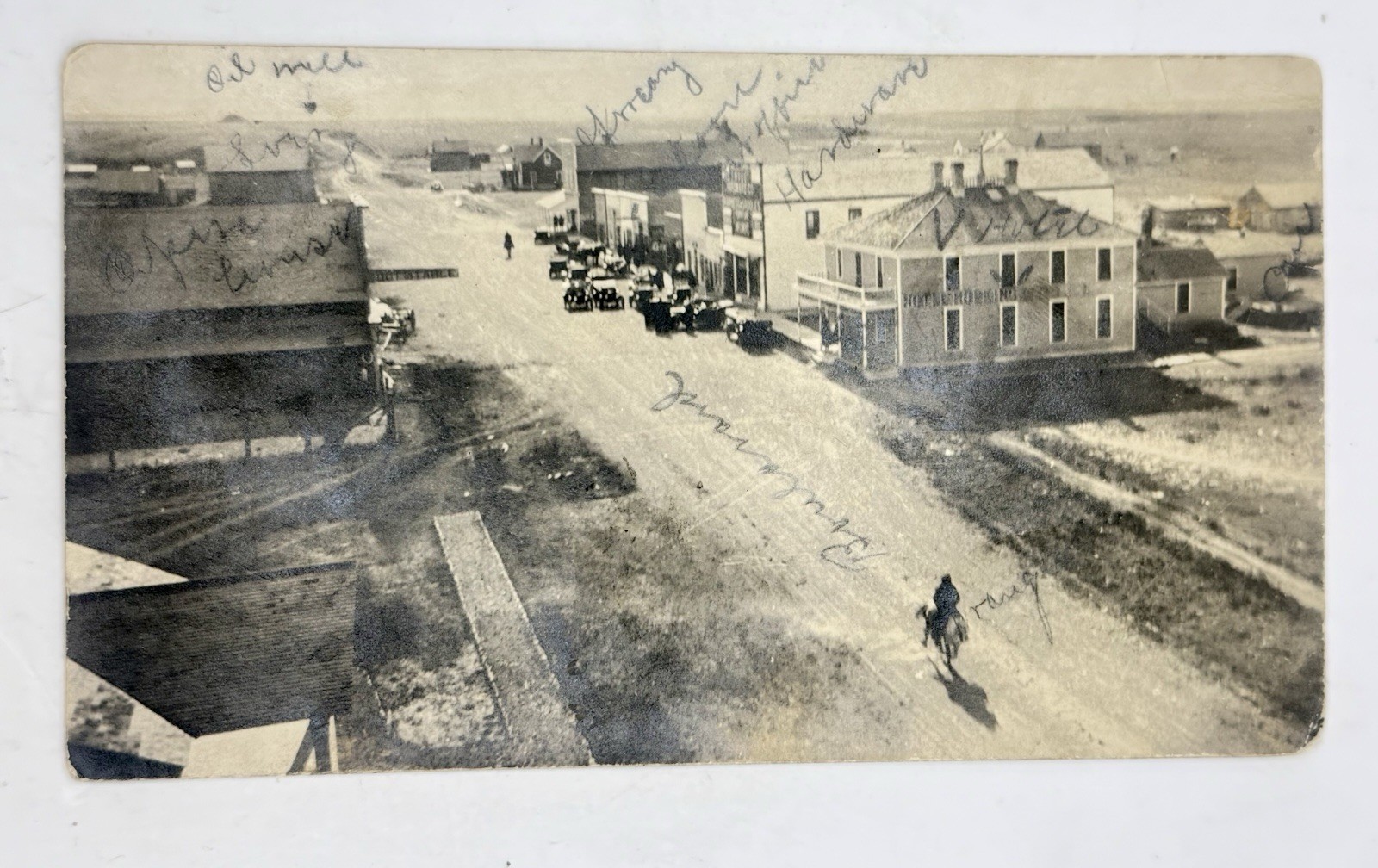
An exceptional and historically significant Real Photo Postcard (RPPC) depicting the entire main business district of Two Dot, Montana during its peak commercial era, c. 1913–1917. This is not a standard town-view postcard. It is a hand-labeled photographic map of the Two Dot business district, annotated directly on the image by someone with firsthand knowledge of every building shown.
Three business signs are independently legible in the photograph itself — confirmed without relying on the annotations:
• HOTEL HOPKINS — sign readable on the hotel building face
• TWO DOT HARDWARE CO. — multi-line sign visible on the hardware building
• TWO DOT STABLE — sign visible on the livery building
These photographic confirmations make this one of the most thoroughly documented small-town Montana RPPCs likely to appear on the market.
THE ANNOTATIONS
A period hand has labeled the following structures directly on the photograph:
• Opera House — labels a distinct structure on the left block; no other photographic record of a Two Dot Opera House is known to exist
• Livery — corresponds to the confirmed Two Dot Stable sign
• Grocery — center-left block
• Post Office — center block
• Hardware — corresponds to confirmed Two Dot Hardware Co. sign
• Hotel — corresponds to confirmed Hotel Hopkins sign
• Oil Mill — upper left, with downward arrow; anomalous and historically significant notation
• Boulevard — labels Main Street in the foreground
The annotator was precise and accurate. Every annotation that can be independently verified against visible signage or documented history checks out.
THE REVERSE MESSAGE
The message side contains a period handwritten note that includes the sender using two dots (••) as shorthand for the town name — employing the actual Two Dot cattle brand symbol in written correspondence rather than spelling out the town name. This is an extraordinary period-authentic detail that reflects deep community identity with George “Two Dot” Wilson’s founding legacy.
The message references the photograph capturing the town’s people during what appears to be a community gathering event, consistent with the remarkable density of automobiles visible in the street scene — at minimum 8–12 period vehicles are present, an extraordinary concentration for a town of this size.
WHY THIS CARD IS HISTORICALLY IMPORTANT
Two Dot, Montana suffered three devastating fires that destroyed virtually its entire business district:
• Winter 1913–14: East side of Main Street destroyed
• June 15, 1918: West side of Main Street destroyed (Hotel Hopkins survived)
• Winter 1920–21: North end of business district destroyed
The majority of buildings visible in this photograph no longer exist. The Opera House, Two Dot Stable, grocery, saloon, and post office visible here were all destroyed. This RPPC may represent the only surviving photographic record of several of these structures, including the Opera House — a building for which no other documentary evidence has been located.
The Two Dot Hardware Company sign visible in this image dates the photograph to the Walton/Moore operating period, as the business was sold in May 1918 and the building destroyed in the June 1918 fire weeks later. This card almost certainly predates both events.
RAILROAD AND RANCHING CONTEXT
Two Dot was a station stop on the Milwaukee Road transcontinental main line and the site of one of its electrification substations. The hotel was documented as always full of railroad workers and passengers. The town was named for cattle rancher George R. “Two Dot” Wilson (1830–1907), who donated the land for the town site and at one time had over 8,000 horses bearing his two-dot brand. The annotator’s use of •• as the town’s written symbol connects this card directly to that founding legacy.
CARD DETAILS
• Format: RPPC (Real Photo Postcard)
• Back: AZO stamp box — dates paper stock c. 1907–1918
• Estimated date: c. 1913–1917 based on Hardware Co. sign, automobile styles, and AZO dating
• Size: Standard postcard, approximately 5.5” x 3.5”
• Condition: VG to VG+. Surface wear consistent with age. Minor corner wear. Small foxing spot upper right corner. Annotations are original period ink, integral to the card’s identity and value — not a condition deduction.
• Reverse: Period handwritten message including •• brand notation. “CORRESPONDENCE” header visible — standard AZO divided back format.
COLLECTOR AND INSTITUTIONAL INTEREST
This card will appeal to:
• Montana history and Western Americana collectors
• Railroad history collectors (Milwaukee Road / Jawbone Railway)
• Ranching and cattle brand history collectors
• Small-town Main Street RPPC specialists
• Montana theater history researchers (Opera House documentation)
• Genealogists with Two Dot, Wheatland County, or Meagher County family connections
• Institutional buyers — Upper Musselshell Museum (Harlowtown, MT), Montana Historical Society, and Montana State University Special Collections have all documented interest in Two Dot materials
The guest register of the Two Dot Hotel (1901–1907) survives at the Upper Musselshell Museum. This postcard is the visual companion to that register — showing the hotel, its sign, and its surrounding business district at peak operation.
COMPARABLE TIER
This card is not priced or categorized as a standard Montana town view. It belongs in the same tier as identified mining camp panoramas and documented main street views with confirmed period business signage — cards that function as primary-source historical documents rather than decorative collectibles.
SHIPPING
Ships in rigid cardboard mailer, card in protective sleeve. Tracked shipping. Combined shipping available.
This listing includes full historical research documentation available to serious buyers and institutions upon request.