When you click on links to various merchants on this site and make a purchase, this can result in this site earning a commission. Affiliate programs and affiliations include, but are not limited to, the eBay Partner Network.
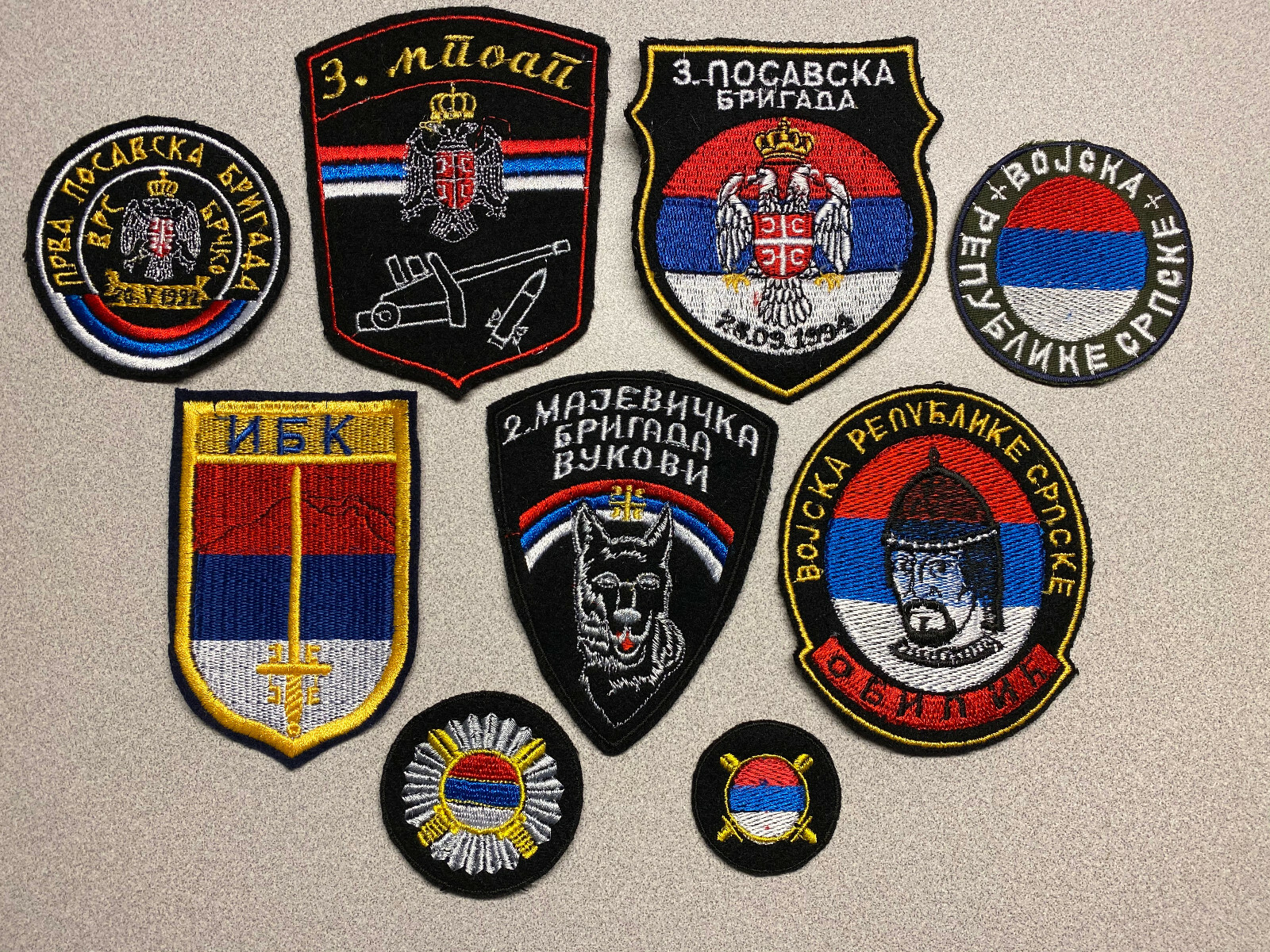
REPUBLIC SRPSKA ARMY, GROUPING OF 9 PATCHES, CIRCA 1992-1995, VINTAGE, WARTIME
From Left to Right, Top Row:
PATCH REPUBLIC SRPSKA ARMY, 3rd POSAVINA SERBIAN BRIGADE, PATCH, CIRCA 1992-1995
REPUBLIC SRPSKA ARMY, 3rd MILITARY POLICE, ANTI-TERRORIST UNIT, OBILIC, PATCH, CIRCA 1992-1995
REPUBLIC SRPSKA ARMY, 2nd MAJEVICA WOLVES, PATCH, CIRCA 1992-1995
PATCH REPUBLIC SRPSKA ARMY, ENLISTED CAP PATCH, CIRCA 1992-1995
From Left to Right, Bottom Row:
PATCH REPUBLIC SRPSKA ARMY, SHOULDER PATCH, CIRCA 1992-1995
PATCH REPUBLIC SRPSKA ARMY, 3rd MIXED ANTI TANK, PATCH, CIRCA 1992-1995
PATCH REPUBLIC SRPSKA ARMY, 3rd CORPS, PATCH, CIRCA 1992-1995
REPUBLIC SRPSKA ARMY, 1st POSAVINA SERBIAN BRIGADE, CIRCA 1992-1995
PATCH REPUBLIC SRPSKA ARMY, OFFICER CAP PATCH, CIRCA 1992-1995
These Serbian patches are bring backs from a U.S. SpecialForces team that was deployed to Brčko during the Bosnian War. Patches ofRepublic of Srpska and the Republic of Serbian Krajina are extremely scarce.Brčko was a geographic point of contention in 1996 when the U.S.-ledImplementation Forces (IFOR) built Camp McGovern on the outskirts of the city.Camp McGovern was built in the ZOS for the purpose of establishing peacekeepingoperations, specifically between Muslims in
Gornji Rahić near Brka and Serbs in Brčko.
The initial US Army unit to deploy into Brčko was Task Force 3-5 CAV, a TaskForce composed of individual units of the 1st Armored Division. The commanderof Task Force 3-5 was LTC Anthony Cucolo. The Task Force headquarters was locatedat Camp McGovern.The Bosnian War or the War in Bosnia and Herzegovina was an international armedconflict that took place in Bosnia and Herzegovina between April 1992 andDecember 1995. The war involved several sides. The main belligerents were the attackingforces of the self-proclaimed Bosnian Serb and Bosnian Croat entities withinBosnia and Herzegovina, the Republika Srpska and Herzeg-Bosnia, who were ledand supplied by Serbia and Croatia respectively, and the Republic of Bosnia andHerzegovina.The war came about as a result of the breakup of Yugoslavia. Following theSlovenian and Croatian secessions from the Socialist Federal Republic ofYugoslavia in 1991, the multi-ethnic Socialist Republic of Bosnia andHerzegovina, which was inhabited by Muslim Bosniaks
(44 percent), Orthodox Serbs (31 percent) and Catholic Croats (17 percent),passed a referendum for independence on 29 February 1992. This was rejected bythe political representatives of the Bosnian Serbs, who had boycotted thereferendum and established their own republic. Following the declaration of independence, the Bosnian Serbs, supported by theSerbian government of Slobodan Milošević and the Yugoslav People's Army (JNA),mobilized their forces inside the Republic of Bosnia and Herzegovina in orderto secure Serbian territory and war soon broke out across the country,accompanied by the ethnic cleansing of the Bosniak population, especially inEastern Bosnia.It was principally a territorial conflict, initially between the Serb forcesmostly organized in the Army of Republika Srpska (VRS) on the one side, and theArmy of the Republic of Bosnia and Herzegovina (ARBiH) which was largelycomposed of Bosniaks, and the Croat forces in the Croatian Defence Council(HVO) on the other side. The Croats also aimed at securing parts of Bosnia andHerzegovina as Croatian. The Serb and Croat political leadership agreed on apartition of Bosnia with the Karađorđevo and Graz agreements, resulting in theCroat forces
turning on the Army of the Republic of Bosnia and Herzegovina and theCroat-Bosniak war. The war was characterized by bitter fighting, indiscriminateshelling of cities and towns, ethnic cleansing and systematic mass rape, mostlyled by Serb and, to a lesser extent, Croat
forces. Events such as the Siege of Sarajevo and the Srebrenica massacre wouldbecome iconic of the conflict.The Serbs, although initially superior due to the vast amount of weapons andresources provided by the JNA, eventually lost momentum as the Bosniaks andCroats allied themselves against the Republika Srpska in 1994 with the creationof the Federation of Bosnia and
Herzegovina following the Washington agreement. After the Srebrenica andMarkale massacres, NATO intervened during the 1995 Operation Deliberate Forceagainst the positions of the Army of Republika Srpska, which proved key inending the war. The war was brought to an end after the signing of the GeneralFramework Agreement for Peace in Bosnia and Herzegovina in Paris on 14 December1995. Peace negotiations were held in Dayton, Ohio, and were finalized on 21December 1995. The accords are now known as the Dayton Agreement. A 1995 reportby the Central Intelligence Agency found that Bosnian Serb forces wereresponsible for 90% of the war crimes committed during the conflict. As ofearly 2008, the International Criminal Tribunal for the former Yugoslavia hadconvicted 45 Serbs, 12 Croats and 4 Bosniaks of war crimes in connection withthe war in Bosnia. The most recent research places the number of people killedat around 100,000–110,000 and the number of people displaced at over 2.2million, making it the most devastating conflict in Europe since the end ofWorld War II.Although Brčko was a focal point for tension in the late 1990s, considerableprogress in multi-ethnic integration in Brčko has since occurred includingintegration of secondary schooling. Reconstruction efforts and the Property LawImplementation Plan have improved the situation regarding property and return.
International Buyers Please Note: We do not ship outside of the United States! No Exceptions. In addition, we will not ship to third party shippers or any other international shipping hubs such as International Shipping (EIS), EIS 110 INTERNATIONALE BLVD, GLENDALE HEIGHTS IL 60139-2080. If you place a offer, or make a purchase, we will cancel your offer, and or cancel your purchase! If you wish to make a purchase, you will have to find someone located within the United States to make the purchase for you. They would be responsible to send the package to you.