When you click on links to various merchants on this site and make a purchase, this can result in this site earning a commission. Affiliate programs and affiliations include, but are not limited to, the eBay Partner Network.
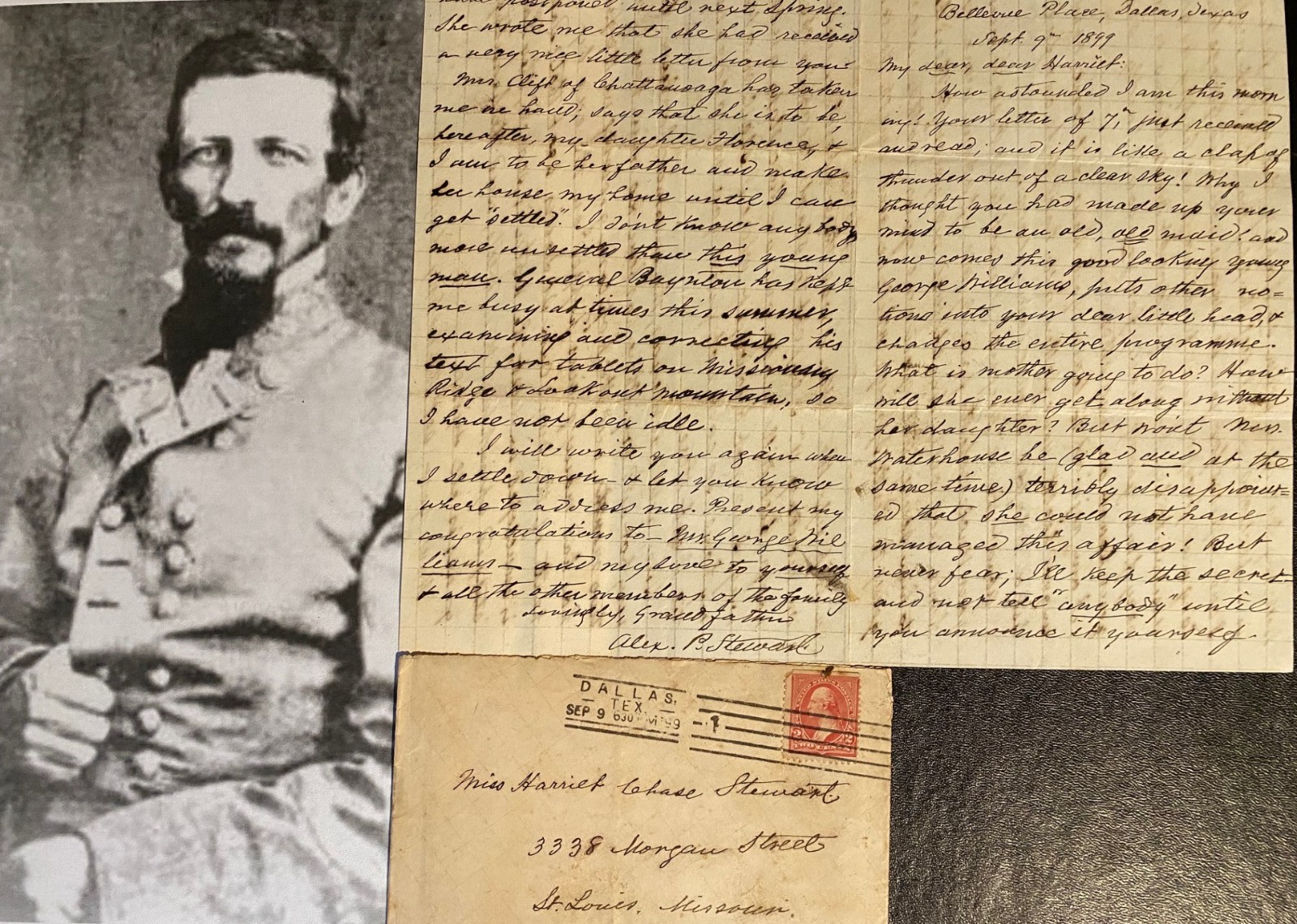
RARE 1899 Confederate Lt. General Alexander Stewart Letter & Cover
Stewart fought in many of the significate battles in the westand by war\'s end,he was theranking Confederate officer from Tennessee and was the last commander of theArmy of Tennessee.
Lt. General Alexander Peter StewartBiography
Lt. General Alexander P. Stewart was called.\"Old Straight\". He was a redhead who lacked the fiery temperamentpopularly associated with that hue and was instead an effective, if quiet andunassuming, leader who served in all the campaigns of the Army of Tennessee,then went on to one of the more distinguished post-war careers. Raised inRogersville and later in Winchester, Tennessee by a devoutly religiousanti-slavery family, he was educated in a local academy and admitted to WestPoint in 1838 to fill a quota from his Congressional District. At the Academyhe followed his lifelong pattern of causing no problems and attracting littlenotice and in 1842 graduated 12th in a class of 56 Cadets that containednumerous future generals including Longstreet, Rosecrans, and Pope.Commissioned a second lieutenant, he spent a boring year at Fort Macon, NorthCarolina, then returned to West Point as a mathematics instructor. Stewart cameto realize that academic life suited him and following his 1845 marriage toHarriet Chase he resigned from the Army to accept the chair of mathematics andnatural philosophy at Cumberland University, Lebanon, Tennessee. He later movedto a similar position at Nashville University and through the 1850s remainedlargely detached from the ever-increasing sectional strife. A Whig opposed tosecession, he was also an advocate of States\' Rights, thus when war came andTennessee left the Union, he followed; initially appointed a major in charge oforganizing and training recruits, he earned praise for commanding the artilleryat Belmont, Missouri and was promoted to brigadier general on November 8, 1861.Assigned a brigade under Bishop-General Leonidas Polk, he fought at New Madridand Shiloh, served with distinction during the Kentucky Campaign, particularlyat the Battle of Perryville, and held his line well at Murfreesboro. Advancedto major general on June 2, 1863, he commanded a division under Longstreet atChickamauga where he was wounded on September 19th but found himself beatenback at Missionary Ridge. As time went on and the command situation in the Armyof Tennessee steadily deteriorated, with General Braxton Bragg facing near-openrevolt from several officers, especially Forrest, Hardee, Cleburne, Buckner,and the Bishop, Stewart somehow managed to stay above the fray and to maintaingood relations with all parties; indeed, by the time Bragg was relieved Stewartwas about the only friend he had left. He was promoted to lieutenant general onJune 23, 1864, Bishop Polk having been killed on June 14th at Pine Mountain,Georgia, by an artillery round. Assigned command of the Third Corps, initiallyunder General Joe Johnston, he participated in the Atlanta Campaign, waswounded on July 28th at Ezra Church, and continued in his position afterGeneral John Bell Hood assumed command of the Army. During Hood\'s TennesseeCampaign of fall 1864 Stewart served well but was assigned, though not by Hood,who exonerated him in an 1865 letter and again in an 1877 missive to IshamHarris, at least a small portion of the blame for the missed opportunity toblock John Schofield on November 29th at Spring Hill (General Schofield was toassert that he could have gotten his troops to Franklin even had the road beenblocked, but that judgment is disputed, while Confederate scholars haveuncovered evidence that Frank Cheatham was drunk and that he ignored at leasttwo direct orders from Hood to attack); his men fought at the Battles ofFranklin and Nashville, then provided notable service during the retreat of thesurvivors into Alabama. In the spring of 1865 Stewart was with what littleremained of the Army of Tennessee when Joe Johnston made his final stand inNorth Carolina. The Army fought well and won victories, but the Cause was lostand Stewart surrendered with Johnston on April 26, 1865, at Bennett\'s Farm,near Durham. Paroled at Greensboro on May 1st, he initially returned toCumberland University and established a policy that he maintained for theremaining 43 years of his life, namely a refusal to sling mud, a practiceengaged in by too many officers from each side. While he would gladly discussbattles and offer insights about those with whom he served, he avoidedcontroversial topics such as the exchanging of Hood for Johnston and declinedto criticize anyone, particularly his fellow Confederates. (Johnston andPresident Davis, by contrast, were to spew bile at each other in print for therest of their long lives). After a brief stay at Cumberland, he worked as asurveyor and as a cotton broker, returned to Cumberland for a time, then from1870 until 1874 was in the insurance business in St. Louis; appointedChancellor of the University of Mississippi in 1874, he became one of severalofficers including Robert E. Lee to head a major educational institution. Forthe most part happy at Ole Miss, he became fed up with disciplinary problemsand in 1886 retired; in the late 1880s a number of preservationists desired toestablish what is now the National Battlefield Park system and saw the wisdomof having the project jointly headed by a General Officer from each side. Thusin 1890 General Stewart and his old friend and enemy General William Rosecransjoined forces in founding the Chickamauga and Chattanooga National Military Park,with Stewart remaining a commissioner until his death. The General was toremain mentally alert and quite active for a man of advancing years, helping tofound the United Confederate Veterans, appearing at numerous veterans\'functions and monument dedications, and answering correspondence. His lateryears were divided between Mississippi, Chattanooga, and St. Louis, with afinal move to Biloxi, Mississippi coming in 1906. Harriet having died in 1898,he resided with his son Alex after 1902 and though slowed by a 1903 stroke keptgoing as well as he could. One aspect of Stewart\'s final years continues toraise questions; a longtime devout Presbyterian, he converted to Jehovah\'sWitness around 1905. Why a well-grounded Calvinist would have chosen to embracea system so at odds with mainline Christianity remains a mystery and while somehave speculated that he was simply uncomfortable with the concept of hell,others have wondered if he might not have been emotionally unhinged either byHarriet\'s death or by some other factor now unknown. Increasingly afflictedwith heart disease in his last year, he died on August 30, 1908, and clearheaded to the end he did not, as some others did, call out in delirium for somelong dead officer to move troops but instead merely said to his dog \"Well,Duke, are you here?\". The ranking Confederate at his demise, leaving onlySimon Bolivar Buckner of the 17 lieutenant generals, he was not and has neverbecome well known to the general public as have some such as Lee, Beauregard,and Longstreet. Thoroughly familiar to scholars of the Civil War, however, hehas the respect of virtually all. Students of the conflict continue to playgames of \"What if...?\" and the question has been asked \"What ifStewart had been given command of the Army of Tennessee when Jeff Davis becamedetermined to fire Joe Johnston in the summer of 1864?\". The suggestioncertainly has points to recommend it, namely that he would probably have beenbetter able to bring peace among the dissident factions better than would havebeen anyone else and that he had an unrivaled ability to stay calm understress. The fact remains, however, that he had only been a lieutenant generalfor a month and lacked the requisite experience to run an Army. (Most studentsof the war agree that, of those available, Hood was the best choice, Hardeebeing too difficult to get along with, Longstreet convalescing from woundssuffered at the Wilderness, and both Robert E. Lee and Edmund Kirby Smithunable to be spared from the jobs they already had). Today, a Chapter of theUnited Daughters of The Confederacy in Chattanooga and a Camp of the Sons ofConfederate Veterans in Winchester, Tennessee carry his name; his story is welltold in Sam Davis Elliott\'s 1999 \"Soldier of Tennessee\".