When you click on links to various merchants on this site and make a purchase, this can result in this site earning a commission. Affiliate programs and affiliations include, but are not limited to, the eBay Partner Network.
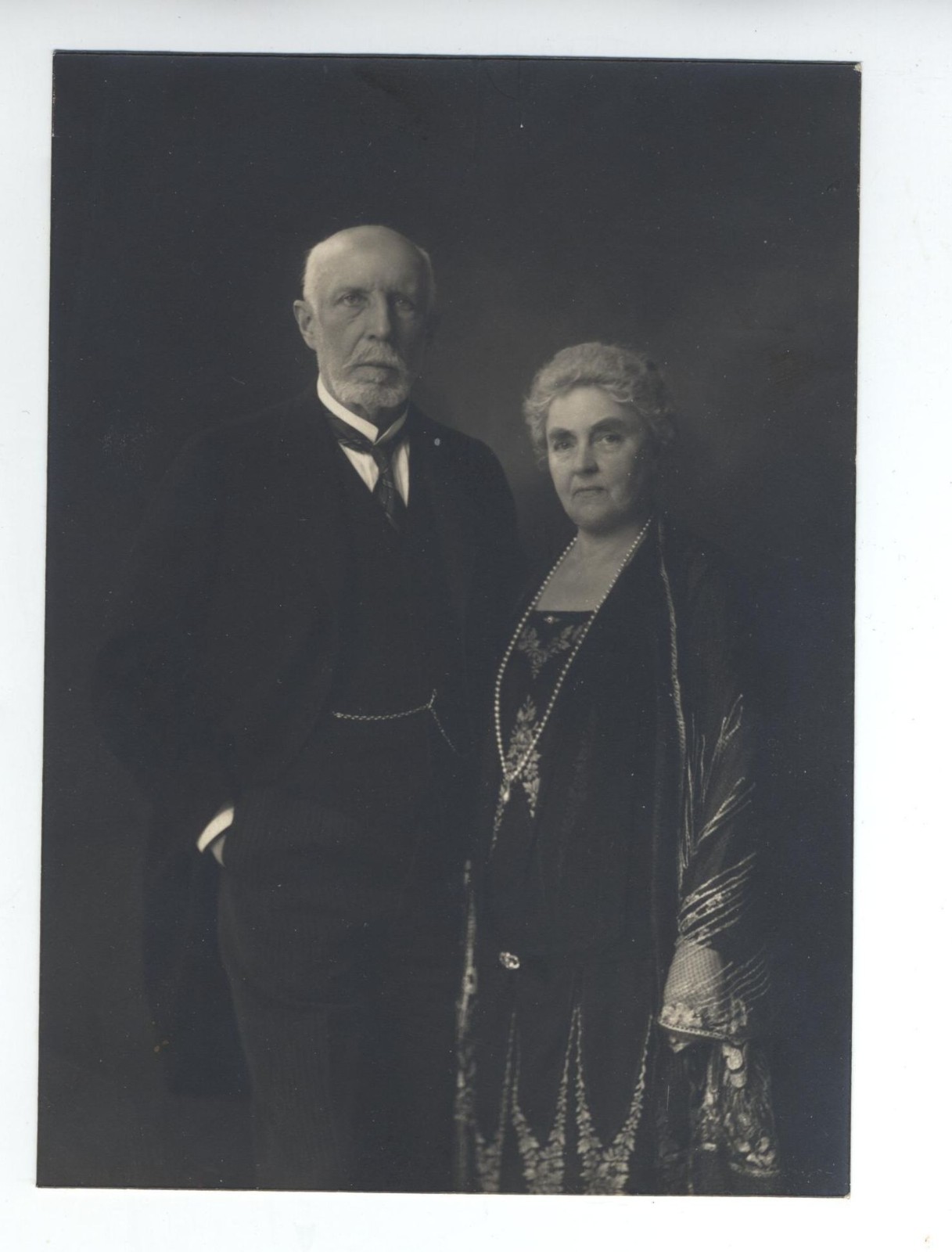
Front of Photo:
Back of Photo:
Handwritten (Pencil/Pen): \"A 4995 / Prince and Princess Oscar Bernadotte / father and mother of Countess Elsa Bernadotte.\" (Note: There is a red line struck through the middle of the text).
Large Purple Stamp: \"A/B TEXT & BILDER\" (Inside a decorative border).
Swedish Text within Stamp: \"VID PUBLICERING AV DENNA BILD MÅ KÄLLAN ANGIVAS \'A-B. TEXT & BILDER\'\" (Translates to: When publishing this image, the source must be stated as \'A-B. Text & Bilder\').
Dated Stamp (Purple): \"OCT 10 29\" (October 10, 1929).
Department Stamp (Purple): \"REFERRED—E. DEPT. / N. E. A.\" (Newspaper Enterprise Association).
Black Cursive Signature/Marking: Appears to read \"Hird\" or \"Hord\" over \"Photo.\"
Historical Background & Bios
The Subjects:
Prince Oscar Bernadotte (1859–1953): Born Prince of Sweden and Norway and Duke of Gotland, he was the second son of King Oscar II. He is most famous for renouncing his rights to the Swedish throne in 1888 to marry a commoner, Ebba Munck. Upon his marriage, he was given the title Prince Bernadotte and later became the Count of Wisborg. He was deeply involved in religious and social work, serving as the chairman of the Swedish YMCA for decades.
Princess Ebba Bernadotte (née Ebba Munck af Fulkila, 1858–1946): Formerly a lady-in-waiting to Crown Princess Victoria of Sweden. Her marriage to Prince Oscar was a major royal scandal of the era, as it was a \"marriage of love\" rather than a political alliance.
Countess Elsa Bernadotte: Mentioned in the handwriting on the back, she was their daughter (1893–1996), known for her prominent role in the Swedish Girl Scout movement.
The Photo:This is a professional press agency photograph from A-B Text & Bilder, a prominent Swedish news photography agency. The 1929 date stamp indicates this photo was likely circulated to international news desks (like the NEA in the USA) for a feature or anniversary.
Item Description
Authentic 1929 Press Photo - Prince Oscar & Princess Ebba Bernadotte of Sweden
This is a rare, original 4x6-inch vintage black-and-white press photograph featuring Prince Oscar Bernadotte and his wife, Princess Ebba. This striking portrait captures the couple in their later years, displaying the dignified elegance of the Swedish nobility.
Prince Oscar is notably remembered for choosing love over the crown, renouncing his royal succession rights to marry Ebba Munck. The back of the photo contains extensive provenance, including a 1929 date stamp from the NEA (Newspaper Enterprise Association) and the stamp of the Swedish agency \"Text & Bilder.\"
Subject: Prince Oscar Bernadotte, Count of Wisborg & Princess Ebba (Ebba Munck).
Date: October 10, 1929 (Stamped).
Size: Approx. 4 x 6 inches.
Condition: Good vintage condition with crisp imagery. The reverse features historical notations regarding their daughter, Countess Elsa Bernadotte.
Keywords: Swedish Royal Family, House of Bernadotte, King Oscar II, Count of Wisborg, Vintage Royalty Ephemera, 1920s Genealogy, European Nobility, Press Photo Archive.
Perfect for collectors of Royal memorabilia, Swedish history, or vintage photography.
Prince Oscar Carl August Bernadotte, Count of Wisborg (15 November 1859 – 4 October 1953) was a Swedish religious activist,[1] the second son of King Oscar II of Sweden and his consort, Sofia of Nassau. Born as a Prince of Sweden and Norway, he was known as Prince Oscar, Duke of Gotland. However, by marrying contrary to Swedish constitutional requirements, he lost those titles, becoming instead Luxembourgish nobility as Prince Bernadotte and Count of Wisborg.
Career
Prince Oscar, before his marriage, served in the Swedish Navy, where he was enlisted for 25 years and attained the rank of Vice Admiral. In his youth, he visited the United States several times, beginning in 1876, and sailed around the world from 1883 to 1885 on the Vanadis.
Bernadotte was very active in social organizations, especially religious ones, such as the YMCA of Sweden and Friends of Mission to the Laps, both of which he chaired for many years. As the only member of Swedish royalty known to be born again, he founded the Södertälje Conferences, as inspired by the Keswick Convention, in 1898 and was an engaging inter-denominational Christian lay preacher of wide repute.
Title
Photograph of Prince Oscar
Through Oscar\'s marriage in Bournemouth on 15 March 1888 to Swedish noblewoman Ebba Munck af Fulkila, lady-in-waiting to the Crown Princess, without the consent of his father, the King, he gave up his right of succession to the Swedish throne and his royal title.
Ebba was a lady-in-waiting of the crown princess, Victoria of Baden, who in 1885 visited her brother-in-law in Amsterdam, where he was to undergo a medical examination. Ebba and Oscar visited the Norwegian sailor church during their stay in Amsterdam and fell in love: Ebba was religious and influenced Oscar in this regard. When Oscar told his family that he wished to marry Ebba, they were scandalized. He was forced to take a two-year consideration period, and Ebba was dismissed as a lady-in-waiting. In 1887, Oscar told his family that he had not changed his mind, and the royal house gave its consent to the marriage on condition that Oscar\'s brothers signed a document promising that they should never enter a similar marriage, which they did. On 21 January 1888, a ball was arranged at the Royal Palace of Stockholm, where Ebba and Oscar were allowed to dance with each other, and on 29 January 1888, the engagement was formally announced. The match was regarded as a great sorrow within the royal house, but it received a lot of sympathy from the public. It was said that a bridge had been placed between the people and the royal house, \"The Munck bridge\", and the fact that Oscar had to give up his royal title made people say that the king no longer had four sons but only three, as one of them \"married and had to quit\". When the couple left Stockholm, a large crowd had gathered at the train station to see them off and show their support.
They were married on 15 March 1888 in St Stephen\'s Church at Bournemouth in England by the vicar Gustaf Beskow, who was close to the queen, Sofia of Nassau, in the presence of Oscar\'s mother, Queen Sophia, two of his brothers (Prince Carl, Duke of Västergötland, and Prince Eugen, Duke of Närke), his cousin the Danish crown princess Louise of Sweden, as well as the mother and brother of Ebba.
He and his wife were named with new titles as Prince and Princess Bernadotte as of their wedding day.[2] It has never been determined if that was a Swedish title of nobility or another form of unofficial courtesy title (such as some later dynasty members have been given). On 2 April 1892, he and his wife were given personal noble titles as Prince and Princess Bernadotte[3] when admitted into the nobility of Luxembourg by Oscar\'s uncle Adolphe, Grand Duke of Luxembourg, previously Duke of Nassau, and also then given a Luxembourgish hereditary title as Count and Countess of Wisborg. Wisborg was derived from Visborg, castle ruins in Oscar\'s former Duchy of Gotland.
Bernadotte\'s family grave north of Stockholm, where the remains of his assassinated son Folke Bernadotte also are interred
The Prince Couple, as they were called, at first lived in Karlskrona, but in 1892 moved to Stockholm and remained there. They maintained summer residences at Villa Fridhem in Gotland and Malmsjö Manor in Sudermania.
Personal life
His wife was the daughter of Carl Jacob Munck af Fulkila (1808–1882) and his spouse, Baroness Henrika Ulrika Antoinetta Carolina Cederström (1819–1912).
They had five children:
Countess Maria Sophie Henrietta Bernadotte af Wisborg (1889–1974)
Count Carl Oscar Bernadotte af Wisborg (1890–1977)
Ebba Sofia Fleetwood (1892–1936)
Elsa Victoria Cedergren (1893–1996)
Count Folke Bernadotte af Wisborg (1895–1948)
He was the last surviving son of Oscar II.
Honours and arms
Honours
Swedish and Norwegian honours[4]
Knight and Commander of the Seraphim, 15 November 1859
Knight of the Order of Charles XIII, 15 November 1859
Grand Cross of St. Olav, with Collar
King Oscar II and Queen Sofia\'s Golden Wedding Medal
King Oscar II\'s Jubilee Commemorative Medal
Crown Prince Gustaf V and Crown Princess Silver Wedding Medal
King Gustaf V\'s Jubilee Commemorative Medal (1928)
King Gustaf V\'s Jubilee Commemorative Medal (1948)
Foreign honours[4]
Denmark: Knight of the Elephant, 20 July 1880[5]
Greece Greek Royal Family: Grand Cross of the Redeemer
Monaco: Grand Cross of St. Charles
Kingdom of Portugal Portuguese Royal Family: Grand Cross of the Tower and Sword
Russian Empire Russian Imperial Family:
Knight of St. Andrew
Knight of St. Alexander Nevsky
Knight of the White Eagle
Knight of St. Anna, 1st Class
Knight of St. Stanislaus, 1st Class
Luxembourg: Grand Cross of Adolphe of Nassau
Empire of Brazil Brazilian Imperial Family: Grand Cross of the Southern Cross
Hawaiian Kingdom Hawaiian Royal Family: Grand Cross of the Order of Kamehameha I
German Empire German Imperial and Royal Family:
Knight of the Black Eagle
Grand Cross of the Red Eagle
Grand Duchy of Baden Baden Grand Ducal Family:[7]
Knight of the House Order of Fidelity, 1881
Knight of the Order of Berthold the First, 1881
Empire of Japan: Grand Cordon of the Order of the Chrysanthemum, 3 September 1884[9]
Thailand Siam:
Knight of the Order of the Royal House of Chakri, 13 July 1897[10]
Grand Cross of the Crown of Siam
Belgium: Grand Cordon of the Royal Order of Leopold I
Tunisia Tunisian Royal Family: Order of the Fundamental Pact
Ottoman Empire Turkish Imperial Family:
Order of Osmanieh, 1st Class
Gold and Silver Imtiyaz Medals
Arms
Arms as Prince of Sweden and Norway, Duke of Gotland
Arms as Prince of Sweden and Norway,
Duke of Gotland
Oscar\'s arms as Count of Wisborg (1892)[11]
Oscar\'s arms as
Count of Wisborg (1892)[11]
Ancestry
Ancestors of Oscar Bernadotte
8. Charles XIV John of Sweden
4. Oscar I of Sweden
9. Désirée Clary
2. Oscar II of Sweden
10. Eugène de Beauharnais, Duke of Leuchtenberg
5. Princess Josephine of Leuchtenberg
11. Princess Augusta of Bavaria
1. Prince Oscar, Duke of Gotland
12. Frederick William, Prince of Nassau-Weilburg
6. William, Duke of Nassau
13. Burgravine Louise Isabelle of Kirchberg
3. Princess Sophia of Nassau
14. Prince Paul of Württemberg
7. Princess Pauline of Württemberg
15. Princess Charlotte of Saxe-Hildburghausen
Oscar II (Oscar Fredrik;[1] 21 January 1829 – 8 December 1907) was King of Sweden from 1872 until his death in 1907 and King of Norway from 1872 to 1905.
Oscar was the son of King Oscar I and Queen Josephine. He inherited the Swedish and Norwegian thrones when his brother died in 1872. Oscar II ruled during a time when both countries were undergoing a period of industrialization and rapid technological progress. His reign also saw the gradual decline of the Union of Sweden and Norway, which culminated in its dissolution in 1905. In 1905, the throne of Norway was transferred to his grandnephew Prince Carl of Denmark under the regnal name Haakon VII. When Oscar died in 1907, he was succeeded in Sweden by his eldest son, Gustaf V.
Early life
Mauritz Frumerie\'s 1829 medal showing the three eldest sons of Crown Prince Oscar: Charles, Gustaf, and Oscar.
Oscar Fredrik was born at the Royal Palace in Stockholm on 21 January 1829, the third of four sons of Crown Prince Oscar and Josephine of Leuchtenberg.[2] Upon his birth, he was created Duke of Östergötland. At birth, he was fourth in the succession to the Swedish throne after his father and older brothers, but as a younger son had no immediate prospect of inheriting the throne. During his childhood, he was placed in the care of the royal governess, Countess Christina Ulrika Taube.[3]
Prince Oscar entered the Royal Swedish Navy as a midshipman at the age of 11, and was appointed junior lieutenant in July 1845. Later, he studied at Uppsala University, where he distinguished himself in mathematics.[4] On 13 December 1848, was made an honorary member of the Royal Swedish Academy of Sciences.
On 6 June 1857, Prince Oscar married Princess Sophia of Nassau at the Biebrich Palace, the ducal residence of the Duchy of Nassau, with whom he had four sons. Princess Sophia was the youngest daughter of Wilhelm, Duke of Nassau and Princess Pauline Friederike Marie of Württemberg, and a half-sister of Adolphe, the then reigning Duke of Nassau and future Grand Duke of Luxembourg.[2]
Aides Daniel Nordlander (upper left) and Fritz von Dardel, Ordnance Officer Ferdinand-Alphonse Hamelin, General Henri-Pierre Castelnau, King Charles XV of Sweden and Prince Oscar, future King Oscar II of Sweden, at the 1867 International Exposition in Paris, France.
Upon the death of his father, King Oscar I, in 1859, Prince Oscar became heir presumptive to the thrones of Sweden and Norway, as his eldest brother King Charles XV of Sweden/Charles IV of Norway was without a legitimate heir, having lost his only son, Prince Carl Oscar, Duke of Södermanland, to pneumonia in 1854. His second elder brother, Prince Gustaf, Duke of Uppland, had died of typhoid fever already in 1852.
King of Sweden and Norway
Norwegian coronation medal for Oscar and Sophia
Oscar II became King on 18 September 1872, upon the death of his brother, Charles XV who died without an heir. At his accession, he adopted as his motto Brödrafolkens väl / Broderfolkenes Vel (\"The Welfare of the Brother Peoples\"). His coronation as Swedish monarch was celebrated in Storkyrkan in Stockholm on 12 May 1873, and his coronation as Norwegian monarch two months later in the Nidaros Cathedral in Trondheim on 18 July 1873.[2] While the King, his family and the Royal Court resided mostly in Sweden, Oscar II made the effort of learning to be fluent in Norwegian and from the very beginning realized the essential difficulties in the maintenance of the union between the two countries.[4]
Foreign and domestic statecraft
Photograph of Oscar II, c. 1870s
His acute intelligence and his aloofness from the dynastic considerations affecting most European sovereigns (both his paternal and maternal grandfathers were French military commanders who served under Napoleon I) gave the king considerable weight as an arbitrator in international questions. At the request of the United Kingdom, Germany, and the United States in 1889, he appointed the Chief Justice of Samoa under the Treaty of Berlin, and he was again called on to arbitrate in Samoan affairs in 1899.[4]
Photograph of Oscar II by Gösta Florman, c. 1891
In 1897, he was empowered to appoint a fifth arbitrator if necessary in the Venezuelan dispute, and he was called on to act as umpire in the Anglo-American arbitration treaty that was quashed by the United States Senate. He won many friends in the United Kingdom by his outspoken and generous support of Britain at the time of the Second Boer War (1899–1902), expressed in a declaration printed in The Times of 2 May 1900, when continental opinion was almost universally hostile.[4]
He remained a strong supporter of the Navy throughout his life, and frequently visited ships of the fleet. When the coastal defence ship Oscar II was launched, he even signed his name on the vessel\'s aft main gun tower.[5]
The office of Prime Minister of Sweden was instituted in 1876. Louis De Geer became the first head of government in Sweden to use this title. The most known and powerful first minister of the Crown during the reign of Oscar was the conservative estate owner Erik Gustaf Boström. Boström served as prime minister in 1891–1900 and 1902–1905. He was trusted and respected by Oscar II, who had much difficulty approving someone else as prime minister. Over a period of time, the King gave Boström a free hand to select his own ministers without much royal involvement. It was an arrangement (unintentional by both the King and Boström) that furthered the road to parliamentarism.
Science and the arts
Portrait of Oscar II by Anders Zorn 1898
A distinguished writer and musical amateur himself, King Oscar did much to encourage the development of education throughout his dominions. In 1858, a collection of his lyrical and narrative poems, Memorials of the Swedish Fleet, published anonymously, obtained the second prize of the Swedish Academy. His \"Contributions to the Military History of Sweden in the Years 1711, 1712, 1713\", originally appeared in the Annals of the academy, and were printed separately in 1865. His works, which included his speeches, translations of Herder\'s Cid and Goethe\'s Torquato Tasso, and a play, Castle Cronberg, were collected in two volumes in 1875–76, and a larger edition, in three volumes, appeared in 1885–88.[4]
His Easter hymn and some other of his poems are familiar throughout the Scandinavian countries. His work on Charles XII of Sweden were translated into English in 1879. In 1881, he founded the world\'s first open-air museum, at Bygdøy, located next to his summer residence near Oslo (then known as Christiania). In 1885, he published his Address to the Academy of Music, and a translation of one of his essays on music appeared in Literature in May 1900. He had a valuable collection of printed and manuscript music, which was readily accessible to the historical student of music.[4]
Being a theater lover, he commissioned a new opera house to be built by Axel Anderberg for the Royal Swedish Opera which was inaugurated on 19 September 1898. It remains as the home of that institution. Oscar II once told playwright Henrik Ibsen that his Ghosts was \"not a good play\". As he was dying, he requested that the theatres not be closed on account of his death. His wishes were respected.
Oscar was also particularly interested in mathematics. In 1887, he set up a contest, to be awarded on the occasion of his 60th birthday in 1889, for \"an important discovery in the realm of higher mathematical analysis\".[6][7] The contest listed four potential areas of research, one of which was the n-body problem in celestial mechanics, relevant to the stability of the Solar System. Henri Poincare, a professor at the University of Paris, won by submitting an entry showing that even the 3-body problem was unstable, the seminal result in what is now called chaos theory.[8][9]
King Oscar II was an enthusiast of Arctic exploration. Along with Swedish millionaire Oscar Dickson and Russian magnate Aleksandr Mikhaylovich Sibiryakov, he was the patron of a number of pioneering Arctic expeditions in the 1800s. Among the ventures the king sponsored, the most important are Adolf Erik Nordenskiöld\'s explorations to the Russian Arctic and Greenland, and Fridtjof Nansen\'s Polar journey on the Fram.[10]
Oscar was also a generous sponsor of the sciences and personally funded the Vega Expedition, which was the first Arctic expedition to navigate through the Northeast Passage, the sea route between Europe and Asia through the Arctic Ocean, and the first voyage to circumnavigate Eurasia.
Death
The political events which led up to the peaceful dissolution of the union between Norway and Sweden in 1905 could hardly have been attained but for the tact and patience of the king himself. He was dethroned on 7 June 1905 by the Storting and renounced the Norwegian throne on 26 October. He declined, indeed, to permit any prince of his house to become king of Norway, but better relations between the two countries were restored before his death.[4] Oscar II died in Stockholm on 8 December 1907 at 9:10 am.[11]
Marriage and children
Oscar II boating.
Engraving by Anders Zorn.
On 6 June 1857, he married in Wiesbaden-Biebrich, Duchy of Nassau (located in present-day Hessen, Germany) Princess Sophia Wilhelmina, the youngest daughter of Duke William of Nassau and Princess Pauline of Württemberg. They had four sons:
King Gustaf V (16 June 1858 – 29 October 1950)
Prince Oscar, Duke of Gotland, later known as Prince Oscar Bernadotte, Count of Wisborg (15 November 1859 – 4 October 1953)
Prince Carl, Duke of Västergötland (27 February 1861 – 24 October 1951)
Prince Eugen, Duke of Närke (1 August 1865 – 17 August 1947)
His eldest son Gustaf was Duke of Värmland and succeeded him as King Gustaf V of Sweden from 1907 until 1950, married Princess Victoria of Baden and they had three sons. His second son, Prince Oscar, lost his rights of succession to the throne upon his unequal marriage in 1888 to a former lady-in-waiting, Ebba Munck af Fulkila, and was granted the title of Prince Bernadotte first in Sweden, and from 1892 in Luxembourg, where he also was created Count of Wisborg as an hereditary title for his marital progeny (Adolphe, Grand Duke of Luxembourg, was the half-brother of his mother, Queen Sophia). The other sons of Oscar II were Prince Carl, Duke of Västergötland who married Princess Ingeborg of Denmark; and Prince Eugén, Duke of Närke, who was well known as an artist and remained a bachelor all his life.
Alleged extramarital children
Oscar II is also suspected to have had several extramarital children,[12] of which at least five are named:
Anna Hofman-Uddgren (1868–1947) by Emma Hammarström (1849–1910)[13]
Elin Esping Smitz (1878–1960) by Paulina Mathilda Esping (1858–1878)[14][15]
Knut August Ekstam (born 1878, in U.S.A. 1903, death unknown) by Marie Friberg (1852–1934)
Florence Stephens (1881–1979) by Elisabeth Kreüger Stephens (1858–1911)[16]
Nils Teodor Ekstam (1889–1954) also by Friberg above[17][18]
However, unlike his father, Oscar II never officially recognized any illegitimate children of his.
Honours
Portrait of Oscar II wearing the Crown of Eric XIV and mantle, by Oscar Björck. King Oscar II was the last crowned Swedish king and was known to enjoy the pomp and ceremony.
Knight and Commander of the Seraphim, 21 January 1829
Knight of the Order of Charles XIII, 21 January 1829
Commander Grand Cross of the Sword, 21 January 1829
Commander Grand Cross of the Polar Star, 21 January 1829
Commander Grand Cross of the Order of Vasa, 15 June 1866[20]
Grand Cross of St. Olav, with Collar, 21 August 1847[21]
Founder and Master of the Order of the Norwegian Lion, 21 January 1904 – 26 October 1905[22]
Duchy of Anhalt Anhalt: Grand Cross of the Order of Albert the Bear
Austria: Grand Cross of the Royal Hungarian Order of St. Stephen, 1866[23]
Knight of the House Order of Fidelity, 1877
Knight of the Order of Berthold the First, 1877
Bavaria: Knight of St. Hubert, 1862[25]
Belgium: Grand Cordon of the Order of Leopold, 17 May 1856[26]
Brazil: Grand Cross of the Southern Cross
Knight of the Elephant, 3 June 1848
Cross of Honour of the Order of the Dannebrog, 5 October 1863
France:
Honour medal for Courage and Devotion, 23 March 1862[28]
Grand Cross of the Legion of Honour
Gold Médaille militaire
Greece Greece: Grand Cross of the Redeemer
Hanover: Grand Cross of the Royal Guelphic Order, 1852[29]
Hawaii: Grand Cross of the Order of Kamehameha I
Italy: Knight of the Annunciation, 10 January 1862[31]
Japan: Grand Cordon of the Order of the Chrysanthemum, 27 July 1881[32]
Mecklenburg: Grand Cross of the Wendish Crown, with Crown in Ore
Monaco: Grand Cross of St. Charles, 16 January 1862[33]
Nassau: Knight of the Gold Lion of Nassau, July 1858[34]
Netherlands: Grand Cross of the Netherlands Lion
Luxembourg: Grand Cross of the Oak Crown
Ottoman Empire:
Order of Osmanieh, 1st Class
Order of Distinction
Beylik of Tunis: Husainid Family Order
Grand Cross of the Tower and Sword
Grand Cross of the Sash of the Three Orders
Persia: House Order of the Imperial Effigy, 1st Class
Prussia:
Knight of the Black Eagle, 28 September 1861;[35] with Collar
Grand Cross of the Red Eagle
Grand Commander\'s Cross of the Royal House Order of Hohenzollern, 12 June 1875[35]
Romania:
Grand Cross of the Star of Romania
Grand Cross of the Crown of Romania
Russia:
Knight of St. Andrew, 9 July 1846
Knight of St. Alexander Nevsky
Knight of the White Eagle
Knight of St. Anna, 1st Class
Knight of St. Stanislaus, 1st Class
Saxony: Knight of the Rue Crown, 1875[36]
Serbia: Grand Cross of the Cross of Takovo
Thailand Siam:
Knight of the Order of the Royal House of Chakri, 29 October 1888
Grand Cross of the White Elephant
Spain: Knight of the Golden Fleece, 14 July 1872[38]
United Kingdom: Stranger Knight Companion of the Garter, 17 May 1881[39]
Venezuela: Collar of the Order of the Liberator
Württemberg: Grand Cross of the Württemberg Crown, 1879[40]
Legacy
The name and portrait of Oscar II have been used as a trademark for King Oscar sardines in Norway since 1902[41] (which remains the only brand to have once obtained his \"royal permission\" [42]) as well as gingerbread cookies (pepparkakor) and other bakery products made by Göteborgs Kex in Sweden.[43]
The culinary creation Veal Oscar was named in his honor supposedly for his fondness for its ingredients: veal cutlet, crab meat, Béarnaise sauce, and asparagus.[44]
Ancestry
Ancestors of Oscar II
8. Jean Henri Bernadotte
4. Charles XIV John of Sweden
9. Jeanne de Saint Vincent
2. Oscar I of Sweden
10. François Clary
5. Désirée Clary
11. Françoise Rose Somis
1. Oscar II of Sweden
12. Alexandre, Viscount of Beauharnais
6. Eugène de Beauharnais, 1st Duke of Leuchtenberg
13. Joséphine de Tascher de La Pagerie
3. Princess Joséphine of Leuchtenberg
14. Maximilian I Joseph of Bavaria
7. Princess Augusta of Bavaria
15. Princess Augusta Wilhelmine of Hesse-Darmstadt
Sophia of Nassau (Sophia Wilhelmine Marianne Henriette; 9 July 1836 – 30 December 1913), also Sofia, was Queen of Sweden and Norway as the wife of King Oscar II. She was Queen of Sweden for 35 years, longer than anyone before her, and the longest-serving queen until 2011, when she was surpassed by Queen Silvia. She is also the most recent woman to have been officially Dowager Queen of Sweden.
Early life
Sophia was the youngest daughter of Wilhelm, Duke of Nassau, by his second wife Princess Pauline Friederike Marie of Württemberg.
Her father died when she was three and was succeeded by her half-brother, the later Adolphe, Grand Duke of Luxembourg. Sophia was given what was considered a suitable education for princesses at the time by private tutors. She was trained in fencing, a sport normally reserved for males, to strengthen her back and correct her posture.[1] Sophia socialized with academics and artists, and the court of Nassau was considered more democratic than what was usual at most German courts. She learned the English language early on and felt sympathy for the British parliamentarian system. The language spoken in her childhood home was not German but English.[1] Sophia was given what has been referred to as an upbringing more similar to the middle-class Victorian life style, which she preferred rather than a royal one. Her brothers used to refer to her as Unsere demokratische Schwester (our democratic sister).[1] She was described as serious, intelligent and dutiful, and interested in language and history: she was also genuinely religious.
In 1848, she witnessed a rebellion in the Duchy of Nassau, which was suppressed by her mother and brothers. She spent the winter of 1853-54 with her mother at the court of her maternal aunt in Saint Petersburg in Russia. Her maternal aunt, Princess Charlotte of Württemberg, was married to Grand Duke Michael Pavlovich of Russia. The trip was not made to arrange a marriage with a Russian prince because her mother did not wish her to convert, which would have been necessary, but rather, to have her study the life in a grand court. During her stay in Russia, she was a student of the pianist Anton Rubinstein. Sophia and her mother were forced to leave Russia at the outbreak of the Crimean war. After the death of her mother in 1856, Sophia lived with her half-sister, Princess Marie Wilhemine of Wied.
In July 1856, at her sister Marie\'s summer residence Monrepos castle outside Nassau, she received a visit from Prince Oscar of Sweden, Duke of Östergötland. Oscar was the second living son of the reigning king. Following the death of his elder brother Gustaf in 1852, he had become the future heir to the Swedish throne because his brother, the reigning Crown Prince, was unable to have more children with his spouse. It was therefore politically necessary for Oscar to marry. In 1855-56, Oscar was sent to visit various royal courts in Europe in order to find a suitable marriage partner in both rank and to his own taste. He visited the British court but did not wish to marry Princess Mary of Cambridge, and the Belgian and Prussian princesses who had been suggested did not wish to marry him. The marriage of Sophia and Oscar should not be regarded as an arranged marriage: Oscar had been given the freedom to choose a princess he liked from the many courts he visited, and Sophia, who had previously been proposed to, did not wish to be pressured into marriage.[2] Sophia and Oscar, however, fell in love with each other.[3]
After the visit, Oscar returned to Sweden to ask for his parents\' consent to marry, which was granted. He then returned to Nassau, where the engagement was made in September and announced in October. During the engagement, Sophia was educated in the Swedish language and history, and corresponded with her future spouse: soon, the correspondence was conducted in Swedish. She also mastered Norwegian quickly.
Duchess and crown princess
Prince Oscar and Princess Sophia at the time of their marriage in 1857
A photograph of Crown Princess Sofia of Sweden with her husband, Crown Prince Oscar and their sons (Gustaf, Oscar Bernadotte, Carl and Eugén), 1865.
Sophia and Oscar were married on 6 June 1857 at the Castle in Wiesbaden-Biebrich. Sophia arrived in the city of Stockholm with Oscar on 19 June 1857, and was met by her Swedish Mistress of the Robes, countess Wilhelmina Bonde, and her maid of honor Augusta Jegerhjelm at the ship Travemünde. There they were greeted with salutes, singing and crowds. Sophia was received with great enthusiasm upon her arrival in Sweden. Since the current Crown Princess Louise had become sterile after delivering her last child, and the elder brother of Oscar, Crown Prince Charles, had no son and his daughter was not accepted as heir to the throne under the present constitution, Sophia was seen as the solution of the succession problem and future Queen. She was dressed in blue at her arrival, and was therefore nicknamed The Blue Duchess, Den Blåa Hertiginnan, in Swedish.[4] At the palace, she was first presented for the royal court, and then introduced to the royal family in the salon of the queen. Upon meeting the king, who was by then described as almost deranged and placed under the regency of the crown prince, she rushed to him, curtsied and embraced him.
In 1858, Sophia gave birth to a son, which secured the Bernadotte dynasty and gave her much popularity. The birth took place at Drottningholm Palace according to old court protocol, with the entire court and members of the government present in the chamber outside of the bedroom as witnesses.[5] Following the death of her father-in-law King Oscar I in 1859, her brother-in-law became King Charles XV and her husband the heir presumptive.[6]
The couple were given Arvfurstens palats in Stockholm as their residence. Sophia was described as calm and controlled, practical and sensible. She had a good relationship with her parents-in-law and her sister-in-law Princess Eugénie. Her relationship to Charles XV and Queen Louise was, however, tense. Sophia, herself strictly moral, disliked the French-influenced frivolity of her brother-in-law Charles XV\'s court.[7]
By 1861, Sophia had given birth three times in three years, and after this her health was frail. The same year she made a trip to Nice to cure her health, and she continued to make trips for health reasons. The next trip was made in 1863; this time to Germany. In 1864, she engaged in the building of their summer residence Sofiero Palace by Öresund, which was named after her. In Sofiero they could remain in contact with the Danish royal family at Fredensborg on the other side of Öresund. The gatherings at Sofiero would sometimes be given a political dimension as the center of family councils.
Sophia exercised strong discipline over her children. Her decision to breastfeed, at that time unusual for the upper class, attracted attention. She also aroused attention when she in 1869 placed her sons in a public school rather than letting them be educated at home as had been the tradition in the royal house.[8] This was the Christian boys\' school Beskowska Skolan of the theologian and vicar Gustaf Emanuel Beskow, whose sermons she often attended. Sophia had always had a very close interest in religion—an interest she shared with her sister-in-law Eugenie, in whose company she was introduced to various different Christian branches. From 1866, she was the chairperson of the charity organisation Allmänna skyddsföreningen (The Protection Society) for poor women in Stockholm.
Sophia was interested in politics and engaged herself in state affairs during her life, and was occasionally present as an observer during the parliamentary sessions. In 1866 her birth country, the Duchy of Nassau, was annexed by Prussia. After this, she kept an anti-Prussian view. In the summer of 1870, she was present in Ems where she met both the Emperor of Russia and the King of Prussia shortly before the declaration of the war, and kept herself informed about the political situation. She did not oppose the united Empire of Germany as such, but disliked how it had been created and the dominance of Prussia. She did, however, have a good personal relationship with Crown Prince Frederick William of Prussia and his consort Victoria, Princess Royal.
Queen of Sweden and Norway
Sofia at Oscar\'s and her coronation, wearing the Queen\'s Crown
Sofia of Nassau as queen of Sweden, ca 1873.
Upon the death of her brother-in-law on 18 September 1872, Sophia became queen consort of Sweden and Norway. At that time, there was a tense political situation and demands for a republic. Oscar was initially not popular, but there were hopes that he would let himself be guided by the advice of Sophia, who was considered politically insightful.[9] Also in Norway, there were hopes that Sophia would use her influence on Oscar to introduce a more equal place in the union.[10] Sophia was crowned with Oscar in Stockholm in Sweden 12 May and in Trondhjem (now Trondheim) in Norway 18 June 1873. In Norway, the couple made a tour around the country in connection to the coronation which has been described as a triumph.
In 1875, the king and queen made a tour in Europe. They first visited Denmark and after this Berlin and then Dresden. The visit to King Albert of Saxony and his Queen, Carola of Vasa in Dresden was considered significant, as this meant a symbolic peace between the Bernadotte dynasty and the deposed Vasa dynasty, as Queen Carola was the granddaughter of the deposed king Gustav IV Adolf and let it be known that the past was forgotten.[11] After Dresden, Sophia interrupted the tour for health reasons while Oscar continued to Weimar and Russia. Another important event was the uncovering of the statue of Charles XIV John in Christiania (since 1926 Oslo) on 7 September 1875, which was celebrated with great festivities with invited foreign royalty and military parades and considered a memorable propaganda occasion. Another important event as Queen of Norway was the stay at Moss in 1877 with the former Prince Imperial Napoleon of France.
Norwegian coronation medal for Oscar and Sophia
1874 medal for Queen Sophia
During the autumns, the royal couples normally stayed at Drottningholm Palace, where they received foreign royal dignitaries and hosted ceremonial parties. During the winters, they engaged in representation in both Stockholm and in Christiania. When visiting Norway, they were met by the border by a separate Norwegian court, who served during their stay there. In Norway, her principal ladies-in-waiting were Alette Due and Elise Løvenskiold. Sophia was known to dress spectacular at formal occasions, with many jewels, much lace and ornaments and bright colors such as red and blue. Oscar II normally spent his summers with his friends at his yacht Drott at Marstrand, while Sophia often spent her summers first at the Ulriksdal Palace, and in later years more often in Norway. From 1892 until 1904, she spent her Norwegian summers at Skinnarbøl manor outside Kongsvinger, where she is remembered for her simple life style and generosity toward the local population. She was popular in Norway, and described as the queen who had spent the most time in Norway among all the queens during the union Sweden-Norway.
Sophia herself described the years between 1873 and 1878 as years of crisis for her.[12] During these years, Oscar had several affairs, notably with Magda von Dolcke and with Marie Friberg. Oscar\'s affair with Magda von Dolcke begun in 1874 and attracted great attention, and he benefited her career at the Royal Dramatic theatre and gave her an allowance.[13] Though she did not demonstrate, Sophia is believed to have suffered from his adultery.[14] It is related how Sophia traveled to Germany to look for comfort with her half sister Marie of Wied, who, it is believed, advised her to accept the situation.[15] At one occasion, the king had a courtier sent to the opera singer Ida Basilier-Magelssen with a request of a \"private audience\", and she replied: \"Tell His Majesty that he may have a private audience with his good and beautiful Queen. I have others things to do than to have private conferences with old gentlemen!\" [15] Being told of this, Queen Sophia sent for Basilier-Magelssen and their meeting reportedly ended with mutual tears over their adulterous husbands.[15] Her health requested her to take frequent trips abroad, and her marriage apparently underwent a crisis where her marital relations were discontinued.[12] The marital crisis was observed and mentioned by her closest surroundings, and during a trip on the continent in 1876, Sophia sent Oscar what she referred to as a farewell letter.[12]
The year of 1878 was a turning point for Queen Sophia. This year she became a follower of the teachings of the British preacher Lord Radstock, to whom she was introduced by her lady-in-waiting Märta Eketrä. After this, she spent a great deal of her everyday life in prayer with her favorite ladies-in-waiting Eketrä, Ebba von Rosen and Ida Wedel-Jarlsberg. Oscar II was skeptical toward this because of his position as the head of the Swedish church, but their relationship was in fact improved after her new religious conviction.[12]
Queen Sophia was after 1878 much engaged in her religious interests, and her work for the so-called new evangelical movement was quite significant. This made her less interested in participating in representation and society life, and Carl Fleetwood remarked that the master of her court was in fact reverend Beskow.[12] She eventually restricted participation in court and society life to when it was absolutely necessary. When she attended the Amaranter Ball in 1885, the occasion was rare enough to attract attention.[16] Sophia preferred a private life, such as dinners and musical soirees in the company of family members and her ladies-in-waiting. Queen Sophia suffered from poor health: in 1875-1877, for example, she was almost constantly absent abroad for health reasons, and though it was better after 1877, she continued to visit particularly Amsterdam for the medical care of Doctor Metzger. During a visit to Paris, she caused great attention when she dined at a public restaurant: this was unusual for a royal woman at this time, and it was also the only time she ever did that.[16] In 1885, her son Prince Carl, Duke of Västergötland fell sick in Istanbul, and she and Oscar II visited the Ottoman Empire, where they were received by Sultan Abdul Hamid II and Sophia was given permission to visit the Imperial Harem.[17] They also visited Romania.
Queen Sofia in formal court dress, ca 1900.
Queen Sophia performed a great effort in her work to improve medical care, and founded the first nursing school in Sweden. She studied the work of Florence Nightingale, and visited Great Britain with Oscar in 1881, where they were received by Queen Victoria. During her visit, she studied the modern medical institutions in London. Upon her return, she launched a project to educate professional nurses in Sweden. This work was only just started by the pioneering work of Emmy Rappe in 1867, but there was as yet no proper educational institution for nurses, and the medical world was sceptical. In 1882 she managed to arrange classes for nurses at the Sabbatsberg Hospital; 1884 she opened the Sophiahemmet University College for the students; and in 1889 it was developed to the Sophiahemmet, a combined hospital and school for nurses. The Sophiahemmet was seen as a role model for the education of nurses in Sweden, and it is also seen as the proper establishment of the nurse profession in Sweden. Sophia was very active in increasing respect for the nursing profession among doctors, who did not consider the work to be suitable for an educated female, and to make the profession respected, she wished for the profession to be seen as a religious calling and that it be undertaken by medically educated women, and she encouraged upper-class women to be nurses, all because she wanted nurses to be respected: the first head of her nursing school was the noble Alfhild Ehrenborg, who was a student of Florence Nightingale, and the Queen was actively involved in the institution until her death. In her nursing school, even students from the aristocracy were expected to scrub the floors. Two students of Sophiahemmet, Alma Brunskog and Olga Claréus was to have great significance for the medical care in Norway. Sophia chaired about fifty different charity organisations in Sweden and Norway. She received help seekers once a week, supported The Salvation Army and founded many organisations herself.
Sophia was reportedly closest to her sons Oscar, whose religious interests she shared, and Eugen. In 1886, she supported Eugen, who wanted to study art in Paris. She also supported Oscar in his wish to marry the noble lady-in-waiting Ebba Munck af Fulkila. Her son Eugen said of her that human worth and justice almost had a higher standing with her than her deep piety.[18] In 1887, she was forced to undergo an ovariotomy operation. The operation was considered potentially life-threatening. Before the operation, she made her will. She also took a vow of Oscar II, that should she survive the operation, the King would allow for Oscar to finally marry Ebba Munck.[19] After the operation, Oscar made use of this and the wedding could finally take place. The surgery was considered a success, but afterwards she had difficulty walking and was occasionally forced to use a wheelchair. Despite this she continued riding.
In 1881, she attended the wedding of her son, Crown Prince Gustav, to Victoria of Baden in Karlsruhe. Sophia had preferred her son to marry Princess Beatrice of the United Kingdom, as she had great admiration for Queen Victoria, but was initially very enthusiastic about the choice of Victoria of Baden, as she was a descendant of the former Swedish Vasa dynasty. Her relationship with her daughter-in-law was, however, to become tense.[12] Sophia and Victoria had opposing political views, and Sophia took offence when Gustav started to listen to Victoria rather than to her, while Victoria criticized Sophia\'s influence on the king: the German diplomat Eulenberg reported that Victoria had stated, that Queen Sophia pressured the King to give in to the opposition to avoid conflicts, that she was relentlessly willful and that Oscar was afraid of her.[12] Sophia disliked Victoria\'s cousin Emperor William II of Germany with whom she had several conflicts.[12]
Politically, Sophia has been described as liberal and almost democratic in her views. Her political influence upon Oscar II is regarded as significant. She is regarded to have acted as his political adviser and is known to have used her political influence on several occasions, at least after 1878. Sophia showed a great interest in Norway and the questions surrounding the union between Sweden and Norway. The King was expected to visit Norway regularly during a