When you click on links to various merchants on this site and make a purchase, this can result in this site earning a commission. Affiliate programs and affiliations include, but are not limited to, the eBay Partner Network.
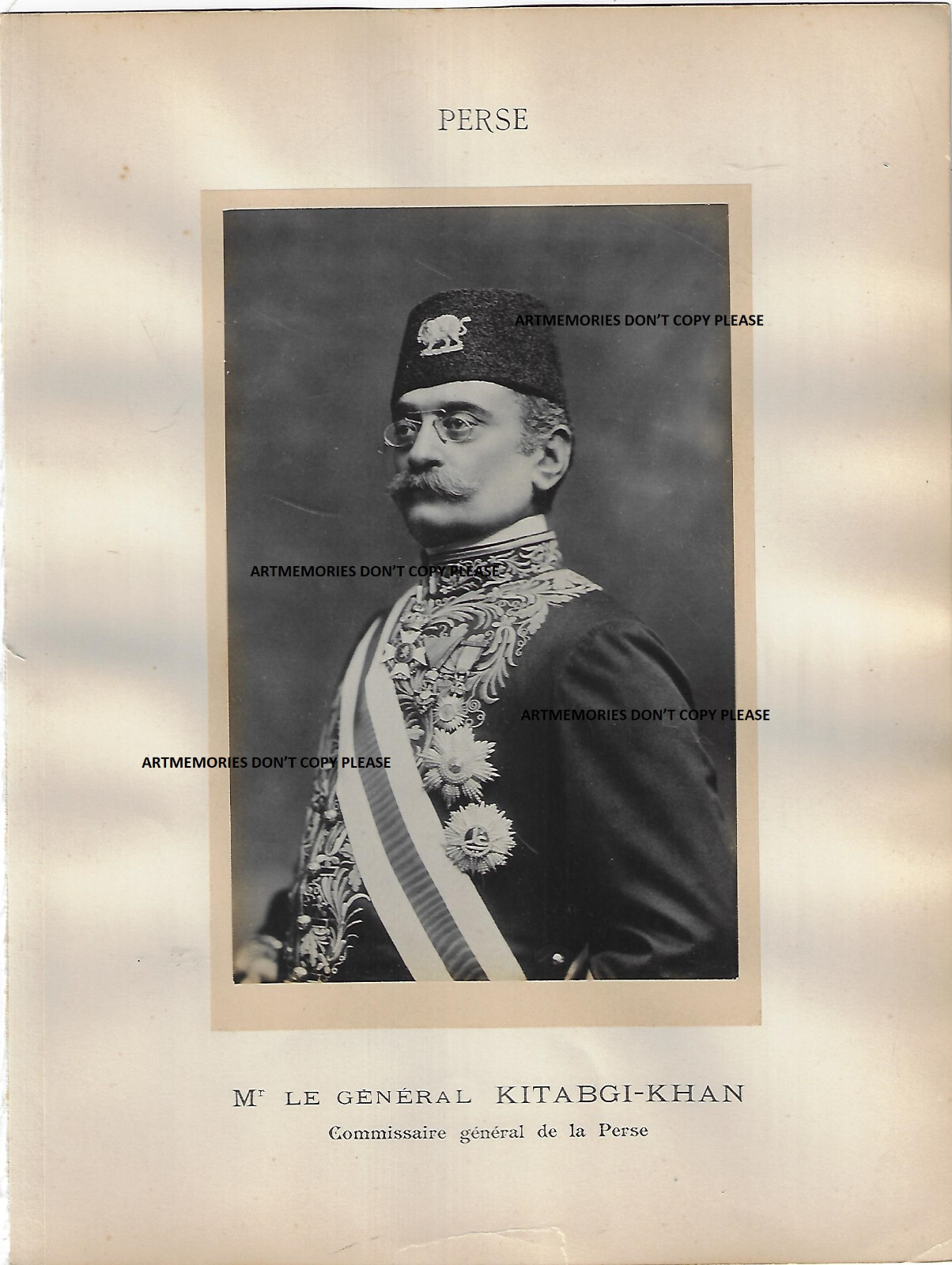
Photo 1900 Général Kitabgi Khan commissaire général de la Perse pendant expo Universelle ( il est né famille arménienne en Turquie)
La photo est collée sur carton / photo is glued on cardboard
La photo seule mesure / photo alone do : 18.8 * 12.3 cm
Le carton mesure / the cardboard do : 30.7 * 23.1 cm
EN FRANCAIS////
Antoine Kitabgi Khan
Antoine Kitabgi Khan, né le2 octobre 1843àConstantinopleet mort le20 décembre 1902àLivourne(Italie), est un général persan qui est directeur général des douanes enPersede 1881 à 1893 et initie d\'importantes concessions sous les règnes deNasseredin shahet de son successeurMozaffareddin shah. Il est en particulier l\'initiateur de la concession de pétrole attribuée en 1901 àWilliam Knox D\'Arcyqui donne naissance à laBritish Petroleum.
Constantinople
Antoine Kitabgi naît en 1843 à Constantinople dans une famille arménienne catholique modeste d\'origine géorgienne1,2. Il est le deuxième enfant et premier fils d\'une fratrie de six. Son père, Vincent Kitabgi, est fournisseur auprès du sultan de pipes à eau ornées de pierres précieuses. Vers l\'âge de 14 ans, Kitabgi est envoyé à Livourne (Italie) pour compléter ses études. Il y apprend l\'italien et le français qu\'il parle couramment en plus du turc et de l\'arménien. Son père étant malade et ne pouvant plus travailler, il rentre à Constantinople en 1861 et se fait embaucher à l\'âge de 18 ans à l\'agence desMessageries maritimes. En 1866, il est employé puis associé dans le commerce d\'étoffes et de draperies de l\'Arménien Ruben Hocozian et, trois ans plus tard, fonde son propre commerce d\'étoffes, draperies et tapis. En 1870, il épouse Philomène Altounian, une Arménienne catholique dont les parents sont originaires du quartier de la Nouvelle-Djoulfa à Ispahan en Perse. Trois garçons, Vincent, Paul et Édouard, naissent à Constantinople de cette union. Le commerce de Kitabgi prospère rapidement. Il devient fournisseur attitré du tailleur du sultan et entreprend de diversifier ses affaires. Il se lance dans la vente d\'armes, obtenant la représentation de grandes firmes européennes et la position de fournisseur d\'armes auprès du ministère de la Guerre. En 1874, associé à l\'Arménien Serkissian, il crée une entreprise de scierie mécanique en Bulgarie, alors province ottomane3.
Mais en 1876, des troubles graves agitent l\'Empire ottoman. Depuis quelques années, les provinces européennes desBalkanssont en rébellion contre l\'Empire. Après l\'Herzégovine, c\'est au tour de laBulgariede se révolter enavril 1876. En conséquence de ces troubles et de la banqueroute de l\'Empire ottoman face à ses créanciers, le sultanAbdülazizabdique le30 mai 1876. Son successeur et neveu,Mourad V, est interné pour folie trois mois plus tard. Il est remplacé par son frèreAbdülhamid IIqui, par la répression sanglante exercée contre l\'insurrection bulgare d\'avril 1876, entraîne la Russie à déclarer la guerre à la Turquie le24 avril 1877(guerre russo-turque de 1877-1878).
Du fait de ces événements, le commerce de Kitabgi est menacé de faillite: l\'entreprise de scierie mécanique est incendiée et pillée par les rebelles bulgares en 1876; les changements brutaux de sultans et de gouvernements lui font perdre sa position de client du tailleur du sultan et de fournisseur d\'armes auprès du ministère de la Guerre. La guerre ralentit le commerce. Il se voit contraint enoctobre 1877de partir en Europe pour négocier ses dettes auprès de ses fournisseurs et créanciers allemands, belges et français3.
Paris et Exposition universelleGénéral Antoine Kitabgi Khan en 1894. Photo dédicacée à son fils Vincent.
Après plusieurs mois passés à Lausanne, Kitabgi s\'installe à Paris avec sa famille à la fin de l\'année 1893. Entre-temps, il n\'a cessé de demander à Amin al-Soltan sa nomination à un poste de diplomate en Europe. Il obtient le poste de Conseiller de la Légation de Bruxelles, dont le ministre est Mirza Djevad Khan, Saad ed-Dowleh. Kitabgi occupe ce poste jusqu\'en 189818.
Pavillon de la Perse à l\'Exposition Universelle de Paris en 1900.
En 1899, Kitabgi est nommé Commissaire général pour la Perse à l\'Exposition universelle de 1900 par Mozaffaredin shah (qui a succédé à son père Nasseredin assassiné en 189619). La photographie en tête de cet article est celle qui paraît dans le guide officiel de l\'Exposition. Kitabgi veut effacer la mauvaise image qu\'avait laissée le pavillon persan érigé à l\'occasion de l\'Exposition universelle de 1889. Il fait appel à l\'architecte français Philippe Mériat pour construire un pavillon inspiré de lamadreseh madar-e chah(école coranique de la mère du shah) à Ispahan20,21. De nombreux objets et produits persans sont exposés et des spectacles orientaux sont donnés au pavillon qui connaît un grand succès chez le public et est encensé par la presse22.
Kitabgi reçoit, en grande pompe, Mozaffaredin shah au pavillon persan le30 juillet 190023. Il lit un discours enpersanà son souverain. Trois jours plus tard, alors que le shah se rend à Sèvres, son landau est pris d\'assaut par un terroriste qui braque un revolver sur lui. Le forcené est maîtrisé avant d\'avoir pu tirer. Le shah prend du retard dans ses visites et Kitabgi est chargé d\'annoncer aux organisateurs des stands concernés qu\'ils ne recevront pas la visite du roi des rois24.
Avant de quitter Paris, le shah en personne confère à Kitabgi le grand cordon du Lion et du Soleil25.
Paris et la concession de chemin de fer en Perse
À Paris, il fait la connaissance en 1878 de dignitaires persans occupés à préparer la venue du shahNassereddinen France à l\'occasion de l\'exposition universelle de 1878. Il s\'agit de Nazare Aga, ministre plénipotentiaire de Perse à Paris, du général Neriman Khan,aide de campdu shah, et deMirza Hosein Khan Moshir od-Dowleh, Premier ministre du shah. Ces dignitaires le convainquent de demander une concession de chemin de fer au shah pour construire une ligne deRachtàTéhéran. Associé au banquier Antoine Alléon, ancien administrateur de laBanque impériale ottomaneà Constantinople et récemment retiré en Normandie à Caen, Kitabgi obtient du shah la concession de chemin de fer endécembre 18783,4,5. Il entreprend alors avec Alléon de former un syndicat de banquiers et financiers français composé entre autres dePierre-Armand Donon, président de laSociété des dépôts et comptes courants, et dePaul Eugène Bontoux, président de l\'Union générale. Enjuillet 1879, Kitabgi rejoint à Vienne le général Neriman Khan, nommé l\'année précédente ministre plénipotentiaire de Perse en Autriche. Aidé par le général, Kitabgi prépare son départ pour la Perse et enaoût 1879il quitte l\'Europe avec sa famille et l\'ingénieur autrichien Scherzer et ses deux aides3,6. Il arrive à Téhéran deux mois plus tard. Les ingénieurs commencent le relevé de la ligne de chemin de fer mais le projet soulève l\'opposition des Russes et des Britanniques et, sous la pression des deux puissances, le shah annule la concession enmars 18807.
Téhéran et la direction générale des douanes persanes
Kitabgi décide de rester à Téhéran et, après de difficiles négociations concernant son salaire, il accepte en 1881 le poste de directeur général des douanes persanes. Son chef est alors Agha Mohammed Ibrahim8qui porte le titre d\'Amin al-Soltan et qui, bien que n\'étant pas officiellement ministre, joue un rôle important à la cour du shah et contrôle entre autres les finances de l\'État. À la mort d\'Agha Ibrahim enjuillet 1883, c\'est son fils Mirza Ali Asghar Khan, Emin ul-Mulk9, qui prend le titre de son père, Amin al-Soltan, et les fonctions de ce dernier, devenant ainsi le nouveau chef de Kitabgi4,5.
Le poste de directeur général des douanes revêt une importance particulière, les taxes sur les importations et les exportations étant une source majeure de revenus pour l’État persan. En 1881, l\'année où Kitabgi prend ses fonctions, les revenus nets des douanes pour le trésor sont de 550.000 tomans (environ 5.500.000 Fr de l\'époque). En 1882 ces revenus sont portés à 730.000 tomans, puis 780.000 tomans en 1883 et 825.000 tomans en 1884. L\'évolution est plus lente ensuite. Quand Kitabgi quitte ses fonctions de directeur général des douanes en 1893, les revenus nets sont de 911.650 tomans4,5.
Ces bons résultats valent à Kitabgi d\'être décoré de l\'ordre du Lion et du Soleilet d\'obtenir en 1887 l\'affermage de la douane de la province de Téhéran. C\'est aussi cette année là que, bien qu\'il n\'exerce aucune fonction militaire, il reçoit du shah le grade de général à titre honorifique et le titre de Khan en remerciement de ses services. C\'est Amin al-Soltan qui, en présence de Kitabgi, demande au shah de récompenser ce dernier en ces termes: «Majesté, voici Monsieur Kitabgi, fidèle serviteur de l\'Empire, qui par ses grandes connaissances et par ses hautes qualités administratives a su organiser les douanes si bien et si sagement que non seulement les revenus en ont considérablement augmenté, mais qu\'un parfait ordre règne partout… Je ne saurais assez recommander à la haute magnanimité de Votre Majesté de l\'anoblir en lui octroyant le titre de Khan4.»
Concession Reuter de 1889 pour la création d\'une banque d\'état et l\'exploitation des mines
En 1872, le baronPaul Julius Reuter, citoyen britannique, avait obtenu de Nasseredin shah une concession exceptionnelle qui lui octroyait non seulement le monopole absolu pendant soixante-dix ans de la construction de lignes de chemin de fer et de tramway mais aussi, pour vingt-cinq ans, l\'exploitation exclusive de toutes les mines de métaux et de minéraux non précieux, le monopole des forêts d\'état, l\'exclusivité de la construction de systèmes d\'irrigation, une option prioritaire sur la création d\'une banque nationale et sur toutes futures entreprises liées à des travaux publics de toute sorte incluant les routes et le télégraphe10.
Cette concession, qui étonna le monde la finance et ne fut pas soutenue par le gouvernement britannique, souleva de fortes protestations de la part des Russes et de la part du peuple persan qui acceptait mal cette ingérence étrangère. Ceci conduisit le shah à annuler la concession sous de faux motifs (comme il le fit plus tard pour la concession Alléon). Reuter, qui avait déboursé des sommes importantes pour obtenir la concession et commencer les travaux d\'une ligne de chemin de fer de Racht à Téhéran, ne fut pas indemnisé et n\'eut de cesse que d\'obtenir réparation de la part du gouvernement persan10.
Endécembre 1888, George Reuter, le second fils du baron, arrive à Téhéran avec le secrétaire de son père, le Français Édouard Cotte, qui avait négocié avec son patron la concession de 1872. Les deux hommes demandent à nouveau une concession de banque, mines et chemin de fer11. Devant les difficultés rencontrées au cours des négociations, Cotte, qui avait connu Kitabgi à Paris en 1878 (à cette époque ce dernier essayait d\'associer Reuter à la concession de chemin de fer demandée avec Alléon), se tourne vers Kitabgi pour solliciter son aide. Ce dernier convainc Reuter et Cotte de limiter leur demande à la banque et aux mines, sachant qu\'ajouter les chemins de fer soulèverait immanquablement l\'opposition des Russes. Kitabgi réécrit l\'acte de concession et persuade Amin al-Soltan d\'octroyer la concession de banque et de mines en faisant valoir que la banque serait un grand bien pour le pays et que cela indemniserait justement le baron Julius Reuter des cinq millions de francs qu\'il avait dépensés en pure perte en 1872, mettant par la même le gouvernement persan à l\'abri de futures revendications4,5.
Le firman royal attribuant la concession à Reuter est signé le30 janvier 1889. La banque prend le nom de Banque impériale et obtient le privilège d\'émettre des billets de banque11. Elle restera banque d\'état jusqu\'en 1925 et rendra de grands services à la Perse12.
Régie des tabacs de 1886 et concession Talbot de régie des tabacs de 1890[modifier|Régie des tabacs de 1886
Enjuillet 1886, Kitabgi fait partie de la suite qui accompagne le shah dans son voyage auMazandéran. Au cours de ce voyage, Amin al-Soltan lui fait part de son intention d\'établir une régie des tabacs en Perse. Kitabgi rédige un projet, approuvé par Amin al-Soltan, et le présente le30 aoûten audience privée à Nasseredin shah qui le félicite et lui demande de rédiger le firman. Dans ses grandes lignes, celui-ci stipule que les marchands de tabac au détail, répartis en deux catégories (villes et campagnes) et trois classes (tambacou, tabac à pipe et tabac à cigarette), devront dorénavant posséder une autorisation spéciale de l\'administration, payer une patente et acquitter une taxe proportionnelle à leurchiffre d\'affaires. Des contrôles auront lieu et en cas d\'infraction – non paiement de la patente ou de la taxe – des amendes seront appliquées4.
Le12 novembre 1886, Kitabgi reçoit d\'Amin al-Soltan une lettre lui donnant les pleins pouvoirs pour mettre en place la régie et la diriger à des conditions financières très avantageuses. Dès le mois de décembre, les mesures sont appliquées et bien acceptées à Téhéran par les débitants de tabac. Mais, finjanvier 1887, des protestations de la part de la population s\'élèvent en province contre la régie et des incidents éclatent. Le shah, craignant que le mécontentement ne s\'étende, décide d\'annuler purement et simplement la régie, se privant d\'une source de revenus annuels que Kitabgi estime à deux millions de francs4.
Concession Talbot de régie des tabacs de 1890
Enavril 1889, Nasseredin shah entreprend son troisième voyage en Europe. Kitabgi obtient d\'Amin al-Soltan de faire partie de la suite royale. Il figure en dix-septième position sur la liste officielle des dignitaires accompagnant le shah et, à ce titre, occupe la chambre 17 à Buckingham Palace lors de la visite du shah à la Reine Victoria. Au cours de ce voyage qui dure cinq mois et pendant lequel Kitabgi est reçu dans les cours européennes visitées par le shah — il est décoré de l\'ordre de Léopoldà Anvers et de l\'ordre de François Josephà Vienne — il fait de nombreuses connaissances dont celle du major britannique Gerald F. Talbot à Londres. C\'est probablement là que les deux hommes discutent pour la première fois de la possibilité pour le major d\'acquérir la concession de la régie des tabacs en Perse. Il est aussi probable que Sir Henry Drummond Wolff, ministre plénipotentiaire de Grande-Bretagne à Téhéran, et son secrétaire Sidney J.A. Churchill qui se trouvent à Londres au moment de la visite du shah sont informés du projet par Kitabgi qui veut s\'assurer de leur soutien une fois les négociations engagées par lui à Téhéran. Les perspectives financières pour Kitabgi en cas de réussite sont très avantageuses4.
Le shah rentre à Téhéran le24 octobre 1889. Motivés par les déclarations d\'un souverain qui a souvent manifesté en Europe le désir de moderniser son pays, les demandeurs de concessions sont nombreux. Kitabgi explique à Wolff et Churchill comment contrer les projets qui risquent de concurrencer celui de Talbot et persuade ce dernier de venir à Téhéran pour présenter lui-même sa demande au roi et à Amin al-Soltan. Peu après l\'arrivée de Talbot à Téhéran, Kitabgi est sollicité par son ami Gregorovitch, premierdrogmande la légation de Russie à Téhéran, pour aider deux banquiers russes, Raffalovitch et Poliakioff, à obtenir une concession de chemin de fer en Perse. Le bruit court que Kitabgi délaisse les intérêts de Talbot pour favoriser les Russes. Sir Henry prévient Kitabgi et laisse entendre que Talbot est mécontent. Kitabgi, pensant que son honnêteté est mise en doute, renvoie à Talbot les lettres par lesquelles ce dernier s\'engage à lui verser les sommes convenues en cas de réussite de la concession. Talbot vient en personne rendre les lettres à Kitabgi, affirmant qu\'il n\'a jamais douté de lui et lui fait une confiance totale4.
Amin al-Soltan et le shah hésitent à accorder sa concession à Talbot. Le premier a encore en mémoire l\'échec cuisant de la régie de 1886. Il craint que de nouveaux troubles n\'éclatent si un Britannique met la main sur le commerce du tabac en Perse. Après de longues et difficiles discussions, Kitabgi, avec l\'appui et l\'aide de Sir Henry et Sidney Churchill, convainc Amin al-Soltan que la régie ne peut apporter que des avantages au gouvernement persan4. Le shah est plus long à convaincre. Kitabgi engage Talbot à faire pression sur le roi en menaçant de rentrer à Londres si l\'affaire ne se conclut pas. Finalement, Nasseredin recourt àl\'istikhara(consultation divinatoire) pour prendre sa décision. La consultation étant favorable, le shah accorde la concession à Talbot. Celle-ci est signée le21 mars 18904.
Peu après, Talbot quitte Téhéran en remerciant Kitabgi en ces termes: «Je vous remercie mille fois, mon bon ami!… pour toute votre amabilité et bonne volonté pour votre tout dévoué, Gerald F. Talbot»
La suite de cette affaire, justifiant les craintes d\'Amin al-Soltan, est connue12,13. La concession, octroyant à Talbot le monopole pour cinquante ans de la production, de la vente et des exportations de tabac persan, soulève la colère des cultivateurs et marchands de tabac. L\'arrivée en Perse de dizaines de Britanniques employés à la régie provoque le mécontentement du peuple. Les protestataires font appel au clergé qui soutient leur cause et organise à partir du printemps 1891, dans tout le pays, une véritable révolte contre le pouvoir et la régie, allant jusqu\'à émettre unefatwacontre l\'usage du tabac, fatwa qui est suivie par la quasi-totalité des classes sociales du pays. Le4 janvier 1892, des émeutes sanglantes font sept morts parmi les manifestants à Téhéran13. Le shah abolit la régie le26 janvier. La plupart des historiens s\'accordent à dire que cette révolte, organisée et associant le peuple, le clergé, les marchands et une partie de la classe dirigeante, est le prélude aux troubles qui agiteront la Perse une douzaine d\'années plus tard et aboutiront à larévolution constitutionnelle persanede 190512,14.
Démission et départ pour l\'Europe
Pendant que s\'organise la révolte au printemps 1891, Kitabgi est en Europe. Il a quitté Téhéran le21 mai 1890pour un voyage de dix-sept mois motivé par trois raisons principales:
- Tout d\'abord, il installe sa famille en Suisse àLausanne.
- Ensuite, Kitabgi passe beaucoup de temps à Londres pour régler avec Talbot tous les détails, logistiques et financiers, de la mise en place de la régie des tabacs.
- Enfin, il est mandaté par Amin al-Soltan pour régler un litige entre la Perse et l\'Italie. Un certain Consonno, négociant italien qui commerçait avec la Perse, ayant pris l\'habitude de frauder les douanes persanes, s\'était vu confisquer ses marchandises en 1883. Consonno avait porté l\'affaire devant les autorités italiennes et celles-ci avaient menacé d\'une crise diplomatique avec la Perse si on ne remboursait pas deux millions et demi de francs à Consonno. La Perse, sur les conseils de Kitabgi, ayant décidé de recourir à l\'arbitrage international, c\'est sir William Arthur White, ambassadeur de Grande-Bretagne à Constantinople, qui est chargé de régler le différend. Kitabgi, documents en main, passe trois mois à Constantinople pour défendre la cause de la Perse. L\'arbitrage est finalement rendu le21 juin 1891en faveur de la Perse15,16.
Kitabgi rentre à Téhéran le10 octobre 1891. La régie est menacée de faillite. Sir Henry, rappelé à Londres et nommé ambassadeur à Madrid, vient de quitter Téhéran. Le chargé d\'affaires britannique à Téhéran, Robert John Kennedy, demande à Kitabgi, par l\'intermédiaire d\'Amin al-Soltan, de prendre la direction de la régie. Jugeant sans issue la situation de celle-ci, Kitabgi refuse4.
Peu après les émeutes sanglantes du4 janvier 1892, Kitabgi est victime de l\'épidémie de grippe qui déferle sur Téhéran et qui touche également le shah et de nombreux dignitaires17. Soigné par leDrTom Francis Odling de la légation britannique, Kitabgi se rétablit juste après que le shah ait aboli la régie.
Déçu de cet échec, ayant amassé une fortune suffisante pour vivre aisément en Europe et souhaitant rejoindre sa famille en Suisse, Kitabgi demande sa démission à Amin al-Soltan. Celui-ci accepte et, le temps de terminer son exercice (qui prend fin ànorouzde l\'année suivante, le21 mars 1893), Kitabgi part rejoindre sa famille à Lausanne dans le courant du printemps 1893.
Concession D\'Arcy
En 1898, Kitabgi entre en possession d\'un rapport sur les gisements potentiels de pétrole en Perse. Ce rapport est l\'œuvre de l\'ingénieur civil, géologue et archéologue françaisJacques de Morganqui, lors d\'une mission scientifique en 1891 dans le sud-ouest de la Perse, avait noté la présence de naphte et étudié la nature des terrains pétrolifères à Kend é-Shirin etKasr é-Shirin. Il avait publié ses observations dans lesAnnales des Mines26. Un de ses collègues de la mission, George Lampre, marié à une nièce d\'Édouard Cotte, sachant que ce dernier avait négocié plusieurs concessions en Perse, lui remet le rapport. Cotte, connaissant l\'intérêt de Kitabgi pour le pétrole, lui confie le rapport après l\'avoir complété5,27.
En 1899 et 1900, Kitabgi, rapport à l\'appui, essaye sans succès d\'intéresser plusieurs capitalistes de haut niveau à l\'obtention d\'une concession de pétrole en Perse. LaRoyal DutchPetroleum Company est approchée. Le directeur de celle-ci,Henri Deterding, conseillé parCalouste Gulbenkian(le futur monsieur 5% du pétrole), rejette l\'opération, l\'estimant trop risquée28.
Parallèlement, Kitabgi ayant demandé à son ami Sir Henry Drummond Wolff de chercher des investisseurs en Grande-Bretagne, ce dernier, par son neveu Lord Orford, fait la connaissance deWilliam Knox D\'Arcy29, un Britannique ayant fait fortune dans les mines d\'or en Australie. Celui-ci se montre intéressé par le pétrole iranien et Wolff lui présente Kitabgi enfévrier 1901. Les deux hommes signent un accord. D\'Arcy fournira le capital nécessaire à l\'opération tandis que Kitabgi prendra en main les négociations avec la Perse. Kitabgi aura 7% des actions de la concession plus 10% à l\'émission, Cotte 3% des actions et Wolff 10% des profits5.
Kitabgi part pour la Perse le14 mars 1901avec suffisamment d\'argent pour distribuer les pots-de-vin nécessaires. Après de difficiles négociations, la concession est accordée à D\'Arcy par Mozaffaredin shah le28 mai 19015,27,30,31et Kitabgi est nommé Commissaire impérial par le gouvernement persan pour veiller aux intérêts de la Perse. Kitabgi met à profit sa connaissance de la cour, du gouvernement et des autorités religieuses persans pour que la concession de pétrole ne connaisse pas le même sort que la concession de la régie des tabacs dix ans plus tôt. Il obtient avant son retour en Europe que D\'Arcy embauche ses trois fils aînés: Paul à Téhéran comme agent de liaison avec le gouvernement persan, Vincent à Londres comme agent de liaison avec D\'Arcy, et Édouard en Perse, à Kasr é-Shirin, comme assistant de l\'ingénieur George Bernard Reynolds chargé par D\'Arcy de la prospection pétrolière5,31.
Retour en Europe et décèsMozaffaredin shah (assis) et sa suite à Contrexéville en 1902. Antoine Kitabgi Khan est le premier personnage à gauche sur la photo.Mozaffaredin shah et sa suite reçus en 1902 à Portsmouth à bord du yachtHMY Victoria and Albert IIpar le roi Édouard VII. Assis de gauche à droite: le prince de Galles, Mozaffaredin shah, la reine Alexandra, le roi Édouard VII et la princesse Victoria du Royaume Uni. Debout entre le shah et la reine: Amin al-Soltan. Au milieu et au fond, sa tête dépassant les autres: Antoine Kitabgi Khan.
De retour en Europe, Kitabgi continue à organiser les opérations de la concession. Enaoût 1902, il rejoint la suite de Mozaffaredin shah qui effectue son deuxième voyage en Europe. Une photographie le montre au milieu de la suite du shah qui pose sur le yachtHMY Victoria and Albert II(en)aux côtés du roiÉdouard VII, de la reineAlexandra, du prince de Galles (futur roiGeorge V) et de la princesse Victoria, sœur de George.
Vers la fin de l\'année, la santé de Kitabgi se détériore et au cours d\'un séjour en Italie, souffrant d\'insuffisance respiratoire, il meurt àLivournele20 décembre 1902, juste avant ses soixante ans et sans avoir vu jaillir le pétrole en Iran. Ses obsèques sont célébrées à Livourne et il sera plus tard inhumé aucimetière du Montparnasseà Paris32. D\'Arcy écrit à Vincent Kitabgi: «I have lost a kind and sincere friend and a valuable and able colleague5,31.» («J\'ai perdu un bon et sincère ami ainsi qu\'un collaborateur précieux et capable.»)
Devenir de la concession
Le pétrole tant attendu par les concessionnaires ne jaillira que le26 mai 1908d\'un puits près de Shuster.
Entre-temps les intérêts de la famille Kitabgi sont pris en charge par Vincent qui est nommé Commissaire impérial à la place de son père. Quant à D\'Arcy, il ne peut plus supporter à lui seul les coûts de prospection. En accord avec les concessionnaires, il incorpore les actions de la société d\'exploitation de la concession à la Burmah Oil Company. Lorsqu\'enfin le pétrole jaillit avec des perspectives de production abondante, la société devient l\'Anglo Persian Oil Company, puis l\'Anglo Iranian Oil Company, et enfin la British Petroleum5,31.
Relations entre Kitabgi et les Amin al-Soltan
Lorsque Kitabgi prend ses fonctions de directeur général des douanes, son chef est Agha Mohammed Ibrahim, Amin al-Soltan, avec lequel il entretient de bonnes relations, le considérant un peu comme un père4. À la mort d\'Ibrahim en 1883, c\'est son deuxième fils, Mirza Ali Asghar Khan, Emin ul-Mulk, qui prend son titre et ses fonctions. Ce jeune homme de25 ansconnaît une carrière fulgurante: il est nommé grand-vizir en 1891 par Nasseredin shah et reçoit de Mozaffaredin shah en 1900 le titre, rarement attribué, d\'Atabek e-Azam9. Il est alors l\'homme le plus puissant de Perse après le shah.
Quand le jeune Amin al-Soltan prend ses fonctions, les relations entre Kitabgi et son nouveau chef sont tendues. Kitabgi supporte mal d\'être sous les ordres d\'un jeune homme de quinze ans son cadet. Mais au fil de leur collaboration, les deux hommes apprennent à s\'apprécier, Kitabgi reconnaissant l\'intelligence d\'Amin al-Soltan et ce dernier les compétences de Kitabgi. Sir Henry Drummond Wolff écrit dans ses mémoires: «The Amin-es-Sultan relied very much on a coadjutor of his — Kitabgi Khan — who was also of Georgian origin. He was a Roman Catholic, and married to an Armenian lady. The European element of the Persian Government was really represented by Kitabgi Khan, for he was well versed in Western matters — being able to draw up a concession and initiate commercial movements. He was the head of the Custom House1.» («L\'Amin-es-Sultan se reposait considérablement sur un de ses coadjuteurs—Kitabgi Khan—qui était aussi d\'origine Géorgienne. C\'était un catholique romain, marié à une Arménienne. L\'élément européen du Gouvernement persan était en vérité représenté par Kitabgi Khan, car il était bien au fait des procédures européennes—étant capable de rédiger une concession et d\'initier des mouvements commerciaux. Il était directeur des douanes.»)
Amin al-Soltan aux fiançailles d\'Edouard Kitabgi et de Marie-Thérèse Bauche en 1905 à Paris.Amin al-Soltan àCarlsbadlors de son tour du monde. Photo signée et donnée à la famille Kitabgi.
Les deux hommes resteront amis jusqu\'à la mort de Kitabgi et cette amitié sera entretenue par les fils de Kitabgi jusqu\'à l\'assassinat d\'Amin al-Soltan en 1907. Ainsi, durant le voyage autour du monde qu\'entreprend ce dernier lorsqu\'il démissionne de son poste enseptembre 1903, il est reçu par les Kitabgi à plusieurs reprises en France et en Suisse comme en témoignent de nombreuses photographies conservées par la famille Kitabgi.
Journaux et correspondance de Kitabgi
Les ouvrages centrés sur Kitabgi Khan écrits avant 2000 concernent surtout la concession D\'Arcy et le rôle clé joué par Kitabgi dans cette affaire et s\'appuient principalement sur les archives du Foreign Office et de la British Petroleum30,31.
Une source considérable d\'informations se trouve dans les journaux et la correspondance de Kitabgi écrits entre 1878 et son décès, documents qui ont été conservés. On y trouve un compte rendu détaillé de son exercice de directeur des douanes persanes, des réformes apportées au système douanier et des tentatives de réformes de la monnaie et du commerce du tabac, ainsi que de la genèse des concessions de banque, de régie des tabacs et de pétrole.
En 2010, ces sources sont mises à la disposition de la communauté scientifique. Une partie d\'entre elles fait l\'objet d\'une analyse approfondie qui sert à la publication de plusieurs documents. Il s\'agit d\'un article publié dans une revue spécialisée à comité de lecture centré sur le rôle joué par Kitabgi dans la genèse de la régie persane des tabacs de 1886 et de la concession Talbot de régie des tabacs de 18904, d\'une thèse pour l\'obtention d\'un PhD de l\'université d\'Oxford et d\'un ouvrage exposant en détail comment Kitabgi obtint pour D\'Arcy sa concession de pétrole de 19015,27et d\'un article dans Encyclopedia Iranica qui reprend ces informations33. Ils apportent un éclairage entièrement nouveau sur ces affaires et corrigent de nombreux détails erronés sur Kitabgi dans la littérature.
IN ENGLISH////
Antoine Kitabgi Khan
Antoine Kitabgi Khan(October 2, 1843,Constantinople– December 20, 1902,Livorno) was a Persian general who was director general of customs inPersiafrom 1881 to 1893 and initiated important concessions during the reigns ofNasseredin shahand his successorMozaffareddin shah. He was in particular the initiator of the oil concession granted in 1901 toWilliam Knox D\'Arcywhich gave birth toBritish Petroleum.
Constantinople
A Catholic,[1][2]Antoine Kitabgi was born in 1843 in Constantinople[3]to an Armenian family of Georgian origin.[1][2]He was the second child and first son of a sibling group of six. His father, Vincent Kitabgi, was a supplier of gem-embellished water pipes to the sultan. Around the age of 14, Kitabgi was sent to Livorno, Italy, to complete his studies. There he learned Italian and French, which he spoke fluently in addition to Armenian and Turkish. His father being sick and unable to work, he returned to Constantinople in 1861 and was hired at the age of 18 at the Maritime Messenger Agency. In 1866, he was employed and later became a partner in the Armenian Ruben Hocozian cloth and drapery business and three years later founded his own cloth, drapery and carpet business. In 1870, he married Philomene Altounian, an Armenian Catholic woman whose parents came from the New Julfa district of Esfahan in Persia. Three boys, Vincent, Paul and Edward, were born in Constantinople from this union. Kitabgi\'s business prospered rapidly. He became the official supplier to the Sultan\'s tailor and began to diversify his business. He began selling arms, obtaining representation from major European firms and the position of arms supplier to the War Ministry. In 1874, in association with the Armenian Serkissian, he created a mechanical sawmill company in Bulgaria, then an Ottoman province.[3]
But in 1876, serious unrest broke out in the Ottoman Empire. For several years, the European provinces of the Balkans had been in rebellion against the Empire. After Herzegovina, it was Bulgaria\'s turn to revolt in April 1876. As a consequence of these troubles and the bankruptcy of the Ottoman Empire in front of its creditors,Sultan Abdülazizabdicated on May 30, 1876. His successor and nephew, Mourad V, was interned for insanity three months later. He was replaced by his brotherAbdülhamid II, who, through the bloody repression of the Bulgarian insurrection of April 1876, led Russia to declare war on Turkey on 24 April 1877 (Russo-Turkish war of 1877-1878).
As a result of these events, Kitabgi\'s business was threatened with bankruptcy: the mechanical sawmill company was burnt down and looted by Bulgarian rebels in 1876; the brutal changes of sultans and governments caused him to lose its position as a client of the sultan\'s tailor and as an arms supplier to the War Ministry. The war slowed down trade. In October 1877, he was forced to leave for Europe to negotiate his debts with his German, Belgian and French suppliers and creditors.[3]
Paris and the 1900 World Fair[edit]Antoine Kitabgi Khan in 1894. Photo dedicated to his son Vincent.
After several months in Lausanne, Kitabgi moved to Paris with his family at the end of 1893. In the meantime, he asked Amin al-Soltan for an appointment as a diplomat in Europe. He obtained the post of Counsellor of the Brussels Legation, whose minister was Mirza Djevad Khan, Saad ed-Dowleh. Kitabgi held this position until 1898.[18]
In 1899, Kitabgi was appointed General Commissioner for Persia at the 1900 World Fair (Exposition Universelle (1900)) by Mozaffaredin shah (who succeeded his father Nasseredin, assassinated in 1896[19]). The photograph at the head of this article is the one that appeared in the official guide of the Exhibition. Kitabgi wanted to erase the bad image left by the Persian pavilion erected on the occasion of the 1889 World Fair. He called upon the French architect Philippe Mériat to build a pavilion inspired by the madreseh madar-e chah (Koranic school of the shah\'s mother) in Esfahan.[20][21]Numerous Persian objects and products were exhibited and oriental shows were given at the pavilion, which was a great success with the public and was praised by the press.[22]
Kitabgi received, with great pomp, Mozaffaredin shah at the Persian pavilion on July 30, 1900.[23]He read a speech in Persian to his sovereign. Three days later, as the Shah was on his way to Sèvres, his carriage was attacked by a terrorist who pointed a revolver at him. The madman was subdued before he could fire. The Shah was late in his visits and Kitabgi was charged with announcing to the organizers of the stands concerned that they would not be visited by the king of kings.[24]
Before leaving Paris, the Shah himself conferred on Kitabgi the great cordon of the Lion and the Sun.[25]
Paris and the railway concession in Persia[edit]
In Paris, he met Persian dignitaries in 1878 who were busy preparing the arrival of Shah Nassereddin in France for the 1878 World\'s Fair. They were Nazare Aga, Minister Plenipotentiary of Persia in Paris, General Neriman Khan, the Shah\'s aide-de-camp, andMirza Hosein KhanMoshir od-Dowleh, the Shah\'s Prime Minister. These dignitaries convinced him to request a railway concession from the Shah to build a line fromRashtto Tehran. Associated with the banker Antoine Alléon, former director of the Ottoman Imperial Bank in Constantinople and recently retired in Normandy in Caen, Kitabgi obtained the railway concession from the Shah in December 1878.[3][4][5]With Alléon, he then undertook to form a syndicate of French bankers and financiers composed, among others, ofArmand Donon, chairman of theSociété des Dépôts et Comptes Courants, andPaul Eugène Bontoux, chairman of the Union générale. In July 1879, Kitabgi joined General Neriman Khan in Vienna, who had been appointed the previous year Minister Plenipotentiary of Persia in Austria. Assisted by the General, Kitabgi prepared his departure for Persia and in August 1879 he left Europe with his family and the Austrian engineer Scherzer and his two assistants.[3][6]He arrived in Tehran two months later. The engineers began surveying the railway line, but the project met with opposition from the Russians and the British and, under pressure from both powers, the Shah cancelled the concession in March 1880.[7]
Tehran and the directorship of Persian customs[edit]
Kitabgi decided to stay in Tehran and, after difficult negotiations concerning his salary, he accepted in 1881 the post of Director General of Persian Customs. His chief at the time was Agha Mohammed Ibrahim[8]who bore the title of Amin al-Soltan and who, although not officially a minister, played an important role at the court of the Shah and controlled, among other things, the finances of the state. On Agha Ibrahim\'s death in July 1883, it was his sonMirza Ali Asghar Khan, Emin ul-Mulk,[9]who took over his father\'s title, Amin al-Soltan, and the latter\'s functions, thus becoming the new ruler of Kitabgi.[4][5]
The position of Director General of Customs was of particular importance, since taxes on imports and exports were a major source of revenues of the Persian state. In 1881, the year Kitabgi took office, net customs revenue for the treasury was 550,000 tomans (about 5,500,000 Fr at the time). In 1882 these revenues rose to 730,000 tomans, then 780,000 tomans in 1883 and 825,000 tomans in 1884. The evolution is slower afterwards. When Kitabgi left his position as Director General of Customs in 1893, the net income was 911,650 tomans.[4][5]
These good results earned Kitabgi the Order of the Lion and the Sun and in 1887 he obtained the lease of the customs of the province of Tehran. It was also in that year that, although he did not hold any military office, he received from the Shah the rank of honorary general and the title of Khan in recognition of his services. It was Amin al-Soltan who, in the presence of Kitabgi, asked the Shah to reward him in these terms: \"Majesty, here is Mr. Kitabgi, a faithful servant of the Empire, who by his great knowledge and his high administrative qualities has been able to organize the customs so well and so wisely that not only have the revenues increased considerably, but that a perfect order reigns everywhere... I cannot recommend enough to Your Majesty\'s high magnanimity that you ennoble him by granting him the title of Khan.[4]»
1889 Reuter concession for the creation of a state bank and the exploitation of mines[edit]
In 1872, BaronPaul Julius Reuter, a British citizen, had obtained theReuter Concessionfrom Nasseredin shah which granted him not only an absolute monopoly for seventy years on the construction of railway and tramway lines, but also for twenty-five years, the exclusive exploitation of all mines of non-precious metals and minerals, the monopoly of state forests, exclusivity in the construction of irrigation systems, a priority option on the creation of a national bank and on all future enterprises related to public works of any kind including roads and telegraph.[10]
This concession, which astonished the financial world and was not supported by the British government, raised strong protests from the Russians and from the Persian people who did not accept this foreign interference. This led the Shah to cancel the concession under false pretexts (as he later did for the Alléon concession). Reuter, who had paid large sums of money to obtain the concession and start work on a railway line from Rasht to Tehran, was not compensated and kept seeking redress from the Persian government.[10]
In December 1888, George Reuter, the baron\'s second son, arrived in Tehran with his father\'s secretary, Frenchman Édouard Cotte, who had negotiated the 1872 concession with the baron. The two men again requested a concession for a bank, mines, and railroad.[11]Faced with difficulties encountered during the negotiations, Cotte, who had known Kitabgi in Paris in 1878 (at that time Kitabgi was trying to associate Reuter with the Alléon railroad concession), turned to Kitabgi for help. The latter convinced Reuter and Cotte to limit their request to the bank and the mines, knowing that adding the railways would inevitably raise Russian opposition. Kitabgi rewrote the deed of concession and persuaded Amin al-Soltan to grant the bank and mines concession, arguing that the bank would be a great asset for the country and that it would compensate Baron Julius Reuter for the five million francs he had spent in 1872 at a loss, thereby protecting the Persian government from future claims.[4][5]
The royal firman awarding the concession to Reuter was signed on 30 January 1889. The bank took the name Imperial Bank and was granted the privilege of issuing bank bills.[11]It remained a state bank until 1925 and rendered great services to Persia.[12]
Tobacco Régie of 1886 and Talbot Tobacco Régie Concession of 1890[edit]Tobacco Régie of 1886[edit]
In July 1886, Kitabgi was part of the suite that accompanied the Shah on his trip to Mazanderan. During this trip, Amin al-Soltan informed him of his intention to establish a tobacco Régie in Persia. Kitabgi drafted a project, approved by Amin al-Soltan, and presented it on August 30 in private audience to Nasseredin shah who congratulated him and asked him to write the firman. In its broad outline, the firman stipulated that retail tobacco merchants, divided into two categories (urban and rural) and three classes (tambacou, pipe tobacco and cigarette tobacco), must henceforth have a special authorization from the administration, pay a patent and pay a tax proportional to their turnover. Controls would take place and in case of infringement - non-payment of the patent or tax - fines would be applied.[4]
On 12 November 1886, Kitabgi received a letter from Amin al-Soltan giving him full powers to set up the administration and run it on very advantageous financial terms. From the month of December, the measures were applied and well accepted in Tehran by the tobacco merchants. However, at the end of January 1887, protests were raised in the provinces against the tobacco Régie and incidents broke out. The Shah, fearing that the discontent would spread, decided to cancel the tobacco Régie outright, depriving himself of a source of annual income that Kitabgi estimated at two million francs.[4]
Talbot Tobacco Régie Concession of 1890[edit]
In April 1889, Nasseredin shah undertook his third trip to Europe. Kitabgi obtained from Amin al-Soltan to be part of the royal retinue. He was seventeenth on the official list of dignitaries accompanying the shah and, as such, occupied room 17 at Buckingham Palace during the shah\'s visit to Queen Victoria. During this trip, which lasted five months and during which Kitabgi was received in the European courts visited by the Shah - he was decorated with the Order of Leopold in Antwerp and the Order of Francis Joseph in Vienna - he made many acquaintances, including the British Major Gerald F. Talbot in London. It is probably there that the two men discussed for the first time the possibility for the Major to acquire the tobacco concession in Persia. It is also likely that SirHenry Drummond Wolff, Minister Plenipotentiary of Great Britain in Tehran, and his secretary Sidney J.A. Churchill who were in London at the time of the Shah\'s visit were informed of the project by Kitabgi who wanted to ensure their support once the negotiations had begun by him in Tehran. The financial prospects for Kitabgi in the event of success were very advantageous.[4]
The Shah returned to Tehran on 24 October 1889. Motivated by the declarations of a sovereign who had often expressed in Europe the desire to modernize his country, there were many people asking for concessions. Kitabgi explained to Wolff and Churchill how to counter projects that risked competing with Talbot\'s and persuaded the latter to come to Tehran to present his request to the king and Amin al-Soltan. Shortly after Talbot\'s arrival in Tehran, Kitabgi was asked by his friend Gregorovitch, the first drogman of the Russian legation in Tehran, to help two Russian bankers, Raffalovitch and Poliakioff, to obtain a railway concession in Persia. Rumor had it that Kitabgi was abandoning Talbot\'s interests in favour of the Russians. Sir Henry warned Kitabgi and hinted that Talbot was unhappy. Kitabgi, thinking that his honesty was questioned, sent back to Talbot the letters in which the latter promised to pay him the agreed sums were the concession successful. Talbot came in person to return the letters to Kitabgi, stating that he had never doubted him and fully trusted him.[4]
Amin al-Soltan and the Shah were reluctant to grant Talbot his concession. The former still remembered the bitter failure of the 1886 tobacco Régie. He feared that new troubles would break out if a British man got his hands on the tobacco trade in Persia. After long and difficult discussions, Kitabgi, with the support and assistance of Sir Henry and Sidney Churchill, convinced Amin al-Soltan that the Régie could only bring benefits to the Persian government. The Shah took longer to convince. Kitabgi engaged Talbot to put pressure on the king by threatening to return to London if the deal was not concluded. Finally, Nasseredin resorted to istikhara (divinatory consultation) to make his decision. The consultation being favorable, the shah granted the concession to Talbot. This was signed on 21 March 1890.[4]
Shortly afterwards, Talbot left Tehran, thanking Kitabgi in these terms: \"I thank you a thousand times, my good friend, for all your kindness and good will for your devoted Gerald F. Talbot\".
The outcome of this venture, justifying Amin al-Soltan\'s fears, is known.[12][13]The concession, granting Talbot a monopoly for fifty years on the production, sale and export of Persian tobacco, aroused the anger of tobacco growers and merchants. The arrival in Persia of dozens of British employees of the tobacco company provoked the discontent of the people. The protesters appealed to the clergy who supported their cause and organized from the spring of 1891, throughout the country, a veritable revolt against the government and the Régie, going so far as to issue a fatwa against the use of tobacco, a fatwa that was followed by almost all social classes in the country. On 4 January 1892, bloody riots killed seven demonstrators in Tehran.[13]The Shah abolished the Régie on 26 January. Most historians agree that this revolt (tobacco protest), organized and associating the people, the clergy, merchants and part of the ruling class, was the prelude to the troubles that would agitate Persia a dozen years later and lead to thePersian Constitutional Revolutionof 1905.[12][14]
Resignation and departure for Europe[edit]
While the revolt was being organized in the spring of 1891, Kitabgi was in Europe. He left Tehran on May 21, 1890 for a seventeen-month journey motivated by three main reasons:
Firstly, he settled his family in Lausanne, Switzerland.
Second, Kitabgi spent a lot of time in London to settle with Talbot all the details, logistical and financial, of the setting up of the Tobacco Régie.
Finally, he was mandated by Amin al-Soltan to settle a dispute between Persia and Italy. A certain Consonno, an Italian merchant who traded with Persia and had gotten into the habit of defrauding Persian customs, had his goods confiscated in 1883. Consonno took the case to the Italian authorities, who threatened a diplomatic crisis with Persia if Consonno was not reimbursed two and a half million francs. Persia, on Kitabgi\'s advice, decided to resort to international arbitration and SirWilliam Arthur White, British Ambassador to Constantinople, was asked to settle the dispute. Kitabgi, documents in hand, spent three months in Constantinople to defend the Persian cause. Arbitration was finally rendered on 21 June 1891 in favor of Persia.[15][16]
Kitabgi returned to Tehran on 10 October 1891. The Régie was threatened with bankruptcy. Sir Henry, recalled to London and appointed ambassador to Madrid, had just left Tehran. The British chargé d\'affaires in Tehran, Robert John Kennedy, asked Kitabgi, through Amin al-Soltan, to take over the management of the agency. Judging the situation of the latter to be hopeless, Kitabgi refused.[4]
Shortly after the bloody riots of 4 January 1892, Kitabgi was the victim of the flu epidemic that swept over Tehran and which also affected the Shah and many dignitaries.[17]Treated by Dr. Tom Francis Odling of the British legation, Kitabgi recovered just after the Shah abolished the Régie.
Disappointed by this failure, having amassed a sufficient fortune to live easily in Europe and wishing to join his family in Switzerland, Kitabgi asked Amin al-Soltan to resign. The latter accepted and, by the time he finished his fiscal year (which ended in Norouz the following year, on March 21, 1893), Kitabgi left to join his family in Lausanne in the spring of 1893.
D\'Arcy oil concession[edit]
In 1898, Kitabgi came into possession of a report on potential oil deposits in Persia. This report was the work of the French civil engineer, geologist and archaeologist Jacques de Morgan who, during a scientific mission in 1891 in southwestern Persia, noted the presence of naphtha and studied the nature of the oilfields at Kend é-Shirin and Kasr é-Shirin. He had published his observations in the Annals of Mines.[26]One of his colleagues of the mission, George Lampre, married to a niece of Édouard Cotte, knowing that the latter had negotiated several concessions in Persia, gave him the report. Cotte, knowing of Kitabgi\'s interest in oil, entrusted him with the report after completing it.[5]
In 1899 and 1900, with the report in hand, Kitabgi tried unsuccessfully to interest several high-level capitalists in obtaining an oil concession in Persia. TheRoyal Dutch Petroleum Companywas approached. The director of the company,Henri Deterding, advised byCalouste Gulbenkian(the future Mr. 5% of oil), rejected the operation, considering it too risky.[27]
At the same time, Kitabgi having asked his friend Sir Henry Drummond Wolff to look for investors in Great Britain, the latter, through his nephew Lord Orford, made the acquaintance of William Knox D\'Arcy,[28]a Briton who had made a fortune in gold mines in Australia. D\'Arcy was interested in Iranian oil and Wolff introduced him to Kitabgi in February 1901. The two men signed an agreement. D\'Arcy would provide the capital necessary for the operation while Kitabgi would take over the negotiations with Persia. Kitabgi would have 7% of the shares of the concession plus 10% at the issue, Cotte 3% of the shares and Wolff 10% of the profits.[5]
Kitabgi left for Persia on March 14, 1901 with enough money to distribute the necessary bribes. After difficult negotiations, the concession was granted to D\'Arcy by Mozaffaredin shah on 28 May 1901[5][29][30]and Kitabgi was appointed Imperial Commissioner by the Persian government to look after the interests of Persia. Kitabgi used his knowledge of the Persian court, government and religious authorities to ensure that the oil concession did not suffer the same fate as the tobacco concession ten years earlier. Before his return to Europe, he got D\'Arcy to hire his three eldest sons: Paul in Tehran as a liaison with the Persian government, Vincent in London as a liaison with D\'Arcy, and Édouard in Persia, in Kasr é-Shirin, as assistant to the engineer George Bernard Reynolds, who was in charge of oil prospecting for D\'Arcy.[5][30]
Return to Europe and death[edit]Mozaffaredin shah (seated) and his ministers in Contrexéville in 1902. Antoine Kitabgi Khan is the first figure on the left in the photo.Mozaffaredin Shah and his suite on board the yacht HMY Victoria and Albert in Portsmouth in 1902. Seated, from left to right: the Prince of Wales, the Shah, Queen Alexandra, King Edward VII, and the Princess Victoria. Standing between the Shah and the Queen: Amin al-Soltan. In the back and in the middle, his head above the others: Antoine Kitabgi Khan.
Back in Europe, Kitabgi continued to organize the oil concession operations. In August 1902, he joined the retinue of Mozaffaredin shah who made his second trip to Europe. A photograph shows him in the middle of the shah\'s retinue posing on the yachtHMY Victoria and Albert (1899)alongsideKing Edward VII,Queen Alexandra, the Prince of Wales and Princess Victoria.
Towards the end of the year, Kitabgi\'s health deteriorated and during a stay in Italy, suffering from respiratory insufficiency, he died in Livorno on 20 December 1902, just before his sixtieth birthday and without having seen the oil spurt in Iran. His funeral was celebrated in Livorno and he was later buried in the Montparnasse cemetery in Paris.[31]D\'Arcy wrote to Vincent Kitabgi: \"I have lost a kind and sincere friend and a valuable and able colleague[5][30].\"
Future of the concession[edit]
The oil so long awaited by the concessionaires did not come out until May 26, 1908 from a well near Shuster.
In the meantime the interests of the Kitabgi family were taken care of by Vincent who was appointed Imperial Commissioner in place of his father. As for D\'Arcy, he could no longer bear the costs of prospecting alone. In agreement with the share holders, he incorporated the shares of the concession operating company into theBurmah Oil Company. When oil finally came out with prospects of abundant production, the company became theAnglo Persian Oil Company, then theAnglo Iranian Oil Company, and finallyBritish Petroleum.[5][30]
Kitabgi\'s relationships with the Amin-al-Soltans[edit]
When Kitabgi took up his position as Director General of Customs, his chief was Agha Mohammed Ibrahim, Amin al-Soltan, with whom he maintained good relations, considering him a bit like a father. When Ibrahim died in 1883, his second son, Mirza Ali Asghar Khan, Emin ul-Mulk, took over his title and duties. This young man of 25 years knew a dazzling career: he was named grand-vizier in 1891 by Nasseredin shah and received from Mozaffaredin shah in 1900 the title, rarely awarded, of Atabek e-Azam.[9]He was then the most powerful man in Persia after the Shah.
When the young Amin al-Soltan took office, relations between Kitabgi and his new leader were strained. Kitabgi found it difficult to bear being under the orders of a young man fifteen years his junior. But as they worked together, the two men learned to appreciate each other, Kitabgi recognizing Amin al-Soltan\'s intelligence and the latter appreciating Kitabgi\'s skills. Sir Henry Drummond Wolff wrote in his memoirs: \"The Amin-es-Sultan relied very much on a coadjutor of his - Kitabgi Khan - who was also of Georgian origin. He was a Roman Catholic, and married to an Armenian lady. The European element of the Persian Government was really represented by Kitabgi Khan, for he was well versed in Western matters - being able to draw up a concession and initiate commercial movements. He was the head of the Custom House[32]\".
Amin al-Soltan at the engagement of Edouard Kitabgi and Marie-Thérèse Bauche, Paris, 1905.Amin al-Soltan in Carlsbad during his world tour. Photo signed and given to the Kitabgi Family.
The two men remained friends until Kitabgi\'s death, and this friendship was maintained by Kitabgi\'s sons until the assassination of Amin al-Soltan in 1907. Thus, during the trip around the world that the latter undertook when he resigned from his post in September 1903, he was received by the Kitabgis on several occasions in France and Switzerland, as can be seen in numerous photographs kept by the Kitabgi family.
Kitabgi\'s diaries and correspondence[edit]
The books focusing on Kitabgi Khan written before 2000 mainly concern the D\'Arcy concession and the key role played by Kitabgi in this venture and are based mainly on the archives of the Foreign Office and British Petroleum.[29][30]
A considerable source of information can be found in Kitabgi\'s diaries and correspondence written between 1878 and his death, documents that have been preserved. They provide a detailed account of his tenure as director of Persian customs, reforms to the customs system and attempts to reform the currency and tobacco trade, and the genesis of bank, tobacco and petroleum concessions.
In 2010, these sources were made available to the scientific community. Some of them were the subject of an in-depth analysis that was used to publish several documents. These include an article published in a peer-reviewed journal focusing on the role played by Kitabgi in the genesis of the 1886 Persian tobacco Régie and the 1890 Talbot tobacco concession,[4]a thesis for a PhD from Oxford University detailing how Kitabgi obtained his 1901 oil concession for D\'Arcy,[5]a book based on the above mentioned PhD thesis[33]and an article in Encyclopedia Iranica that includes this information.[34]They shed a whole new light on these events and correct many erroneous details about Kitabgi in the literature.