When you click on links to various merchants on this site and make a purchase, this can result in this site earning a commission. Affiliate programs and affiliations include, but are not limited to, the eBay Partner Network.
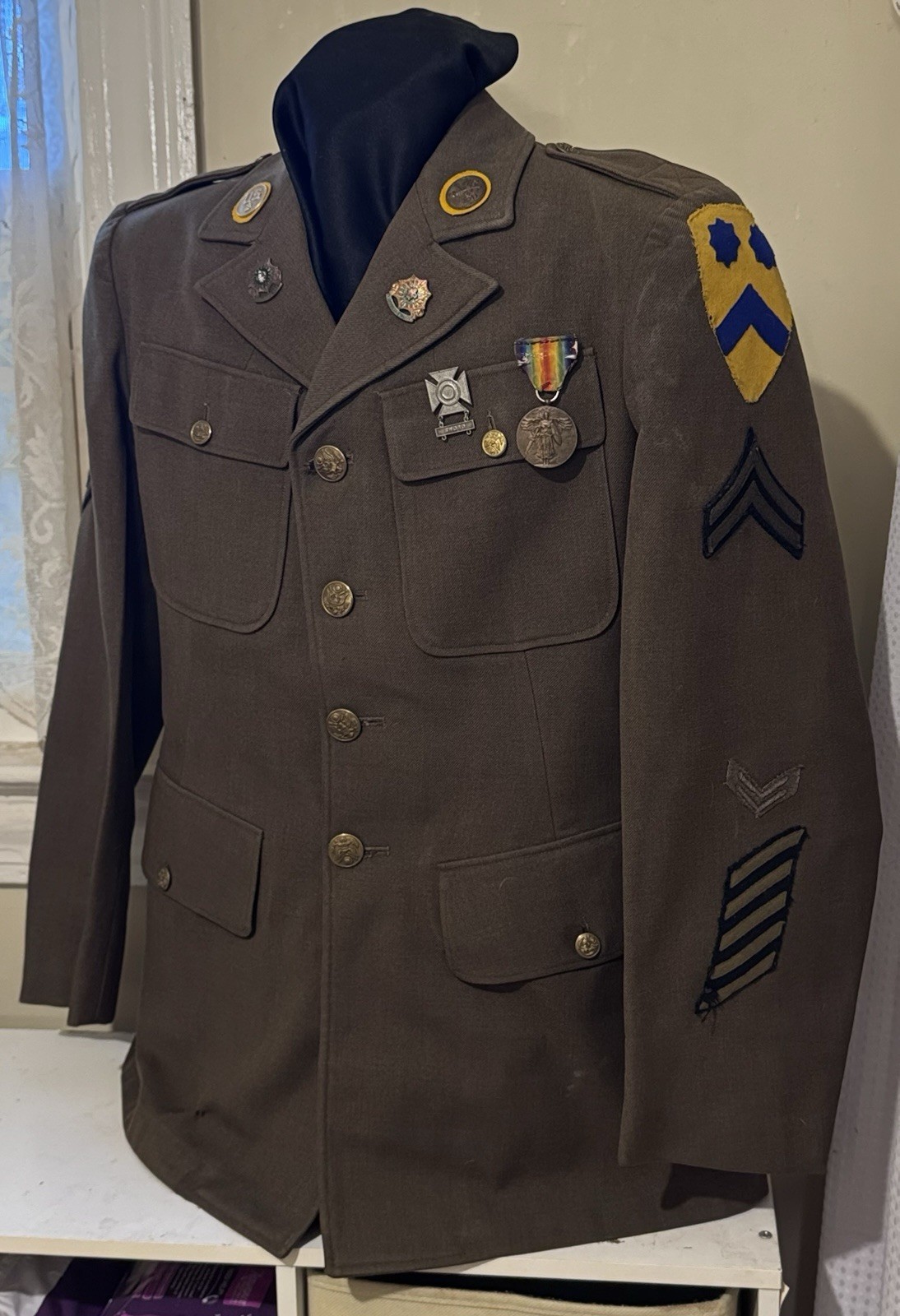
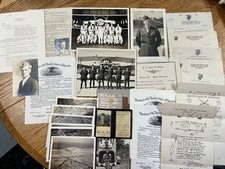
For your consideration is this;• Pre WWII M1926 Spec 8-31B Mustard Whipcord Wool Service Coat MFG by the Philadelphia Quartermaster Depot circa 1930-33. This coat was issued by and identified Cpl R. Childers (28312). Cpl Childers served with Machine Gun Troop, 2nd Cavalry. I have discovered a 1930 Christmas Card for MG TROOP, 2nd Cavalry showing
Roy E Childers is a Sgt by Christmas of 1930.I have discovered a picture of him in his WWI uniform on ancestry.com• Machine Gun Troop, 2d Cavalry, 3d Cavalry Bde circa 1930’s. TIME PERIOD:
This coat dates from 1930 through 1936. The MG TR, 2d CAVALRY was absolutely active within the early 1930’s.The 2nd Cavalry Division was a Division strictly on paper, that said, the 3d & 4th Bde’s were active in the 1930’s and wore the 2d Cavalry Division’s SSI.As the 2nd & 14th Cavalry were assigned to the 3rd Cavalry Brigade during the early 1930’s.The 9th & 10th Cavalry were assigned to the 4th Cavalry Brigade during the same period.The 2d Cavalry DIV wasn’t activated until 1941 but there are very early mutton and twill wool patches that date WELL before the embroidery patches of the 1940’s. It’s simple. The Brigades wore the 2D CAV DIV SSI’s even though it was a paper unit up to 1941.October 15, 1940, Headquarters, 3d Cavalry Brigade (part of the U.S. Army's 2d Cavalry Division) was activated, at Fort Riley, Kansas.The 3rd Cavalry Brigade wore the SSI of the 2nd Cavalry Division between 15 Oct 1940 and 1 April 1941.This is the reason why you will see multiple variants of the 2nd Cavalry Division SSI. For example this coats SSI is Blue Twill wool sewn onto a cavalry yellow twill wool field.2D Cavalry DIV Variants:
Towards 1 April 1941 you will see embroidered blue silk on cavalry yellow mutton or twill and lastly you will see fully embroidered 2d cavalry division patches that look not much different to contemporary 1st Cavalry Division patches.Fort Riley, Kansas (1919–1942): Following WWI, the troop relocated to Fort Riley. Throughout the interwar period, it remained active here, serving as a weapons testing and demonstration unit for the elite Cavalry School until the regiment was temporarily inactivated and mechanized in July 1942.
Description:Design: A four-pocket olive-drab wool service coat featuring a notched lapel that could also be buttoned completely closed at the neck with a throat tab for winter weather.Material: Typically constructed of whipcord wool fabric with a cotton silk mix liningManufacturer: Philadelphia Quartermaster Depot Condition:
This is a museum quality coat and displays very nicely.Coat Contains:• M1926 Spec 8-31B Wool Service Coat id’d Cpl R. Childers (28312)
• M1926 Type II Collar Disc • “US 2”
Yellow Twill Disc
• M1926 Type II Collar Disc • “MG Crossed Sabers”
Yellow Twill Disc
• 2nd U.S. cavalry DI Screw Back x 2
• Qualification Badge • SWORD (Sterling Silver)
• WWI MedalHistory of Machine Gun Troop, 2d Cavalry;Garrison: Fort Riley, Kansas.The Machine Gun Troop of the 2nd Cavalry was stationed at Fort Riley, Kansas, during the 1930s, maintaining horse-mounted machine gun capabilities before the U.S. Army transitioned toward mechanization in the late 1930s.2D CAVALRY DIVISION:•First Active Period: 15.5 Months• April 1, 1941 – July 15, 1942•What happened: Following its activation, the racially mixed division trained intensely and participated in the massive 1941 Louisiana Maneuvers. However, the onset of WWII forced the military to prioritize armored divisions over horse cavalry.• The First Inactivation: On July 15, 1942, the division was inactivated. Its white personnel and assets were transferred out to build the newly forming 9th Armored Division2) Second Active Period: 14.5 Months• February 25, 1943 – May 10, 1944• What happened: Due to a massive influx of Black enlistees, the War Department chose to reactivate the 2d Cavalry Division on February 25, 1943, restructuring it as a mounted, all-Black division. They spent the rest of the year training at Fort Clark, Texas• What happened: Due to a massive influx of Black enlistees, the War Department chose to reactivate the 2d Cavalry Division on February 25, 1943, restructuring it as a mounted, all-Black division. They spent the rest of the year training at Fort Clark, Texas