

|
Site Categories |
|
Featured Items |

Poodle, Spaghetti Trim, Ucagco


|
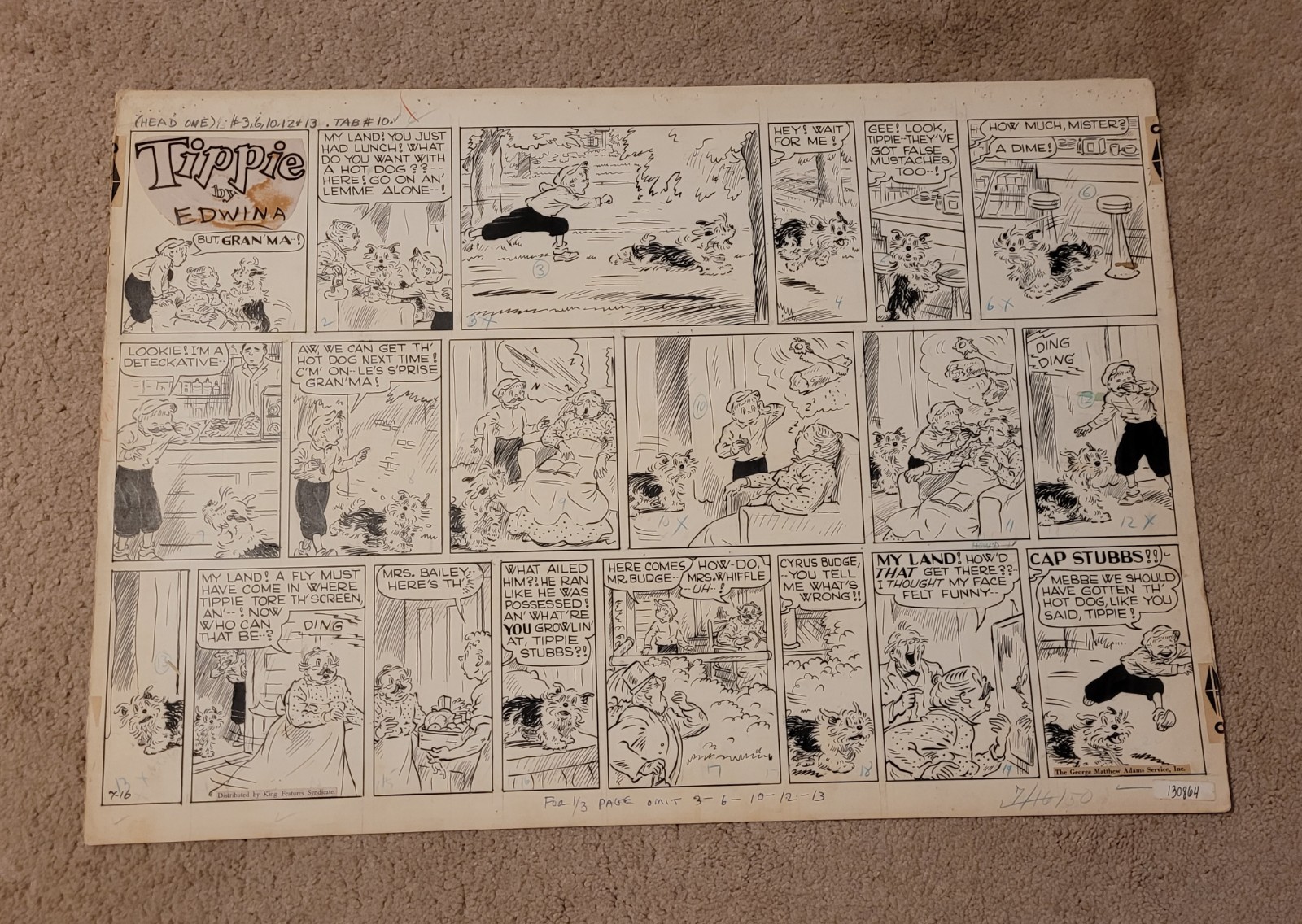
Original Edwina Dumm Tippie Comic Strip Art Sunday Page 1950 Female Cartoonist For Sale

When you click on links to various merchants on this site and make a purchase, this can result in this site earning a commission. Affiliate programs and affiliations include, but are not limited to, the eBay Partner Network.

Original Edwina Dumm Tippie Comic Strip Art Sunday Page 1950 Female Cartoonist:
$1500.00
Offered here is a rare, large-scale piece of American comic history: an original hand-drawn Sunday comic strip by Edwina Dumm (1893–1990). Dumm was a trailblazer as the first woman in the U.S. to work as a full-time editorial cartoonist. This piece features her most famous characters—the boy Cap Stubbs and his dog Tippie—and was created during the height of her career in the mid-1940s. +1 Biographies & History Edwina Dumm: A pioneer for women in the arts, Dumm began her career in 1916. She eventually moved to New York City, where she resided at the address noted on the back of this board. She was a member of the National Cartoonists Society and is celebrated for her ability to infuse animals with human-like personality without losing their \"dog-ness.\" +1The Strip: Cap Stubbs and Tippie focused on the adventures of a young boy and his dog. It was widely syndicated by the George Matthew Adams Service. This particular 1945 strip showcases the \"domestic bedlam\" that made the comic a staple in American households for decades.
Product Specifications Keywords for Search Edwina Dumm, Original Comic Art, Female Illustrator, Women\'s History, 1940s Sunday Strip, Tippie Dog Art, Cap Stubbs, Antique Cartoon Art, Illustration Board, Golden Age Comics, Newspaper Syndicate Art, Rare Ephemera.
\'Cap Stubbs and Tubbie\'.Dumm received her first job as a staff artist at the newspaper the Daily Monitor in 1915, for which she made spot illustrations, portraits of politicians and an editorial cartoon. She created her comic strip \'Cap Stubbs and Tippie\' for Adams Syndication Service as a daily strip in 1918, and a Sunday page was added in 1934.Tippy, by Edwina (1941)
\'Cap Stubbs and Tibbie\'.The strip was initially about a Mark Twain-inspired boy and scruffy dog, but the dog soon gained in popularity. Therefore, the title was changed to \'Cap Stubbs and Tippie\' and eventually to simply \'Tippie\' in the mid-1960s. \'Tippie\' was also turned into a weekly feature in Life magazine and the London Tatler, but the dog\'s name in this version was \'Sinbad\'.This image comes from Cartoons Magazine, Volume 11 Number 1 circa January 1917. The text reads... She is a \"regular\" cartoonist and has her workshop in a real newspaper office amid the click of telegraph instruments and typewriters. She is Miss Edwina Dumm, of the Columbus Daily Monitor, and one of the few women cartoonists in the United States. She had always wanted to be a cartoonist, so she went to work to pay for an art education, thus showing a lot of spunk and independence. she is quite old, being in her early twenties, and is a daughter of a newspaper man. Below is one of her cartoons.\"Quite old\" -- HA! Wonder what they would\'ve said when she retired... FORTY-NINE YEARS LATER! Or when she finally died TWENTY-FOUR YEARS AFTER THAT at age 97!Anyway, Edwina (as she signed all her strips) started doing political cartoons, often of a pro-suffrage nature, at the Columbus Daily Monitor a year before the above piece ran. She then started a regular strip called The Meanderings of Minnie, but she soon picked up a national sydicate. She moved to New York and changed the strip\'s lead to a boy, renaming it Cap Stubbs and Tippie. (The Sundays featured primarily Cap\'s dog and were simply called Tippie.) It ran until her retirement in 1966.In the 1930s, she also began a weekly strip in Life called Sinbad and a second newspaper strip titled Alec the Great. All three of her strips took their names from the dog she would use as a lead character, and all of their designs were based on her own short-haired pups. In fact, her dog from that time was himself named Sinbad. But her practice made her quite adept at drawing dogs, that short-haired one in particular, and Trina Robbins called her \"a dog artist par excellence, possibly the best in the 20th century.\"
Born July 21, 1893 in Upper Sandusky, Ohio, Edwina Frances Dumm never thought twice about being a woman in the male dominated field of cartooning. In a time when women could not vote, she believed that her talent as an artist was all she needed in order to be successful. Her family encouraged Edwina\'s sense of independence and permitted her to become a vegetarian at an early age.Edwina was a little girl who loved to draw. She admired the illustrations for novels such as Lewis Carroll\'s Through the Looking Glass and Alice in Wonderland, but Mark Twain\'s Huckleberry Finn and Tom Sawyer inspired her more. The troublesome but lovable boy characters in these novels would later influence Edwina\'s comic strip \"Cap Stubbs and Tippie\". But for Edwina it was Mark Twain\'s worldview that affected her more. \"You know what Mark Twain said?\" she remarked in a 1985 interview. \"He said he\'d never let school interfere with his education.\" Mark Twain\'s idea that personal experience was worth more than formal education stayed with Edwina throughout her high school years. In her senior year, she learned of a new requirement that would force her to take chemistry, a subject she neither liked nor thought necessary for her future. With a group of classmates, Edwina protested the requirement. She was the only student to stand her ground, eventually getting permission to have the requirement waived.When her family moved to Columbus in 1911, Edwina admitted that she saw no reason to go to high school. \"I never wanted to go to school,\" she recalled. \"I swore when I got out of high school that I\'d never go in a school as long as I lived.\"For as long as sketching and drawing had been a staple in Edwina\'s life, so had pursing her dream of moving to New York City to work as an artist. While her family supported this dream, her father urged her to be sure that she had a back-up plan should a career in art not pay the bills. After graduating from high school, Edwina took a job as a stenographer for the Columbus Board of Education and enrolled in a cartooning correspondence course from the Landon School in Cleveland. Upon completing the course, she applied to be a staff artist at at the Daily Monitor, a new weekly newspaper. She was hired, and began drawing spot illustrations, portraits of politicians and an editorial cartoon. Her work was first published on August 7, 1915. Her first signed cartoon appeared November 27, 1915.The Monitor began daily publication in July 1916 and Edwina began drawing a daily editorial cartoon at that time. She was the first woman in the nation to work as an editorial cartoonist for a daily newspaper. Recalling her time on the Monitor, Edwina said,. \"I thought you had to know a lot about the politics of the past... [but] all you had to know at that time--and possibly today--was what was going on that day and the policy of the paper.\"Relying at first on her father for political information, Edwina was soon on her own after he suffered a stroke. Edwina adapted quickly and produced cartoons dealing with issues such as the Mexican War, World War I, prohibition, the economy, and women\'s suffrage. She drew on the experiences of her friends, some of whom were in the military during the time of the Mexican War, and her own personal viewpoints, such as her views on women\'s suffrage. Artistic and witty, her cartoons were published for two years until the Monitor ceased in 1917.Edwina\'s time at the Daily Monitor gave her enough experience and savings to fulfill her dream of moving to New York City. She immediately went to see George Matthew Adams, a newspaper columnist and founder of the Adams Syndication Service. She had sent him copies of a comic strip that she had created for the \"Spotlight Sketches\" humor page of the Monitor. \"The Meanderings of Minnie\" focused on a girl and her dog. Adams liked her work and offered her a contract to draw a comic strip that would run six days a week (no Sunday pages) for his syndicate. Edwina changed her character from a girl to a boy, and her new creation \"Cap Stubbs and Tippie\" premiered in 1918. A Sunday page was added in 1934.\"Cap Stubbs and Tippie\" followed the adventures of a mischievous little boy and his shaggy dog. Continuing for almost half a century, the strip amused audiences with its humor and warmth. The lovable pooch and his family inspired several related works, including short stories written by Edwina and sheet music by her New York City roommate Helen Thomas, which Edwina illustrated. Edwina\'s love for dogs made its way into many of her other works as well, such as \"Sinbad\" and \"Alec the Great,\" both published during the run of \"Cap Stubbs.\" \"Sinbad,\" named after a reader contest, was published in Life magazine and the London-based Tatler, and later reprinted in Sinbad: A Dog\'s Life, in 1930. \"Alec the Great,\" which was syndicated from 1931 to 1969, was a single panel cartoon of a dog accompanied by short verses written by her brother, Robert Dumm. These were reprinted in Alec the Great: 1,001 Verses Wise, Witty and Cheerful in 1946.Edwina\'s success in New York City expanded well beyond her comic strips. She illustrated several books, such as Two Gentlemen and a Lady by Alexander Woolcott and Burges Johnson\'s Sonnets from the Pekinese. She achieved her dream of creating a cover for Life magazine in 1930 when she illustrated the cover for its January issue. Edwina\'s achievements were honored in 1978, when she received the Gold Key Award from the National Cartoonists Society Hall of Fame, making her the only woman to receive this honor.Throughout her life and well into her retirement, Edwina\'s love for sketching and drawing continued beyond her published cartoons. She produced a variety of drawings and paintings, most of which were done while traveling on the subway in New York City. Her self titled \"subway sketches,\" while never formally published, demonstrate the depth of her artistic talent in her realistic watercolors of people, animals, and crowds, and remain today to be some of her finest pieces of work. Created simply for her own amusement, these works of art clearly show a side of Edwina that wasn\'t seen in her cartoons and comic strips.After dedicating more than fifty years of her life to creating cartoon art, Edwina Dumm retired from cartooning in 1966 at the age of seventy-three. She died in New York City on April 28, 1990.Edwina Dumm was the first female to draw political cartoons regularly for a daily newspaper in America. She was born in 1893 in Ohio. Her father was an entertainer who got into the newspaper business. Edwina, fascinated by publishing and having a penchant for drawing, took a correspondence course in art and eventually landed a position with the Columbus Daily Monitor in Ohio. To be clear, Ms Dumm was not the first female to publish political cartoons in the United States, just the first one to publish cartoons on a daily basis for a newspaper. There are many examples of other women publishing political cartoons in journals, especially suffrage journals, before Dumm.The Columbus Daily Monitor only ran from July 10, 1916 to July 5, 1917, but Dumm’s contribution to the newspaper is its most enduring aspect. In the early 20th century, women did not get many opportunities to express themselves politically, and a neophyte newspaper would be the ideal place for a woman to exploit for that purpose. She was talented and motivated, and in the culture of separate spheres, demanded less money than the men. What more could a newspaper want?Shown below, “Lost Argument” is, perhaps Dumm’s best known cartoon. In it she suggests that women should be recruited for World War I and that they have many of the necessary skills. However, true to the chivalry of the times and from the look of the commanding officer reviewing the recruits, it ain’t gonna happen.edwina-dumm-lost-argumentIn her book, Cartooning for Suffrage, Alice Sheppard cites several examples of women’s rights and suffrage cartoons by Dumm, including the one above. However, the following Dumm cartoon shows how scathing her criticism of the American suffrage imbalance could be. When Russia gave women the right to vote in 1917, she suggests that if a politically unstable country can grant the vote to women, surely an established country like the United States can as well.edwina-dumm-fashion-hintsPulitzer Prize editorial cartoonist, Signe Wilkinson says of women political cartoonists in the early 20th century, “After the suffrage campaign succeeded, these cartoons vanished from the printed page, leaving rare, brittle clippings and the 19th Amendment as the only traces of their public lives.”[1] And while that happened to most women cartoonists, Dumm’s career ended because the Daily Monitor went out of business two years before the passage of the Susan B. Anthony Amendment.Of political cartooning for a newspaper, Dumm said the only discrimination she experienced was that she was not invited to socialize with the other political cartoonists drawing for various newspapers in Columbus at the time. However, she did have to contend with at least one condescending tribute to her efforts. An article in a 1917 issue of the magazine Cartoons begins, “She is a ‘regular’ cartoonist and has her workshop in a real newspaper office amid the click of telegraph instruments and typewriters.” When the Monitor went belly-up, no other newspaper in Columbus would hire her; however, she was able to land on her feet. She moved to New York City and achieved her more notable cartooning legacy. She created a cartoon strip called “Capp Stubbs and Tippie” (shown below) that was syndicated nationally.capp-stubbs-and-tippieShe also worked on other comic strips and illustrated children’s books until she retired in 1966. Her retirement included painting watercolors of people in the New York Subways (below).The Golden Age of Comic Books describes an era in the history of American comic books from 1938 to 1956. During this time, modern comic books were first published and rapidly increased in popularity. The superhero archetype was created and many well-known characters were introduced, including Superman, Batman, Robin, Captain Marvel, Captain America, and Wonder Woman.
EtymologyThe first recorded use of the term \"Golden Age\" was by Richard A. Lupoff in an article, \"Re-Birth\", published in issue one of the fanzine Comic Art in April 1960.[1]
HistoryAn event cited by many as marking the beginning of the Golden Age was the 1938 debut of Superman in Action Comics #1,[2][3] published by Detective Comics[4] (predecessor of DC Comics). Superman\'s popularity helped make comic books a major arm of publishing,[5] which led rival companies to create superheroes of their own to emulate Superman\'s success.[6][7]
World War II
Comic-book cover with a caped, red-costumed Captain Marvel throwing a car into a wall
Whiz Comics #2 (Feb. 1940), with the first appearance of Captain Marvel
Cover art by C. C. BeckBetween 1939 and 1941 Detective Comics and its sister company, All-American Publications, introduced popular superheroes such as Batman and Robin, Wonder Woman, The Flash, Green Lantern, Doctor Fate, the Atom, Hawkman, Green Arrow and Aquaman.[8] Timely Comics, the 1940s predecessor of Marvel Comics, had million-selling titles featuring the Human Torch, the Sub-Mariner, and Captain America.[9] Although DC and Timely characters are well remembered today, circulation figures suggest that the best-selling superhero title of the era was Fawcett Comics\' Captain Marvel Adventures with sales of about 1.4 million copies per issue. The comic was published biweekly at one point to capitalize on its popularity.[10] Another notable series was The Spirit by Will Eisner, which deviated from the usual publishing model of the period as a weekly multi-page supplement in the Register and Tribune Syndicate newspapers for which Eisner held the copyright, a rare consideration for creators of that period.Patriotic heroes donning red, white, and blue were particularly popular during the time of the Second World War following the Shield\'s debut in 1940.[11] Many heroes of this time period battled the Axis powers, with covers such as Captain America Comics #1 (cover-dated March 1941) showing the title character punching Nazi leader Adolf Hitler.[12]As comic books grew in popularity, publishers began launching titles that expanded into a variety of genres. Dell Comics\' non-superhero characters (particularly the licensed Walt Disney animated-character comics) outsold the superhero comics of the day.[13] The publisher featured licensed movie and literary characters such as Mickey Mouse, Donald Duck, Roy Rogers and Tarzan.[14] It was during this era that noted Donald Duck writer-artist Carl Barks rose to prominence.[15] Additionally, MLJ\'s introduction of Archie Andrews in Pep Comics #22 (December 1941) gave rise to teen humor comics,[16] with the Archie Andrews character remaining in print well into the 21st century.[17]At the same time in Canada, American comic books were prohibited importation under the War Exchange Conservation Act,[18] which restricted the importation of non-essential goods. Canadian publishers responded to this lack of competition by producing titles of their own, informally called the Canadian Whites. While these titles flourished during the war, they did not survive the lifting of trade restrictions afterwards.
Post-war and shift from superheroesThe term Atomic Age of Comic Books is sometimes used to describe a brief time period, starting with either the end of World War II in 1945 or in 1948 with the first outcry of Fredric Wertham,[19][20] and lasting until the mid-1950s. Some authors consider this an interregnum period or an era in its own right,[21][22] but most regard it as still part of the Golden Age. During this time, the popularity of superhero comics waned. To retain reader interest, comic publishers diversified into other genres, such as war, Westerns, science fiction, romance, crime and horror.[23] Many superhero titles were canceled or converted to other genres.[citation needed]In 1946, DC Comics\' Superboy, Aquaman and Green Arrow were switched from More Fun Comics into Adventure Comics so More Fun could focus on humor.[24] In 1948 All-American Comics, featuring Green Lantern, Johnny Thunder and Dr. Mid-Nite, was replaced with All-American Western.[citation needed] The following year, Flash Comics and Green Lantern were canceled.[citation needed] In 1951 All Star Comics, featuring the Justice Society of America, became All-Star Western. The next year Star Spangled Comics, featuring Robin, was retitled Star Spangled War Stories.[citation needed] Sensation Comics, featuring Wonder Woman, was canceled in 1953.[citation needed] The only superhero comics published continuously through the entire 1950s were Action Comics, Adventure Comics, Batman, Detective Comics, Superboy, Superman, Wonder Woman and World\'s Finest Comics.[25] Plastic Man appeared in Quality Comics\' Police Comics until 1950, when its focus switched to detective stories; his solo title continued bimonthly until issue 52, cover-dated February 1955.Timely Comics\' The Human Torch was canceled with issue #35 (March 1949)[26] and Marvel Mystery Comics, featuring the Human Torch, with issue #93 (Aug. 1949) became the horror comic Marvel Tales.[27] Sub-Mariner Comics was canceled with issue #42 (June 1949) and Captain America Comics, by then Captain America\'s Weird Tales, with #75 (Feb. 1950). Harvey Comics\' Black Cat was canceled in 1951 and rebooted as a horror comic later that year—the title would change to Black Cat Mystery, Black Cat Mystic, and eventually Black Cat Western for the final two issues, which included Black Cat stories.[28] Lev Gleason Publications\' Daredevil was edged out of his title by the Little Wise Guys in 1950.[29] Fawcett Comics\' Whiz Comics, Master Comics and Captain Marvel Adventures were canceled in 1953, and The Marvel Family was canceled the following year.[30]Also during this period, the mass media with the advent of television were forcing media companies to put out comics that reflected the popular culture of the time period. Comic books focused on space, mystery, and suspense that television and other forms of media were turning to in the march toward scientific progress.[31] According to historian Michael A. Amundson, appealing comic-book characters helped ease young readers\' fear of nuclear war and neutralize anxiety about the questions posed by atomic power.[32] It was during this period that long-running humor comics debuted, including EC Comics\' series Mad and Dell\'s series Uncle Scrooge (both in 1952).[33][34]
End of the eraIn 1953, the comic book industry hit a setback when the United States Senate Subcommittee on Juvenile Delinquency was created in order to investigate the problem of juvenile delinquency.[35] After the publication of Fredric Wertham\'s Seduction of the Innocent the following year that claimed comics sparked illegal behavior among minors, comic book publishers such as EC\'s William Gaines were subpoenaed to testify in public hearings.[36] As a result, the Comics Code Authority was created by the Association of Comics Magazine Publishers to enact self-censorship by comic book publishers.[37] At this time, EC canceled its crime and horror titles and focused primarily on Mad.[37] The Silver Age of Comic Books is recognized by some as beginning with the debut of the first successful new superhero since the Golden Age, DC Comics\' new Flash, in Showcase #4 (Oct. 1956).[38][39][40]
See also iconComics portal1930s portal1940s portal1950s portal Silver Age of Comic Books
Bronze Age of Comic Books
Modern Age of Comic Books
List of Golden Age comics publishers
List of Marvel Comics Golden Age characters
Golden Age of Science Fiction
Frances Edwina Dumm (1893 – April 28, 1990) was a writer-artist who drew the comic strip Cap Stubbs and Tippie for nearly five decades; she is also notable as America\'s first full-time female editorial cartoonist. She used her middle name for the signature on her comic strip, signed simply Edwina.Biography
One of the earliest female syndicated cartoonists, Dumm was born in Upper Sandusky, Ohio, and lived in Marion and Washington Courthouse, Ohio throughout her youth before the family settled down in Columbus.[1] Anna Gilmore Dennis was her mother, and her father, Frank Edwin Dumm, was a playwright-actor who later worked as a newspaper reporter. Dumm\'s paternal grandfather, Robert D. Dumm, owned a newspaper in Upper Sandusky which Frank Dumm later inherited. Her brother, Robert Dennis Dumm, was a reporter for the Columbus Dispatch, and art editor for Cole Publishing Company\'s Farm & Fireside magazine.In 1911, she graduated from Central High School in Columbus, Ohio, and then took the Cleveland-based Landon School of Illustration and Cartooning correspondence course. Her name was later featured in Landon\'s advertisements. While enrolled in the correspondence course, she also took a business course and worked as a stenographer at the Columbus Board of Education.In 1915, Dumm was hired by the short-lived Republican newspaper, the Columbus Monitor, to be a full-time cartoonist.[2] Her first cartoon was published on August 7, 1915, in the debut issue of the paper. During her years at the Monitor she provided a variety of features including a comic strip called The Meanderings of Minnie about a young tomboy girl and her dog, Lillie Jane, and a full-page editorial cartoon feature, Spot-Light Sketches[3]. She drew editorial cartoons for the Monitor from its first edition (August 7, 1915) until the paper folded (July 1917). In the Monitor, her Spot-Light Sketches was a full-page feature of editorial cartoons, and some of these promoted women\'s issues. Elisabeth Israels Perry, in the introduction to Alice Sheppard\'s Cartooning for Suffrage (1994), wrote that artists such as Blanche Ames Ames, Lou Rogers and Edwina Dumm produced:...a visual rhetoric that helped create a climate more favorable to change in America\'s gender relations... By the close of the suffrage campaign, women\'s art reflected the new values of feminism, broadened its targets, and attempted to restate the significance of the movement.[4]After the Monitor folded, Dumm moved to New York City, where she continued her art studies at the Art Students League. She was hired by the George Matthew Adams Service[5] to create Cap Stubbs and Tippie, a family strip following the lives of a boy Cap, his dog Tippie, their family, and neighbors. Cap\'s grandmother, Sara Bailey, is prominently featured, and may have been based on Dumm\'s own grandmother, Sarah Jane Henderson, who lived with their family. The strip was strongly influenced by Mark Twain’s Adventures of Huckleberry Finn, as well as Dumm’s favorite comic, Buster Brown by Richard F. Outcault. Dumm worked very fast; according to comics historian Martin Sheridan, she could pencil a daily strip in an hour.[6]Her love of dogs is evident in her strips as well as her illustrations for books and magazines, such as Sinbad, her weekly dog page which ran in both Life and the London Tatler. She illustrated Alexander Woollcott\'s Two Gentlemen and a Lady. For Sonnets from the Pekinese and Other Doggerel (Macmillan, 1936) by Burges Johnson (1877–1963), she illustrated \"Losted\" and other poems.From the 1931 through the 1960s, she drew another dog for the newspaper feature Alec the Great, in which she illustrated verses written by her brother, Robert Dennis Dumm. Their collaboration was published as a book in 1946. In the late 1940s, she drew the covers for sheet music by her friend and neighbor, Helen Thomas, who did both music and lyrics. During the 1940s, she also contributed Tippie features to various comic books including All-American Comics and Dell Comics.In 1950, Dumm, Hilda Terry, and Barbara Shermund became the first women to be inducted into the National Cartoonists Society.[7]When the George Matthew Adams Service went out of business in 1965, Dumm\'s strip was picked up by The Washington Star Syndicate. Dumm continued to write and draw Tippie until her 1966 retirement (which brought the strip to an end).[8]Personal life
Dumm never married. After she retired from her comic strip, she remained active with watercolor paintings, photography and helping the elderly at her New York City apartment building when she was well into her eighties.Awards
She was a recipient of the National Cartoonists Society Gold Key Award in 1978, and remained the only woman to win this award until 2013.Edwina Dumm was one of the first female cartoonists. She was born in 1893 in Upper Sandusky, Ohio. Her father, Frank Edwin Dumm, was an actor and playwright who later became a newspaperman. Edwina was inspired by her father\'s new job to become a political and editorial cartoonist. She took a correspondence course at the Landon School of illustrating and cartooning and sent out many samples of her work to syndicates, and eventually moved to New York.Cap Stubbs by Edwin Dumm
\'Cap Stubbs and Tubbie\'.Dumm received her first job as a staff artist at the newspaper the Daily Monitor in 1915, for which she made spot illustrations, portraits of politicians and an editorial cartoon. She created her comic strip \'Cap Stubbs and Tippie\' for Adams Syndication Service as a daily strip in 1918, and a Sunday page was added in 1934.Tippy, by Edwina (1941)
\'Cap Stubbs and Tibbie\'.The strip was initially about a Mark Twain-inspired boy and scruffy dog, but the dog soon gained in popularity. Therefore, the title was changed to \'Cap Stubbs and Tippie\' and eventually to simply \'Tippie\' in the mid-1960s. \'Tippie\' was also turned into a weekly feature in Life magazine and the London Tatler, but the dog\'s name in this version was \'Sinbad\'.Sindbad by Edwina Dumm
\'Sindbad\'.Between 1931 and 1969, Dumm also created the poetic \'Alec the Great\' panels, also about a dog, scripted by her brother, Robert Dennis Dumm. In 1978, she was the first woman to receive the Gold Key Award from the National Cartoonists Society Hall of Fame. Edwina Dumm also made illustrations for (children\'s) books and retired in 1966, after a long and successful career. She then devoted herself to painting watercolor portraits, and making sketches while riding the subway.Born July 21, 1893 in Upper Sandusky, Ohio, Edwina Frances Dumm never thought twice about being a woman in the male dominated field of cartooning. In a time when women could not vote, she believed that her talent as an artist was all she needed in order to be successful. Her family encouraged Edwina\'s sense of independence and permitted her to become a vegetarian at an early age.Edwina was a little girl who loved to draw. She admired the illustrations for novels such as Lewis Carroll\'s Through the Looking Glass and Alice in Wonderland, but Mark Twain\'s Huckleberry Finn and Tom Sawyer inspired her more. The troublesome but lovable boy characters in these novels would later influence Edwina\'s comic strip \"Cap Stubbs and Tippie\". But for Edwina it was Mark Twain\'s worldview that affected her more. \"You know what Mark Twain said?\" she remarked in a 1985 interview. \"He said he\'d never let school interfere with his education.\" Mark Twain\'s idea that personal experience was worth more than formal education stayed with Edwina throughout her high school years. In her senior year, she learned of a new requirement that would force her to take chemistry, a subject she neither liked nor thought necessary for her future. With a group of classmates, Edwina protested the requirement. She was the only student to stand her ground, eventually getting permission to have the requirement waived.When her family moved to Columbus in 1911, Edwina admitted that she saw no reason to go to high school. \"I never wanted to go to school,\" she recalled. \"I swore when I got out of high school that I\'d never go in a school as long as I lived.\"For as long as sketching and drawing had been a staple in Edwina\'s life, so had pursing her dream of moving to New York City to work as an artist. While her family supported this dream, her father urged her to be sure that she had a back-up plan should a career in art not pay the bills. After graduating from high school, Edwina took a job as a stenographer for the Columbus Board of Education and enrolled in a cartooning correspondence course from the Landon School in Cleveland. Upon completing the course, she applied to be a staff artist at at the Daily Monitor, a new weekly newspaper. She was hired, and began drawing spot illustrations, portraits of politicians and an editorial cartoon. Her work was first published on August 7, 1915. Her first signed cartoon appeared November 27, 1915.The Monitor began daily publication in July 1916 and Edwina began drawing a daily editorial cartoon at that time. She was the first woman in the nation to work as an editorial cartoonist for a daily newspaper. Recalling her time on the Monitor, Edwina said,. \"I thought you had to know a lot about the politics of the past... [but] all you had to know at that time--and possibly today--was what was going on that day and the policy of the paper.\"Relying at first on her father for political information, Edwina was soon on her own after he suffered a stroke. Edwina adapted quickly and produced cartoons dealing with issues such as the Mexican War, World War I, prohibition, the economy, and women\'s suffrage. She drew on the experiences of her friends, some of whom were in the military during the time of the Mexican War, and her own personal viewpoints, such as her views on women\'s suffrage. Artistic and witty, her cartoons were published for two years until the Monitor ceased in 1917.Edwina\'s time at the Daily Monitor gave her enough experience and savings to fulfill her dream of moving to New York City. She immediately went to see George Matthew Adams, a newspaper columnist and founder of the Adams Syndication Service. She had sent him copies of a comic strip that she had created for the \"Spotlight Sketches\" humor page of the Monitor. \"The Meanderings of Minnie\" focused on a girl and her dog. Adams liked her work and offered her a contract to draw a comic strip that would run six days a week (no Sunday pages) for his syndicate. Edwina changed her character from a girl to a boy, and her new creation \"Cap Stubbs and Tippie\" premiered in 1918. A Sunday page was added in 1934.\"Cap Stubbs and Tippie\" followed the adventures of a mischievous little boy and his shaggy dog. Continuing for almost half a century, the strip amused audiences with its humor and warmth. The lovable pooch and his family inspired several related works, including short stories written by Edwina and sheet music by her New York City roommate Helen Thomas, which Edwina illustrated. Edwina\'s love for dogs made its way into many of her other works as well, such as \"Sinbad\" and \"Alec the Great,\" both published during the run of \"Cap Stubbs.\" \"Sinbad,\" named after a reader contest, was published in Life magazine and the London-based Tatler, and later reprinted in Sinbad: A Dog\'s Life, in 1930. \"Alec the Great,\" which was syndicated from 1931 to 1969, was a single panel cartoon of a dog accompanied by short verses written by her brother, Robert Dumm. These were reprinted in Alec the Great: 1,001 Verses Wise, Witty and Cheerful in 1946.Edwina\'s success in New York City expanded well beyond her comic strips. She illustrated several books, such as Two Gentlemen and a Lady by Alexander Woolcott and Burges Johnson\'s Sonnets from the Pekinese. She achieved her dream of creating a cover for Life magazine in 1930 when she illustrated the cover for its January issue. Edwina\'s achievements were honored in 1978, when she received the Gold Key Award from the National Cartoonists Society Hall of Fame, making her the only woman to receive this honor.Throughout her life and well into her retirement, Edwina\'s love for sketching and drawing continued beyond her published cartoons. She produced a variety of drawings and paintings, most of which were done while traveling on the subway in New York City. Her self titled \"subway sketches,\" while never formally published, demonstrate the depth of her artistic talent in her realistic watercolors of people, animals, and crowds, and remain today to be some of her finest pieces of work. Created simply for her own amusement, these works of art clearly show a side of Edwina that wasn\'t seen in her cartoons and comic strips.After dedicating more than fifty years of her life to creating cartoon art, Edwina Dumm retired from cartooning in 1966 at the age of seventy-three. She died in New York City on April 28, 1990.A cartoonist is a visual artist who specializes in both drawing and writing[1] cartoons (individual images) or comics (sequential images). Cartoonists differ from comics writers or comics illustrators/artists in that they produce both the literary and graphic components of the work as part of their practice.Cartoonists may work in a variety of formats, including booklets, comic strips, comic books, editorial cartoons, graphic novels, manuals, gag cartoons, storyboards, posters, shirts, books, advertisements, greeting cards, magazines, newspapers, webcomics, and video game packaging.Terminology
See also: Comics creator
A cartoonist\'s discipline encompasses both authorial and drafting disciplines[1] (see interdisciplinary arts). The terms \"comics illustrator\", \"comics artist\", or \"comic book artist\" refer to the picture-making portion of the discipline of cartooning[2] (see illustrator). While every \"cartoonist\" might be considered a \"comics illustrator\", \"comics artist\", or a \"comic book artist\", not every \"comics illustrator\", \"comics artist\", or a \"comic book artist\" is a \"cartoonist\".Ambiguity might arise when illustrators and writers share each other\'s duties in authoring a work.[3]History
Editorial cartoons
Main article: Editorial cartoon
The English satirist and editorial cartoonist William Hogarth, who emerged in the 18th century, poked fun at contemporary politics and customs; illustrations in such style are often referred to as \"Hogarthian\".[4] Following the work of Hogarth, editorial/political cartoons began to develop in England in the latter part of the 18th century under the direction of its great exponents, James Gillray and Thomas Rowlandson, both from London. Gillray explored the use of the medium for lampooning and caricature, calling the king (George III), prime ministers and generals to account, and has been referred to as the father of the political cartoon.[5]
Benjamin Franklin\'s Join, or Die (May 9, 1754), credited as the first cartoon published in an American newspaper
Origin in the U.S.
While never a professional cartoonist, Benjamin Franklin is credited with the first cartoon published in The Pennsylvania Gazette on May 9, 1754: Join, or Die, depicting the American colonies as segments of a snake.[6][7] In the 19th century, professional cartoonists such as Thomas Nast, whose work appeared in Harper\'s Weekly, introduced other familiar American political symbols, such as the Republican elephant.[6]Comic strips
Main article: Comic strip
ComicsSpeech balloon
Comics comics
Media formats
Comic bookComic stripDigital comicGag cartoonTrade paperbackGraphic novelLight novelPolitical cartoonWebcomicWebtoon
Comics by country and culture
American comicsArgentine comicsBande dessinées (Belgium/France/Quebec)Australian comicsBrazilian comicsBritish comics (Welsh-language)Canadian comicsCroatian comicsCzech comicsDutch comicsEuropean comicsGerman comicsHungarian comicsIndian comicsIrish comicsItalian comicsMalaysian comicsMangaManhua (Hong Kong)ManhwaMexican comicsPakistani comicsPhilippine comicsPolish comicsPortuguese comicsSerbian comicsSouth African comicsSpanish comicsThai comicsTurkish comicsVietnamese Comics portal
vte
Comic strips received widespread distribution to mainstream newspapers by syndicates.[8]Calum MacKenzie, in his preface to the exhibition catalog, The Scottish Cartoonists (Glasgow Print Studio Gallery, 1979) defined the selection criteria:The difference between a cartoonist and an illustrator was the same as the difference between a comedian and a comedy actor—the former both deliver their own lines and take full responsibility for them, the latter could always hide behind the fact that it was not his entire creation.[9]
Many strips were the work of two people although only one signature was displayed. Shortly after Frank Willard began Moon Mullins in 1923, he hired Ferd Johnson as his assistant. For decades, Johnson received no credit. Willard and Johnson traveled about Florida, Maine, Los Angeles, and Mexico, drawing the strip while living in hotels, apartments and farmhouses. At its peak of popularity during the 1940s and 1950s, the strip ran in 350 newspapers. According to Johnson, he had been doing the strip solo for at least a decade before Willard\'s death in 1958: \"They put my name on it then. I had been doing it about 10 years before that because Willard had heart attacks and strokes and all that stuff. The minute my name went on that thing and his name went off, 25 papers dropped the strip. That shows you that, although I had been doing it ten years, the name means a lot.\"[10]See also
Comics creator
Daily comic strip
Editorial cartoonist
Female comics creators
Glossary of comics terminology
List of cartoonists
List of newspaper comic strips
List of manga comics
Sunday strip
Webcomic
Societies and organizationsAssociation of American Editorial Cartoonists
Association of Illustrators
Cartoonists Rights Network International
Indian Institute of Cartoonists
National Cartoonists Society
Society of Illustrators of Los Angeles
Society of Children\'s Book Writers and Illustrators
Society of Illustrators
Society of Illustrators of Los Angeles
|
|
Related Items:
Original Edwina Dumm Tippie Comic Strip Art Sunday Page 1950 Female Cartoonist $1500.00
Original Edwina Dumm Tippie Comic Strip Art Sunday Page 1950 Female Cartoonist $1500.00
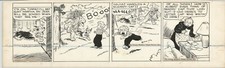
Edwina Dumm Cap Stubbs and Tippie Orig Ink Daily Comic Strip Art signed 1946 227 $89.99
|
|
|
Shopping Cart  |

|
Recently Viewed |
|
Latest Items |
|
Facebook |
Secure Websites

|
