When you click on links to various merchants on this site and make a purchase, this can result in this site earning a commission. Affiliate programs and affiliations include, but are not limited to, the eBay Partner Network.
The tournament of Roses Parade began on January 1, 1890 as a way to [promote Southern Californias’s warm winter weather. The Parade was sponsored by the Valley Hunt Club and featured horse-drawn carriages covered in flowers. The athletic competitions consisted on running races and tug-of-war.
In 1785, the event became so big that the Pasadena Tournament of Roses Association was formed.
In order to help fund the ever-growing festival, the first Rose Bowl football game was played in 1902 between Michigan and Stanford. It didn’t go well. Michigan was up 49-0 in the 3rd quarter and Stanford left the field and did not come back.
So the Association didn’t want another smear the following year and decided no more football for a while. Instead, the Rose Bowl Committee decided to have Ben-Hur style chariot races, ostrich races, and polo matches.
The second football game wouldn’t be played until 1916.
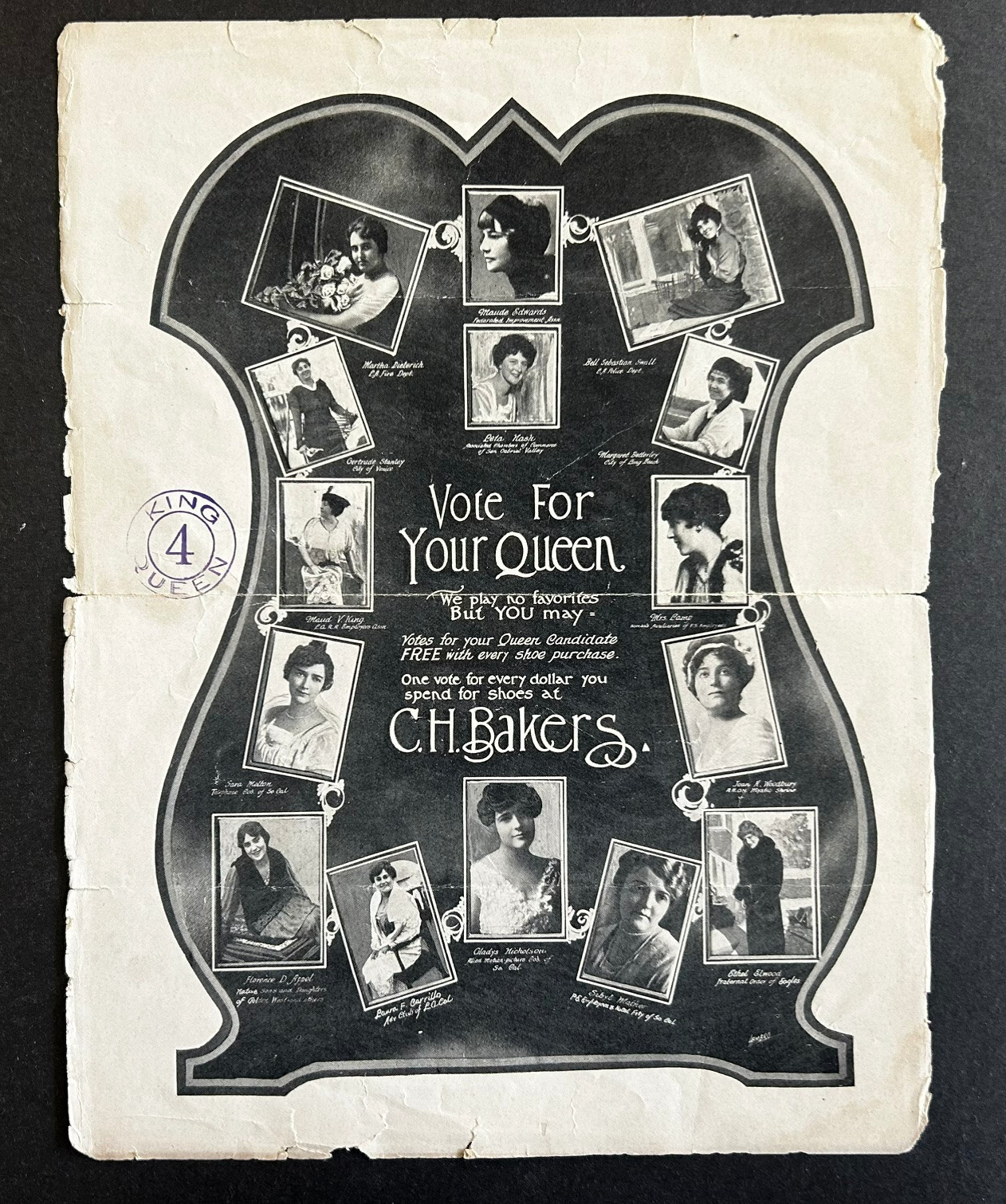
In 1904, C. H. Baker opened his first shoe store instincts. A few years later, he had a great promotional idea. So in 1907, he gave every customer a chance to vote for the Queen as long as they bought something. For every pair of shoes you bought, you could have one vote for Queen. Also, for every dollar you spent, you could have another vote.
In 1907, when the chariot races were still going on at the Tournament of Roses Parade, 15 women competed for the title of Rose Queen. That year, Joan H. Woodbury (who is pictured fourth from top on the right hand side of the candidates in this poster) was crowned Queen. Woodbury also was the first Rose Queen to be “crowned” in an official ceremony.
This original poster/flyer is made of lighter weight papered ha been horizontally folded some time in the last 119 years and is has a slight separation in spots. Luckily, it has no effect on the great graphics. Some of the edges are a bit rough but—again—with no effect on the graphics. The poster/flyer measures 7 1/2 x 10 inches.
I’m fairly certain that none of these exist and is a great piece of Rose Bowl early history.