When you click on links to various merchants on this site and make a purchase, this can result in this site earning a commission. Affiliate programs and affiliations include, but are not limited to, the eBay Partner Network.
“Michael Kabotie Lomawywesa was born on September 3, 1942 on the Hopi Indian Reservation in northeastern Arizona. He grew up in the village of Shungopavi and attended school on the reservation until the Hopi high school was closed. He graduated from Haskell Indian School in Lawrence, Kansas in 1961. While in his junior year there he was invited to spend the summer at the Southwest Indian Art Project at the University of Arizona. Participants included Fritz Scholder, Helen Hardin, Charles Loloma and Joe Hererra (who became a life long friend and his primary artist mentor).
Lomawywesa learned the overlay technique from both his father and Wallie Sekayumptewa, but did little silverwork until the late 1970s. Adding in contemporary construction methods, Lomawywesa's technique consisted of layering two pieces of silver on top of one and other, cutting the design into the top layer, and oxidizing or blackening the bottom layer to fill the negative spaces and provide relief like depth.[1] His jewelry designs echoed his paintings, steeped in Hopi culture. He exhibited annually at Indian Market from 1982 to 1999.[3] Though best known as a painter, he considered jewelry his livelihood, stating to CNN correspondent Bill Tucker in 2000, "Jewelry is my job. Art and painting is my journey. Lomawywesa lectured across America, in New Zealand, Germany, and Switzerland. His works are in such museums as the Heard Museum in Phoenix, Arizona, the Museum of Mankind in London, the Sequoyah Research Center in Little Rock, Arkansas, and the Gallery Calumet-Neuzzinger in Germany.[citation needed] Lomawywesa was Signature Artist for the 2010 Heard Museum Indian Fair and Market in Phoenix and a consultant to the Native American Arts Festival on Idyllwild Art's campus in Idyllwild, California for nine years up until his death in 2009”
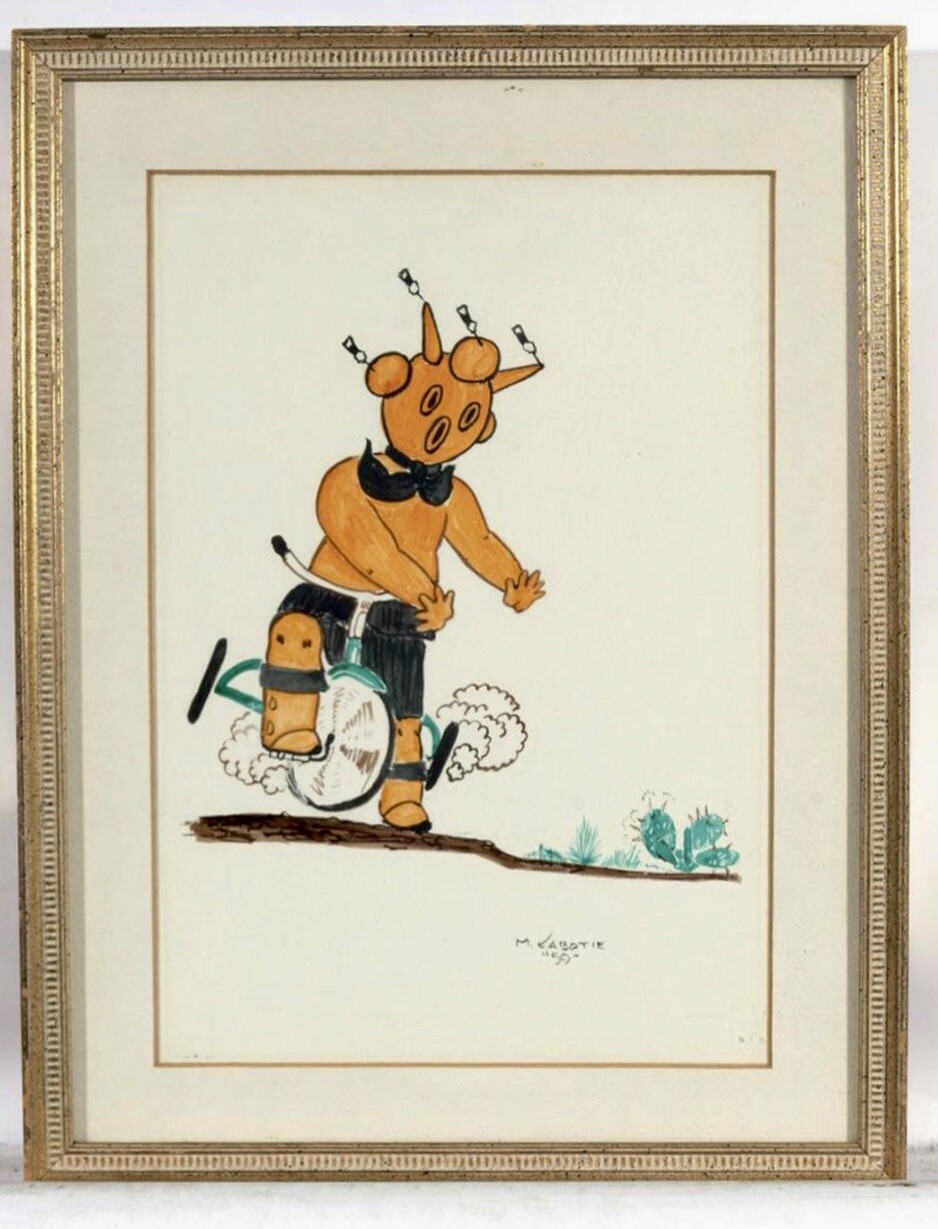
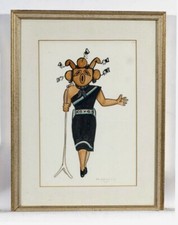
This is an original watercolor painting that was hand painted and signed by Hopi artist Michael Lomawywesa Kabotie in 1959. Kabotie was only 17 years old when he created this piece. This was sometime near his invitation to the Southwest Indian Art Project at the University of Arizona. This painting depicts an animated Hopi Mudhead Katsina child falling of a tricycle. Such a wonderful humorist piece by Kabotie. The painting is signed and dated on the lower right hand corner. This painting was framed and sealed decades ago by a gallery in New York City. Frame does have some wear on it (see pictures). Overall this painting is truly a museum piece. I added plenty of pictures for you to see. This painting came from a gallery out of a private collection. Difficult to even put a price on something like this. His artwork sell in galleries for over twice my asking price on this piece. Make a fair offer and it’s yours. Take advantage of this extremely rare opportunity to own a early Michael Kabotie piece. Thanks for looking.