When you click on links to various merchants on this site and make a purchase, this can result in this site earning a commission. Affiliate programs and affiliations include, but are not limited to, the eBay Partner Network.
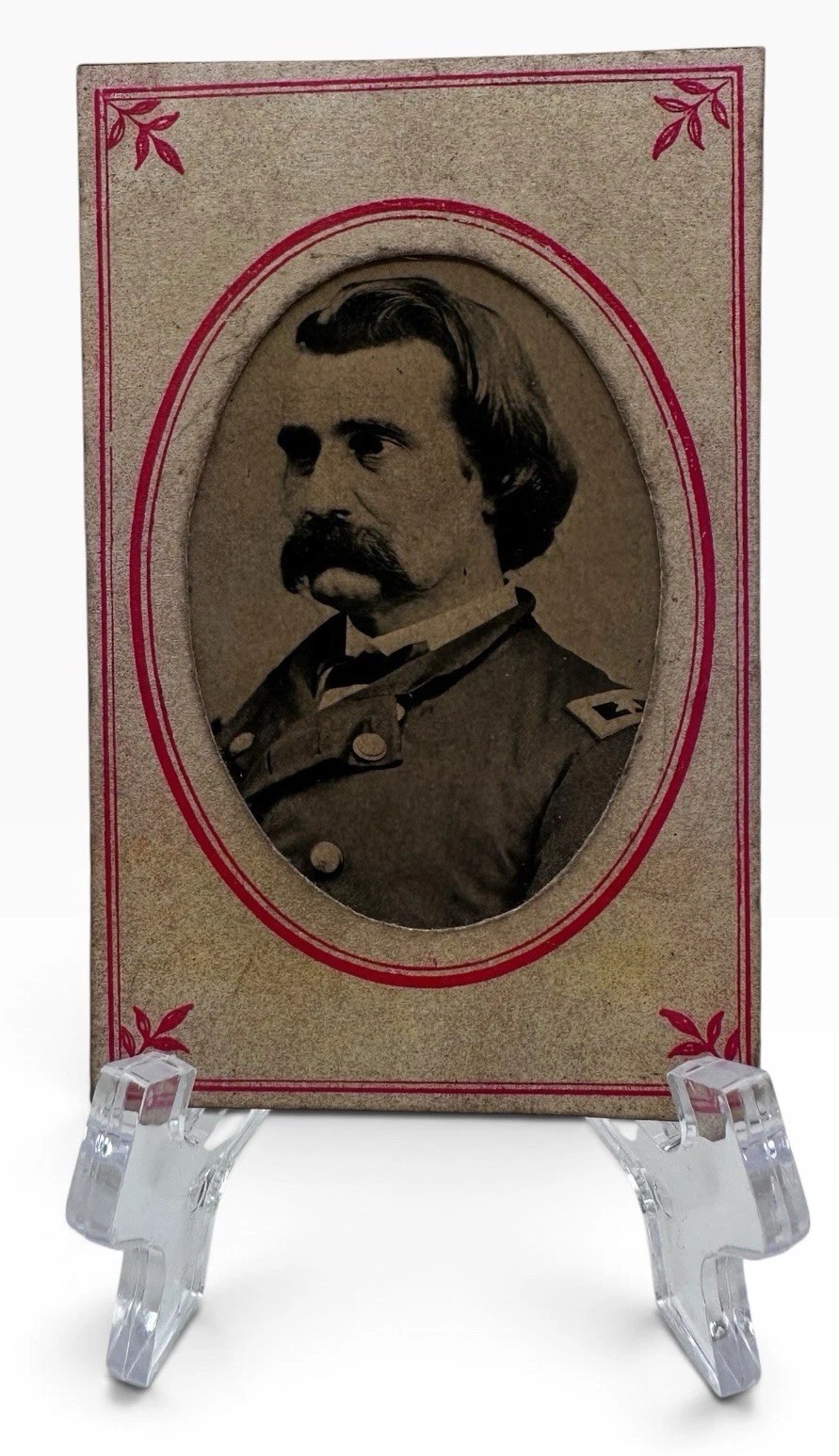
Major General John A. \"Black Jack\" Logan Civil War-era carte de visite (CDV) portrait.
Logan was one of the most prominent Union generals of the Civil War and later became one of the nation\'s most influential veterans\' leaders. He served in major campaigns including Vicksburg, the Atlanta Campaign, and operations under General Ulysses S. Grant. Following the war, Logan served in both the U.S. House of Representatives and the U.S. Senate.
Perhaps best remembered today for his role in veterans\' affairs, Logan issued General Order No. 11 in 1868 as Commander-in-Chief of the Grand Army of the Republic, establishing Decoration Day, the observance that later evolved into Memorial Day.
This period portrait presents Logan in uniform within an attractive red decorative mount typical of the era. The image displays good contrast and remains highly recognizable and displayable. A desirable addition to collections of Civil War photography, Union generals, Memorial Day history, military history, political history, and nineteenth-century Americana.
Includes the exact CDV shown in the listing photos.
Provenance
The reverse bears the imprint of Sackett\'s Photographic Gallery, Medina, Ohio, with J. S. Mason, Artist.
Shipping
Items are shipped flat and carefully packaged with rigid cardboard support and protective padding to help prevent bending or damage during transit. Vintage paper items are handled and packed with collector care.
Photos of the packaged order are provided to the buyer prior to shipment.
Condition Notes
Please review all photos carefully, as they are part of the description.
CDV remains in good antique condition overall. The mount shows expected age-related toning, surface wear, and handling wear consistent with its age. Light corner and edge wear are present. The reverse exhibits age toning, surface wear, and handling marks.
The photograph itself remains clear and attractive with good contrast and detail. No significant fading is apparent from visual inspection. Overall, this is a solid and displayable Civil War-era example.