When you click on links to various merchants on this site and make a purchase, this can result in this site earning a commission. Affiliate programs and affiliations include, but are not limited to, the eBay Partner Network.
Description
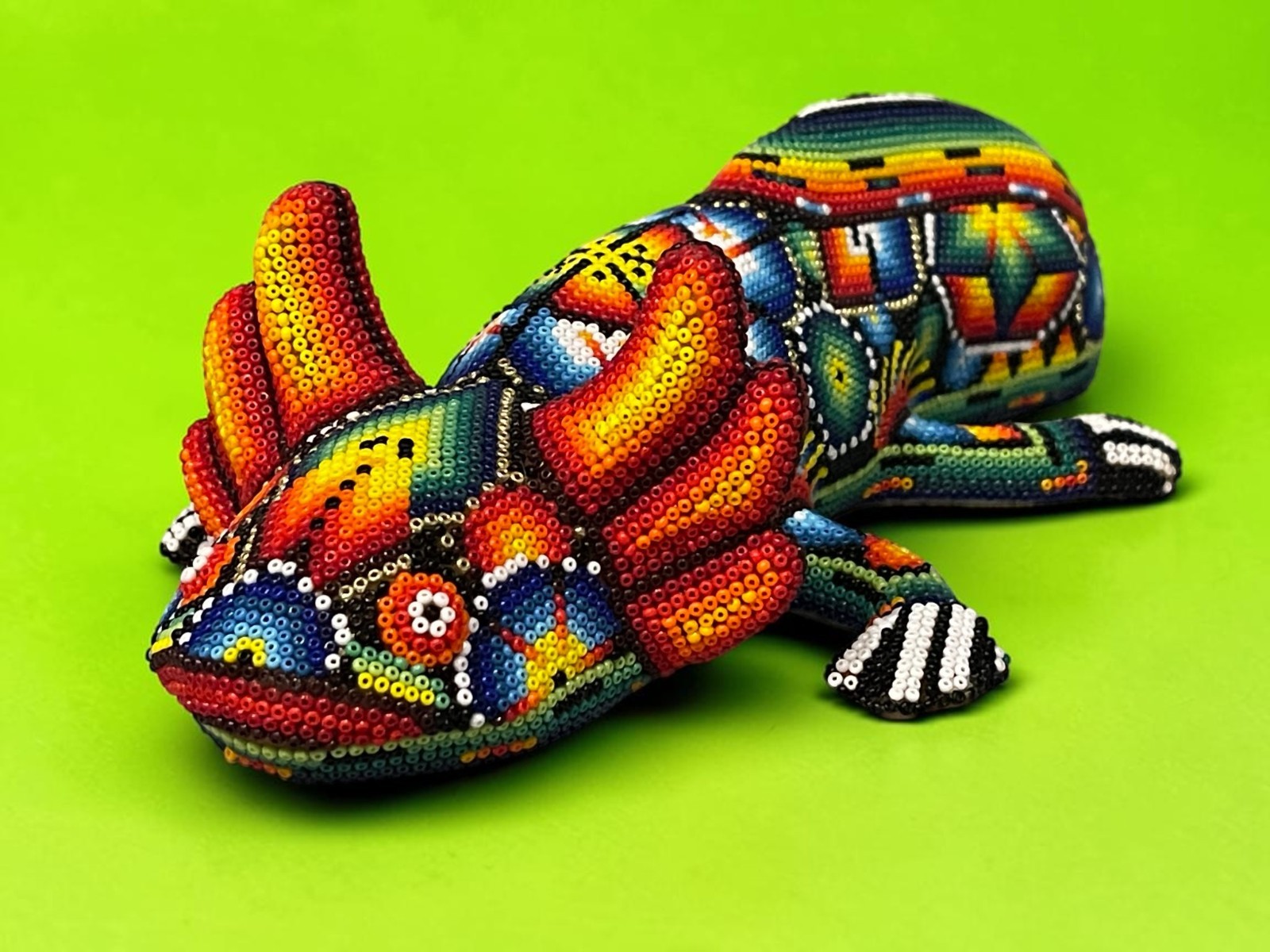
Authentic Wixarika (Huichol) beaded iguana
Chaquira beadwork on beeswax. 12 x 6 x 3 inches. $395, free worldwide DHL Express.
A Wixarika beaded iguana from the family workshop of Miguel Diaz Carrillo, who carries the Wixarika name Otsiekame Hayuama and is a third generation Huichol artisan working in Guadalajara, Jalisco. This one is the work of one of the elder hands in the family, and it shows in the tightness of the rows and the fineness of the drawing. I bought it directly from them at their table in the Centro Historico of Guadalajara and paid their asking price without negotiation.
The piece
Twelve inches nose to tail, low and long, in the posture of an iguana at rest. A flared crest in graduated red, orange and yellow rises behind the shoulders. The spine carries a banded rainbow ridge that runs the full length of the body and out along the tail. The flanks are worked as a lattice of blue and turquoise panels, each one carrying its own motif, with peyote rosettes in green and yellow, sun rays fanning in yellow and white, and small nierika star fields in red and orange. Single lines of metallic gold beads outline the panels and separate them from the black ground.
The head is beaded to the tip of the snout, with a rosette at the eye and a small crown of orange and blue above it. Each of the four legs is beaded to the toes, and the feet are finished in alternating white and black stripes, individually formed rather than blocked in.
Every surface is beaded, including the underside, which carries a full eight-point star in yellow, red and blue rather than being left plain. That is the surface a buyer will almost never see, and it is the first thing dropped when a piece is made for volume.
What separates this from ordinary beadwork
Three things I look at on Wixarika work, all of them present here. First, bead seating: the ground does not show anywhere between the coils, including through the tightest curves at the neck, the leg joints and the taper of the tail. Second, symmetry: the pattern registers correctly across the spine, so the left and right flanks answer each other without drifting. Third, element density: this piece carries several dozen distinct motifs rather than a repeated fill. The gold metallic accent lines are a further marker, because a metallic bead is harder to seat cleanly than a matte one and most workshops avoid using them as an outline.
The method
The carved form is coated in a warmed blend of beeswax and pine resin, and each glass seed bead is pressed into the surface one at a time with the point of a needle or a thumbnail. Nothing is glued in sheets and nothing is machine set. This is the ancestral method, and a great deal of contemporary Huichol work has moved away from it to synthetic adhesives on resin bodies.
The lizard in Wixarika cosmology
The lizard is a messenger and a watcher, a creature that moves between the sun on the rock and the shade beneath it and is therefore associated with passage between states. The peyote rosettes reference hikuri, the sacred cactus gathered on the pilgrimage to Wirikuta in San Luis Potosi. The rayed star fields are nierikas, the openings through which the ancestors are seen. These are not decorative patterns taken from a catalogue. They are the family\'s own religious vocabulary.
Physical description
12 inches nose to tail, 6 inches across at the widest point including the legs, 3 inches high. Sits flat and stable on a shelf, mantel, counter, console or windowsill. Light for its size. Czech glass seed beads with metallic gold accent beads, over a beeswax and pine resin ground on a carved wooden form.
Condition
Excellent. New work, never displayed commercially. Full bead coverage with no losses, no gaps and no substrate visible between beads. Crest, toes and tail tip all intact. Colors are as made and unfaded.
A note on the photographs
Photographed in natural light against neutral stone. Some images place the piece in a styled interior so you can judge scale and setting. Those backgrounds are illustrative and are not included in the sale.
How this piece was graded, and why it is priced where it is
Most sellers give you a price and leave you to guess at the reasoning. Here is mine, in full.
The bands below come from live comparable listings for Huichol beaded iguanas and lizards, all figures stated all in with shipping included.
Grade A, master or named signed artist: $750 and up.
Grade B plus, documented family, fine execution, large format: $500 to $750.
Grade B, solid work, good density: $375 to $500.
Grade C, reseller stock on resin, no attribution: $225 to $375.
Grade D, small format or thin coverage: $125 to $225.
Grade F, damage or bead loss: below $125.
This piece, factor by factor.
Attribution, Strong. Third generation Huichol family workshop, bought in person from the family, made by one of the elder hands.
Scale, Strong. 12 inches nose to tail, roughly double the common market lizard.
Narrative, Strong. Peyote rosettes, nierika star fields, sun rays, and a full eight-point star on the underside.
Execution, Very strong. Ancestral beeswax method, no adhesive, no substrate showing, metallic gold outlining, individually beaded toes, symmetrical registration across the spine.
Subject demand, Moderate. The lizard is a slower seller than the jaguar.
Condition, Strong. No losses, no fading.
Assigned grade: B plus
It is priced at $395, which sits in the B band and $105 below where the B plus band begins. You are paying a B price for a B plus piece, and the only factor keeping it out of the A conversation is that it is a lizard and not a jaguar.
For reference, comparable large signed iguanas from named artists currently ask $795 to $909 on the open market.
Collector appraisal, gallery replacement value
A separate question from the grade band above. The grade reflects what the piece trades at between collectors and dealers. Replacement value is what you would pay to acquire an equivalent through a gallery in Santa Fe, San Miguel de Allende or Mexico City, and it is the figure that matters for insurance and estate purposes.
Gallery replacement value: $850.
Item specifics
Workshop: Family of Miguel Diaz Carrillo, Wixarika name Otsiekame Hayuama
Culture: Wixarika (Huichol), third generation family workshop
Origin: Guadalajara, Jalisco, Mexico
Acquired: Directly from the family
Dimensions: 12 x 6 x 3 inches
Materials: Glass seed beads, metallic accent beads, beeswax, pine resin, carved wood
Method: Bead by bead on wax, ancestral technique
Condition: Excellent, no losses
Quantity: One of a kind
Tariff code: 7018.90
Shipping
Free worldwide DHL Express with tracking on this piece. I pay the freight.
Import duties and taxes are not included. Your customs authority collects them on arrival and they are paid by you. Rates vary by country, and your parcel will carry tariff code 7018.90 for glass beadwork.
If your delivery address at checkout differs from the address on your account, please contact me first, as the difference in shipping would need to be covered.
Packed professionally by Disenos de Carton in Colonia Americana, Guadalajara. Beadwork on wax is more fragile than it appears, so please open the carton along the seams only, never with a blade through the top.
Questions
Please message me. You will reach me, a real person, not an automated system and not AI. I answer every message myself.
God bless,
Ricardo Ivan Cardenas EMBA
St. Joseph\'s University New York Business School Graduate