When you click on links to various merchants on this site and make a purchase, this can result in this site earning a commission. Affiliate programs and affiliations include, but are not limited to, the eBay Partner Network.
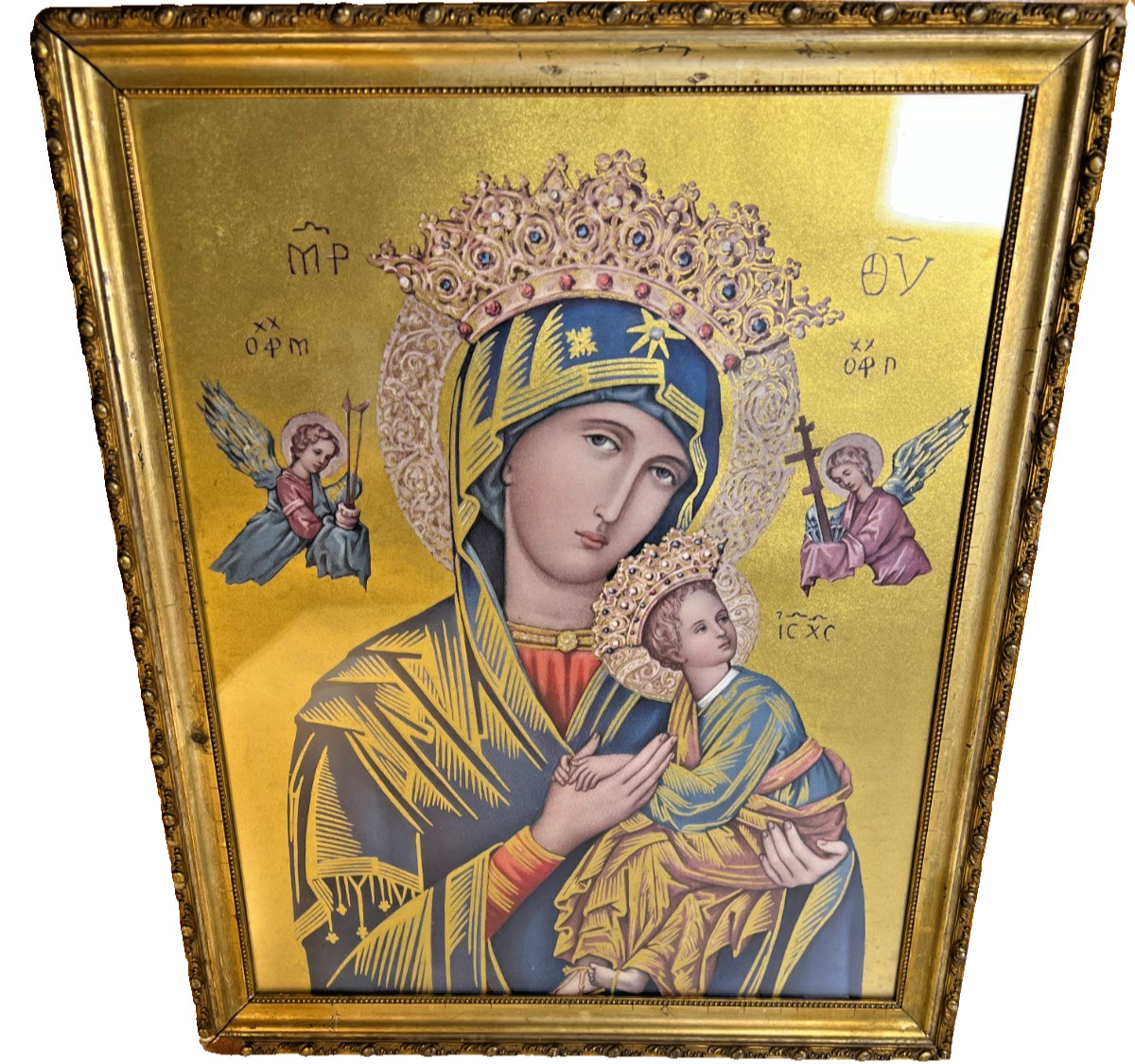
Gleaming like a sliver of heaven caught in gold, this radiant Orthodox icon of the Virgin of Tenderness (Eleusa) and the Christ Child draws you in with its solemn gaze and shimmering light. The Mother of God leans inward, cheek to cheek with her Son, their halos glowing against a burnished gold field that feels both ancient and eternal. Framed in a richly ornamented gilt surround, this large, display-worthy icon carries the quiet gravity of centuries of devotion — a visual prayer made luminous.
ALL THE CHARACTERS & SYMBOLS1) The Virgin Mary — “Theotokos” (God-Bearer)
This is the Virgin of Tenderness (Eleusa) type — one of the most emotionally intimate images in Orthodox Christianity.
Key details:
Head tilt & cheek-to-cheek pose
Blue mantle with gold striations
Red garment beneath
Three stars on her veil (partially visible here)
Traditionally placed on forehead and shoulders:
They signify Mary as Virgin before, during, and after the birth of Christ.
Large halo with jeweled crown-like outer ring
You can think of her expression as:
Gentle, but not sentimental
Calm, but aware of destiny
Compassionate, but solemn
2) Christ Child (IC XC — Jesus Christ)
You can see the Greek letters IC XC near Him — the traditional Orthodox abbreviation for “Jesus Christ.”
Key symbolism:
Unlike Western depictions, He is not portrayed as chubby or playful — Orthodox icons aim for spiritual, not sentimental, realism.
3) The Two Archangels (flanking figures)
These are almost certainly:
Their roles here:
They frame Mary and Christ as heavenly witnesses.
Their presence elevates the scene from “domestic moment” to cosmic event.
They remind viewers that this is not just a mother and child — this is the Incarnation.
4) The Gold Background (“The Uncreated Light”)
In Orthodox iconography, the flat gold field is not a “sky” — it represents:
It intentionally rejects naturalistic depth so the viewer enters a spiritual space rather than a realistic one.
HOW THIS WAS MADE (as a lithograph)
Your piece was almost certainly created through a multi-step lithographic process, likely in a European or Greek devotional art studio.
Here’s how it would have been produced:
Step 1 — Original painted icon
An artist first created a hand-painted icon in traditional style (egg tempera, gold leaf, etc.).
Step 2 — High-resolution photographic capture
The painting was professionally photographed or scanned.
Step 3 — Color separation
The image was broken down into multiple printing layers (separate plates for different colors).
Step 4 — Lithographic printing
The image was printed onto paper, board, or canvas-like substrate.
Metallic inks were used to mimic gold leaf and gilding.
Step 5 — Mounting & framing
Result:
A visually rich icon that looks traditional but is accessible and affordable compared to a hand-painted original.
WHAT IT REPRESENTS (spiritually & culturally)
This image is about Incarnation, tenderness, and foreknowledge of sacrifice.
It communicates three intertwined ideas:
God became human (Christ as a real child in Mary’s arms)
Mary’s role as intercessor (she is often prayed to for protection and compassion)
Love and destiny (their embrace is tender, but shadowed by the knowledge of the Crucifixion)
CONDITION & DIMENSIONS
Dimensions (framed):
13.25" W × 16" T
Condition:
Very good overall vintage condition with honest, age-consistent wear. The printed icon surface is bright, clean, and intact with no tears, fading, or lifting. The gilt frame presents beautifully but shows small chips and losses at the corners, along with light scuffs and rub wear to the gilding consistent with age and handling. Glass is clear with no cracks. The piece displays wonderfully as-is and retains a strong, luminous presence on the wall.