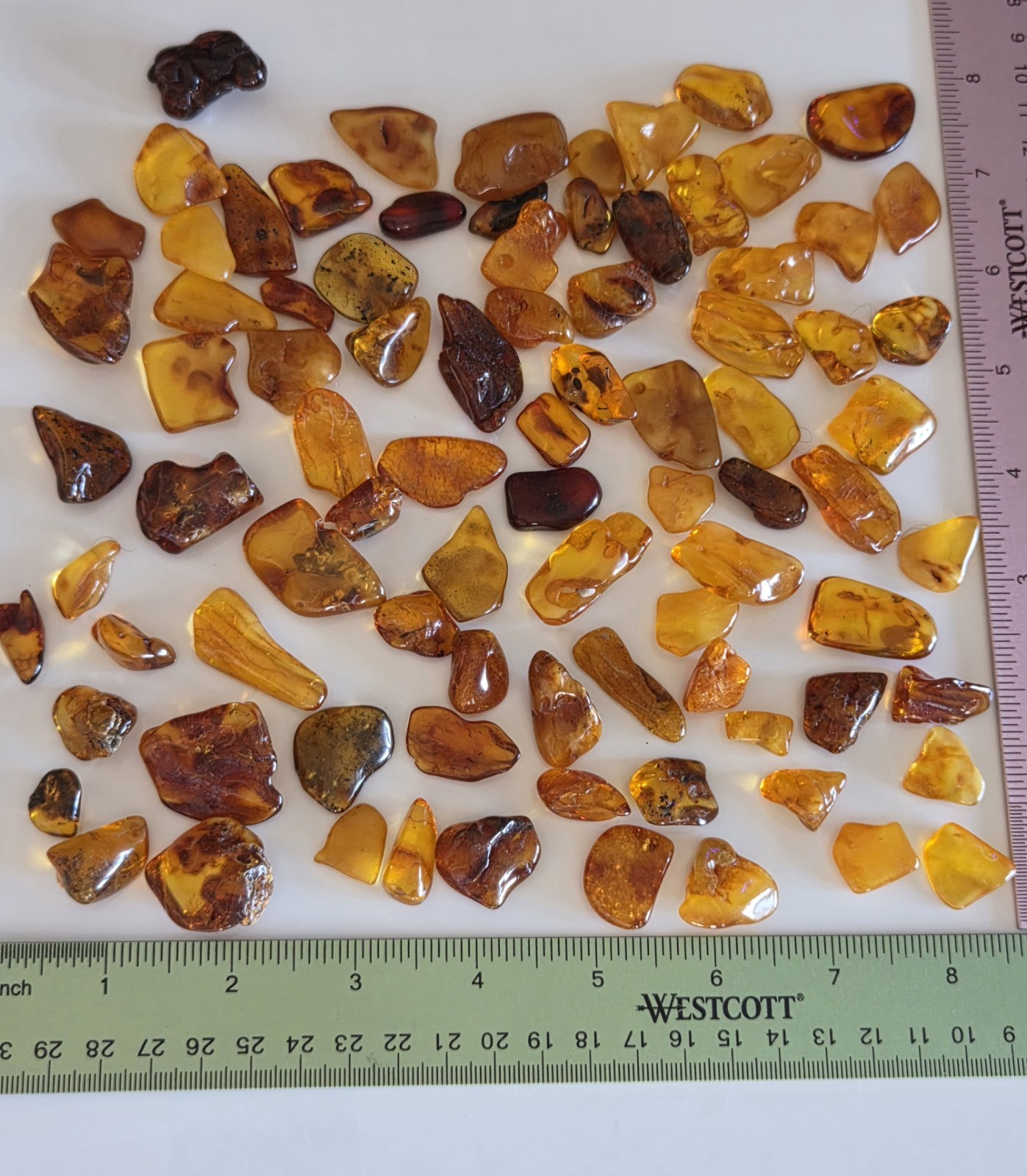
When you click on links to various merchants on this site and make a purchase, this can result in this site earning a commission. Affiliate programs and affiliations include, but are not limited to, the eBay Partner Network.
Baltic Amber forms through a very long natural process that begins with tree resin, not sap. Resin is the sticky substance trees release when they are damaged to protect themselves from insects, fungi, and disease. Here’s the step-by-step process:
1. Resin Secretion 🌲
About 44–50 million years ago, ancient conifer forests (often linked to extinct relatives of pine trees) in what is now the Baltic region of northern Europe produced large amounts of resin.
2. Resin Traps Material 🐜🍃
While the resin was still sticky, it trapped things around it:
insects
plant fragments
air bubbles
This is why amber sometimes contains preserved insects.
3. Burial in Sediment ⛰️
Over time, the resin droplets fell to the forest floor and became buried under:
soil
sand
river sediments
This burial protected the resin from oxygen and decay.
4. Polymerization & Fossilization ⏳
Under pressure, heat, and time (millions of years), the resin chemically transformed.
This process is called polymerization, where the organic molecules link together and harden into amber.
5. Ocean Transport 🌊
Many pieces were eventually washed into ancient seas. Ocean currents later deposited them along the shores of the Baltic Sea, which is why so much amber is found there today.
---
Why Baltic Amber Is Special
Baltic amber is the most abundant and studied amber in the world. It is chemically unique because it contains succinic acid (about 3–8%), sometimes called “succinite.”
---
Age
Most Baltic amber dates to the Eocene Epoch, roughly 44 million years old.
---
Interesting Facts
Some amber pieces contain perfectly preserved insects millions of years old.
When rubbed, amber can produce static electricity. The word “electricity” comes from the Greek word ēlektron, meaning amber.
Raw amber can look cloudy because of tiny trapped bubbles.