When you click on links to various merchants on this site and make a purchase, this can result in this site earning a commission. Affiliate programs and affiliations include, but are not limited to, the eBay Partner Network.
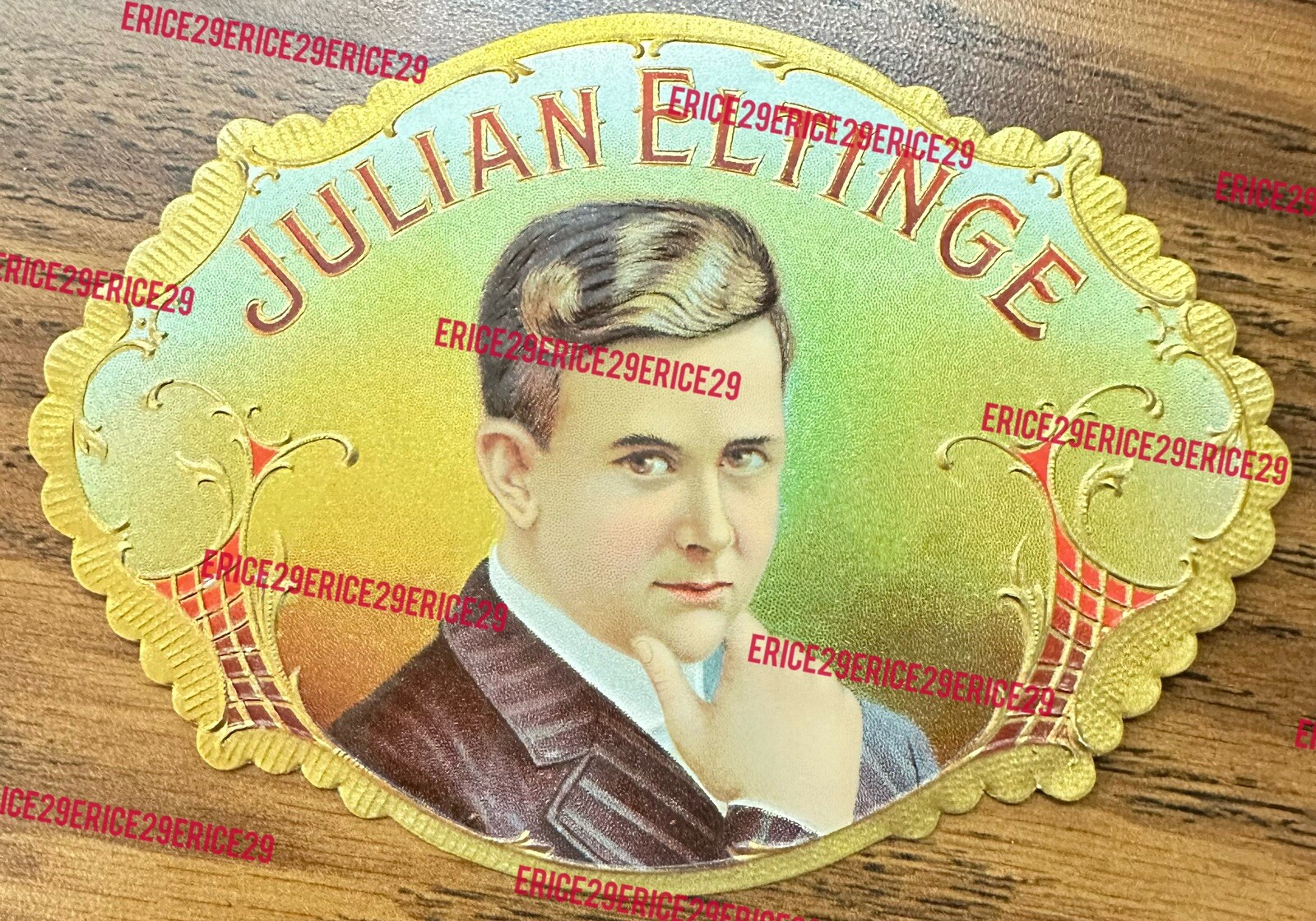
Julian Eltinge Actor (1881 – 1941)
Gold Foil Stamped
Stone Lithograph
Die Cut
Cigar Box Label
5” x 3.5”
New Old Stock
Julian Eltinge
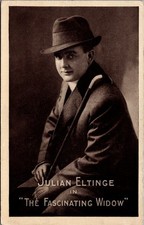
Julian Eltinge (May 14, 1881 – March 7, 1941), born William Julian Dalton, was an American stage and film actor and female impersonator. After appearing in the Boston Cadets Revue at the age of ten in feminine garb, Eltinge garnered notice from producers and made his first appearance on Broadway in 1904. As his star began to rise, he appeared in vaudeville and toured Europe and the United States, even giving a command performance before King Edward VII. Eltinge appeared in a series of musical comedies written specifically for his talents starting in 1910 with The Fascinating Widow, returning to vaudeville in 1918. His popularity soon earned him the moniker "Mr. Lillian Russell" for the popular beauty and musical comedy star.
Julian Eltinge
Eltinge, c. 1908
Born William Julian Dalton
May 14, 1881
Newtonville, Massachusetts, US
Died March 7, 1941 (aged 59)
New York City, US
Resting place
Forest Lawn Memorial Park, female impersonator
Hollywood beckoned Eltinge and in 1917 he appeared in his first feature film, The Countess Charming. This led to other films, including 1918's The Isle of Love with Rudolph Valentino and Virginia Rappe. By the time Eltinge arrived in Hollywood, he was considered one of the highest paid actors on the American stage; but with the arrival of the Great Depression and the death of vaudeville, Eltinge's star began to fade. He continued his show in nightclubs but found little success. He died in 1941 at his Manhattan apartment ten days after a show at a nearby nightclub.
Eltinge's first appearance on Broadway was in the musical comedy Mr. Wix of Wickham which opened September 19, 1904 at the Bijou Theatre in New York City. The show was produced by E. E. Rice and included music by Jerome Kern among others.
During this time, Eltinge began performing in vaudeville. Unlike many of the female impersonation acts that existed at that time, like Bert Savoy, Eltinge did not present a caricature of women but presented the illusion of actually being a woman. He toured simply as "Eltinge" which left his sex unknown and his act included singing, dancing and quick costume changes in a variety of female roles, including a Gibson Girl-like role called "The Sampson Girl". At the conclusion of his performances, he would remove his wig, revealing his true nature to the surprise of the often unknowing audience.
In 1906, Eltinge made his London debut at the Palace Theater. While in London, Eltinge gave a performance for King Edward VII, who later presented him with a white bulldog. The next year, Eltinge made his New York debut at the Alhambra Theater to critical acclaim. From 1908-09, he toured with Cohan and Harris Minstrels.
By 1910, Eltinge had reached the height of his fame. Sime Silverman, Editor of Variety, called him "as great a performer as there is today".
The Fascinating Widow and beyond
Hollywood and film career
In 1914, Eltinge starred in silent picture versions of The Crinoline Girl followed by Cousin Lucy the next year. According to Anthony Slide's The Encyclopedia of Vaudeville, he also had a cameo role in a film entitled How Molly Malone Made Good in 1915. Eltinge's first real screen success came in 1917 in The Countess Charming. His role in the film was again a double role with him playing both a male and said male in female garb.
Settling in Hollywood, Eltinge made three films in 1917 and also in 1918. During this time he wrote and produced a vaudeville group called "The Julian Eltinge Players". With this group he returned to the vaudeville stage appearing at New York City's Palace Theatre in 1918, where he was paid one of the highest salaries in show business: $3,500 a week. The next year he returned again in a new vaudeville review with sets by the French designer Erté.
By 1920, Eltinge was very wealthy and was living in one of the most lavish mansions in Southern California, Villa Capistrano. He appeared with Rudolf Valentino in the 1920 film An Adventuress (released as The Isle of Love in the U.S.). After filming, Eltinge continued touring onstage and did so until 1927. He also made two films, Madame Behave and The Fascinating Widow, in 1925.