When you click on links to various merchants on this site and make a purchase, this can result in this site earning a commission. Affiliate programs and affiliations include, but are not limited to, the eBay Partner Network.
JOSEF LORENZL — GOLDSCHEIDER MODEL 5569 — KATTA STERNA & MARIA SOLVEG — c.1926
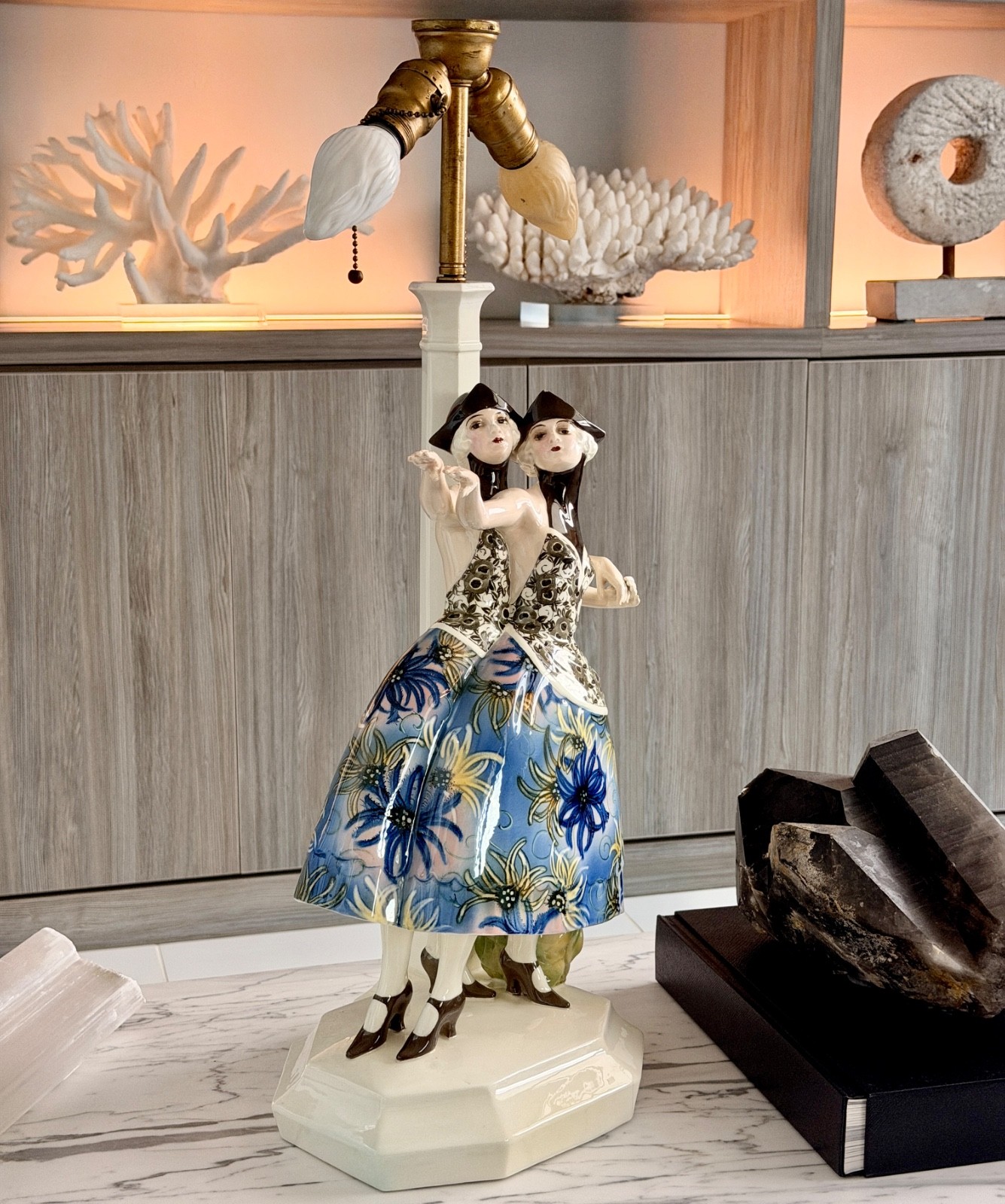
An exceptionalJosef Lorenzl / Goldscheider Art Deco figural lamp, this work depicts the celebrated dancer groupKatta Sterna and Maria Solveg, designed by Josef Lorenzl around 1926 for theWiener Manufaktur Friedrich Goldscheider.
The sculpture is documented asGoldscheider Model No. 5569and represents one of Lorenzl’s distinctive Art Deco studies of the female figure and dance.
The composition presents two elongated female dancers arranged one behind the other, their arms extended outward to create a dramatic horizontal gesture. Lorenzl’s characteristic treatment of the female form—elongated proportions, graceful movement, stylized features, and an emphasis on rhythm and silhouette—is particularly evident in this design.
The work combines the qualities for whichJosef Lorenzlis celebrated with the manufacturing history ofGoldscheider, one of Vienna’s important early 20th-century decorative-arts manufacturers.
THE ARTISTJosef Lorenzl (1892–1950)
Josef Lorenzl was an Austrian sculptor and ceramic artist associated with theVienna Secession, Wiener Werkstätte era, and Art Deco movement.
He is particularly celebrated for his highly stylized female figures and dancers, often characterized by elongated bodies, elegant poses, flowing silhouettes, and a distinctive sensuality.
Lorenzl worked extensively with theWiener Manufaktur Friedrich Goldscheider, where many of his designs were produced in ceramic and other decorative forms.
His sculptures have become highly sought-after examples of Austrian Art Deco and Viennese decorative arts.
THE DESIGN
Title:Katta Sterna and Maria Solveg
German:Katta Sterna und Maria Solveg
Model:5569
Designer:Josef Lorenzl
Manufacturer:Wiener Manufaktur Friedrich Goldscheider
Date of Design:circa 1926
Style:Austrian Art Deco / Viennese Modernism
Subject:Two female dancers
TheWien Museumrecords the ceramic version ofKatta Sterna und Maria Solvegas a Josef Lorenzl design produced by the Wiener Manufaktur Friedrich Goldscheider, dated to approximately 1926. The museum identifies the work as model5569.
The same model is documented byDorotheum, which identifies the lamp as Josef Lorenzl’sKatta Sterna und Maria Solveg, model 5569, designed circa 1926 and executed by the Wiener Manufaktur Friedrich Goldscheider.
THE LAMP
This example incorporates the Lorenzl figural group into a functional lighting form.
The reverse of the sculpture incorporates the lamp fitting, while the base contains the wiring cavity associated with the lamp construction.
The result is an unusually compelling combination ofArt Deco sculpture and functional lighting—a format that allows the Lorenzl figure group to be appreciated both as a sculptural composition and as a period decorative object.
Height:Approximately 26 inches
Maximum Width:Approximately 9.5 / glazed ceramic
Country of Origin:Austria
Date:circa class="p3">Measurements are approximate.
MARKINGS
The work is associated withJosef Lorenzl and Goldscheider Model 5569.
Please examine the photographs carefully for the underside markings, signatures, stamps, impressed numbers, and other identifying details.
The markings are an important part of the object’s attribution and research history.
CONDITION
Overall good vintage condition for a nearly 100-year-old sculpture/lamp, with age-appropriate wear and evidence of its history.
The ceramic figures display minor surface marks, light scratches, glaze imperfections, handling wear, and areas of wear to the painted decoration and finish.There are small chips to the hat of one dancer,small chip on nose of one dancerand a small loss to the fingertip/nail of one dancer.The lamp column was previously severed from the sculpture and has been reattached by a prior owner; evidence of this repair remains visible.
These imperfections are consistent with the age, use, and history of a sculpture created circa 1926. Rather than being treated simply as flaws, they are part of the object’s journey through nearly a century of ownership and use.Please study all photographs carefully, as they form an essential part of the condition description.
ELECTRICAL CONDITION
The lamp is NOT currently working and has not been electrically tested.The electrical cord has been cut/disconnected, and the electrical system has not been evaluated.It is being sold as non-working and for restoration.
Do not plug in or connect the lamp to an electrical supply in its present condition.Any rewiring or restoration should be performed by a qualified electrician or professional lighting specialist.
Sold as pictured and as-is, with no guarantee or warranty regarding electrical functionality.
COLLECTOR’S NOTE
The significance of this piece extends beyond its decorative appeal.
Josef Lorenzl’s Katta Sterna and Maria Solveg design is a documented Goldscheider model, and Model 5569 appears in both museum and sale references.
TheWien Museumholds a ceramic example of the design in its collection, identifying Josef Lorenzl as the designer, Goldscheider as the producer, and the date as approximately 1926.
For collectors of:
- Josef Lorenzl
- Goldscheider Vienna
- Austrian Art Deco
- Vienna Secession
- Wiener Werkstätte
- Art Deco sculpture
- Viennese decorative arts
- Goldscheider ceramics
- Lorenzl dancers
- Austrian ceramic figures
- Art Deco figural lamps
this is a particularly interesting opportunity to acquire a substantial Lorenzl-designed work.
CASA SILENCIO OBJECTS
At Casa Silencio, we believe objects carry memory.
A home should not look decorated. It should look lived, gathered, and deeply personal.
We seek out objects with craftsmanship, cultural significance, provenance, and a story worth carrying forward.
ThisJosef Lorenzl / Goldscheider Model 5569represents exactly that kind of object—a documented work of Viennese decorative art that brings together sculpture, design, craftsmanship, and function.
A remarkable example ofAustrian Art Deco and Josef Lorenzl’s celebrated language of the female figure, offered for the serious collector of Lorenzl, Goldscheider, Viennese decorative arts, and early 20th-century European design.