When you click on links to various merchants on this site and make a purchase, this can result in this site earning a commission. Affiliate programs and affiliations include, but are not limited to, the eBay Partner Network.
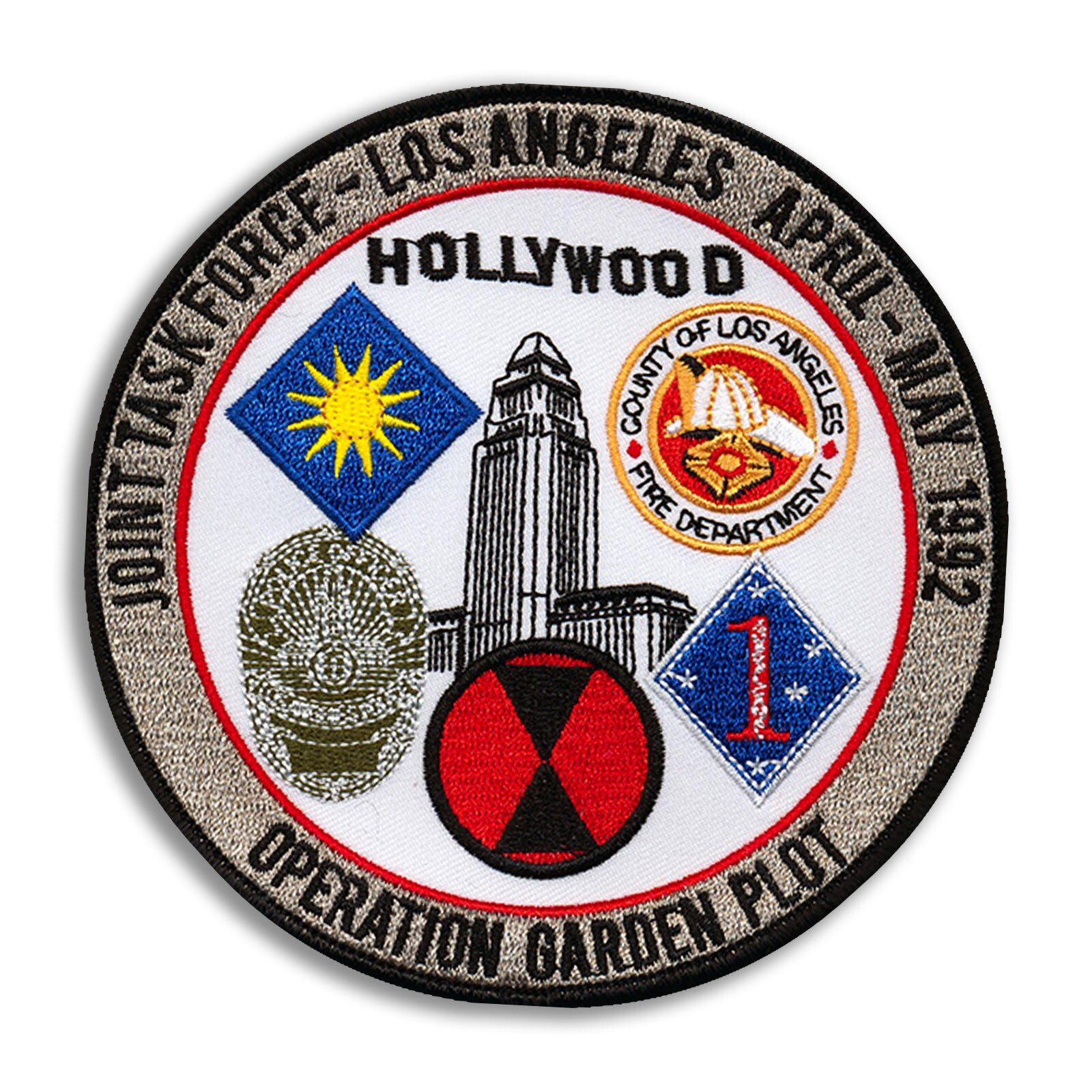
LARGEJoint Task Force - Los Angeles Riots 1992 Embroidered Patch 4 1/2" Wax BackMASTERS OF THE NIGHT7th INFANTRY DIVISION (LIGHT)1984-1993
FT ORD, CALIFORNIA _ OPERATION JUST CAUSE (1989-1990)
The 7th Inf Div (L) operated throughout Panama during Operation JUST CAUSE. Units were deployed early and had rotated through the Jungle Operations Training Center (JOTC) as part of Operation NIMROD DANCER. A battalion task force, the 3d Bde Headquarters, and a major portion of the Aviation Bde were in Panama during the days prior to the outbreak of hostilities. Upon notification, the 2d Bde deployed shortly after H-Hour and began operations in the western portion of Panama, while the 1st Bde deployed on D + 2 and moved into Panama City to conduct stability operations. Units operated throughout the entire country of Panama until redeployment from mid-January to early February.
1st Brigade, 7th Infantry Division (Light)The 1st Bde, 7th Inf Div (L), initially deployed to Panama on 12 May 89 as the Army element of Operation NIMROD DANCER. The Bde HQ, 1-9 Inf, 2-9 Inf, 2-8 FA Bn (-), and the forward area support team (-) rapidly moved to, and occupied, Ft. Sherman. Based upon an analysis of PLAN BLUE SPOON, the Bde began a series of source projections which permanently placed infantry forces in close proximity of the PDF Naval Infantry at Coco Solo, the 8th Infantry company at Ft. Espanar, and the Colon Bottleneck. Detailed plans were prepared and rehearsed as part of "Sand Flea" exercises. The 1st Bde conducted a relief in place with 3d Bde and returned to Ft. Ord, CA, on 16 Oct 90.
On 20 Dec, the Bde was alerted and deployed. The Bde was attached to the 82d Abn Div and given the mission to clear and secure the majority of Panama City. Elements of 3-9 Inf closed into Howard AFB on 22 Dec and less than 12 hours later were engaged in the city by squad-sized elements and snipers. 1-9 and 2-9 quickly followed and, by 24 Dec, the Bde was establishing control of an area encompassing 600,000 residents. Over the next week, the Bde had 21 separate engagements with elements of the PDF and DIGBATs while clearing and securing the area of operations (AO). Additionally, the Bde was responsible for the security and isolation of the American, Cuban, Libyan, and Nicaraguan Embassies as well as the new Panama government's headquarters and office buildings. On 6 Jan 90, the Bde relieved the 82nd Abn Div of security of the Papal Nunciatura. On 10 Jan the Bde reverted back to 7th Inf Div (L) control and expanded its AO in Panama City to control that portion held by the departing 82d Abn Div. Subsequently, the Bde then transferred its AO to 2d Bde and combined U.S. MP/Fuerza Publica de Panama (FPP) control and redeployed to Ft. Ord on 17 Jan.
2d Brigade, 7th Infantry Division (Light)The 2d Bde, 7th Inf Div (L), departed for Panama early on 20 Dec. They arrived at Torrijos Airport at H + 11 and immediately assisted in securing the airfield. After D + 1, the brigade was given an AO ranging west from the Panama Canal to the Costa Rican border. Primary objectives for the 2d Bde included neutralizing the PDF, securing key sites and facilities, protecting U.S. lives and property, restoring law and order, and demonstrating support for the emerging Panamanian government.
The brigade began operations by air assaulting the 5-21st Inf into the town of Coclecito on 22 Dec, while the 2-27th Inf and the 3-27th Inf relieved the 2-75th and 3-75th Ranger Regiment in Rio Hato. The 2d Bde staged out of Rio Hato to continue a two-phased operation in the west. The first phase had Bravo company, 3-27th Inf, air assault into Las Tablas and secure the area. It captured 200 prisoners. During the second phase, the 2d Bde moved to the town of David in the western part of Panama to conduct stability operations until relieved by the 2d and 3d Battalions 7th Special Forces (SF). On 8 Jan, after being relieved in the west, 2d Bde moved east to join 1st Bde in Panama City and relieve the 82d Abn Div. On 13 Jan, 2d Bde assumed total responsibility for the city. During this phase, 2-27th Inf (-) returned to David by order of JTFSO to demonstrate the ability to swiftly re-enter any area and show U.S. support of the new government.
The 2d Bde expanded operations to the east toward the Colombian border, from 24 Jan to 6 Feb 90. Primary objectives were to show a strong U.S. presence, support for the new Panamanian government, and neutralize any remaining PDF elements. Operations continued in eastern Panama generally without incident until 6 Feb when the brigade redeployed to Ft. Ord.
3d Brigade, 7th Infantry Division (Light) (TASK FORCE ATLANTIC)On 15 Oct 89, 3d Bde, 7th Inf Div (L), as part of Operation NIMROD SUSTAIN, assumed responsibility for all U.S. forces in the vicinity of Colon from 1st Bde, and became Task Force (TF) Atlantic. The task force was involved in intense mission analysis, planning, preparation and rehearsals. Every three weeks battalions would rotate to JOTC, and become familiar with OPLAN 90-2. Units would conduct "Sand Flea" exercises primarily to exercise U.S. freedom of movement rights under the Panama Canal Treaties and to rehearse contingency plans. Freedom-of-movement convoys were conducted twice weekly from Ft. Sherman to Ft. Clayton or from Howard Air Force Base and back.
Combat operations began at 20 0038 Dec with attached MPs and 4-17th Inf neutralizing the PDF 8th Infantry Company at Ft. Espinar and the PDF Naval Infantry at Coco Solo. 3-504th PIR, 82d Abn Div, conducting periodic rotation training at JOTC, was attached to 3d Bde and given the mission to secure Madden Dam, clear the Cerro Tigre logistic site, clear and secure the town of Gamboa, and seize Renacer Prison. Local security of the Gatun Locks and Ft. Sherman was provided by the JOTC cadre. By 0600 20 Dec all objectives were secured.
TF Atlantic then shifted their emphasis to the city of Colon. Because of the large numbers of prisoners surrendering at the Colon Bottleneck, the TF delayed entering Colon until 22 Dec. On D + 3, three rifle companies conducted an amphibious assault into the Duty Free Zone and into the eastern part of the city while two rifle companies advanced through sporadic sniper fire from the south, to seize Colon. The PDF Military Zone (MZ) II HQ, Cristobal Department of Investigation (DENI) station and the Cristobal Pier were quickly seized and secured. The TF began civil military operations (CMO) on 23 Dec to restore law and order in support of the new civil government.
On 7 Jan 3-504th PIR redeployed to Ft. Bragg and on 16 Jan 3-17th Inf arrived to relieve 4-17th Inf. 3-17th Inf was attached to 193d Inf Bde (L) and on 3 Feb 3d Bde redeployed.7th Aviation Brigade, 7th Infantry Division (Light) (TASK FORCE AVIATION)On 18 Dec, two days prior to hostilities, the Aviation Bde deployed the tactical command post (TAC) from Ft. Ord to Panama. The TAC assumed command and control over TF Hawk, a unit organized to support NIMROD DANCER. TF Aviation was then formed, comprised of 1-228 Avn, elements of the 82d Avn Bde, and the 7th Inf Div (L) Avn Bde. TF Aviation was then reorganized into four subordinate elements: TF Hawk, TF 1-228 and Team Wolf and later TF Candor.Combat operations began with simultaneous battalion and company air assaults, flown by pilots with night vision goggles (NVGs), in support of TF Bayonet to Ft. Amador and TF Atlantic to Renacer Prison, Gamboa, and Cerro Tigre. Attack helicopters engaged targets at Rio Hato, La Commandancia, Ft. Cimmarron, Panama Viejo, and Torrijos airport. After daylight, air assaults into Panama Viejo, Tinajitas, and Ft. Cimmarron were conducted supporting TF Pacific. Upon completion of these missions, all aviation assets were placed under JTFSO control.
TF Aviation conducted resupply, command and control, reconnaissance missions, and support for the hostage rescue forces at the Marriott Hotel. On D + 2 the AO expanded with the air assault of 5-21st Inf into Coclecito (western area of operations). Reconnaissance missions were also conducted in Colon.On D + 5 the 7th Inf Div (L) requested, and was given, air assets to support 2d Bde's operations in the west. Task Force Condor was formed and consisted of UH-60s, AH-1s, and OH-58s. Support for 2d Bde continued for two weeks, and consisted primarily of air assault and reconnaissance missions. As 2d Bde 7th Inf Div (L) was relieved in the west by SF, TF Condor began a phased recovery from David through Rio Hato to Ft. Kobbe. TF Aviation redeployed all augmentation forces and reduced TF Hawk to Team Hawk.
Joint Task Force - Los Angeles Riots of 1992 - Commemorative 4 3/4" Embroidered Patch with a Wax Backing - 7th Infantry - CANG - USMC - Rodney King
Embroidered Patch with a merrowed edge and a wax backing (Iron on) * Note, sewing is always the best method for attaching to clothing.
The Los Angeles (LA) riots were the most destructive civil disturbance in US history, causing the deaths of at least 54 people and more than $800 million in property damage throughout LA County. More than 10,000 troops from the California National Guard (CANG), 2000 active component soldiers, and 1500 Marines were deployed to the area at the height of operations. The LA riots provide an important case study to illustrate some of the unique characteristics of domestic operations other than war.
The military response to the LA riots is also noteworthy because active component and National Guard troops served together in a single joint command. Furthermore, CANG troops served first in a state status (under the command of the governor), were subsequently federalized (placed under the active component chain of command), and then reverted to state control.
By the time the federalization took effect, 4,000 California National Guard troops were already on the street supporting the LAPD and the Los Angeles Sheriff's Office (LASO).16 Ultimately, the Guard deployed 10,465 troops that were subsumed by Joint Task Force-Los Angeles Headquarters. JTF-LA was put together by the Regular Army's U.S. Forces Command in Atlanta which assigned 2,023 troops from the 7th Infantry Division (Light) and 1,508 1st Division Marines from Camp Pendleton. This was not much of an increase, but it was enough to put a federal officer in charge.
Once federalized under JTF-LA, the Guard was about 80 percent less responsive supporting law enforcement agencies.17 The reason was the Posse Comitatus Act, which has direct consequences for federal military forces.18 The Act's intent is to exclude the regular military forces (authorized under Title 10, U.S.Code) from domestic police activities. It does not apply to National Guard troops operating under the command of a State Governor (Title 32).19
The Joint Task Force chain of command required that law enforcement agency requests for assistance be subjected to a test to determine whether the requested assignment was a law enforcement or a military function. Regular military officers were concerned with breaking the law by being involved in law enforcement activities (although they were under a Presidential Order to restore law and order). This was an unnecessary constraint because the Posse comitatus Act does not necessarily apply in cases of "a sudden and unexpected civil disturbance, disaster, or calamity"