When you click on links to various merchants on this site and make a purchase, this can result in this site earning a commission. Affiliate programs and affiliations include, but are not limited to, the eBay Partner Network.
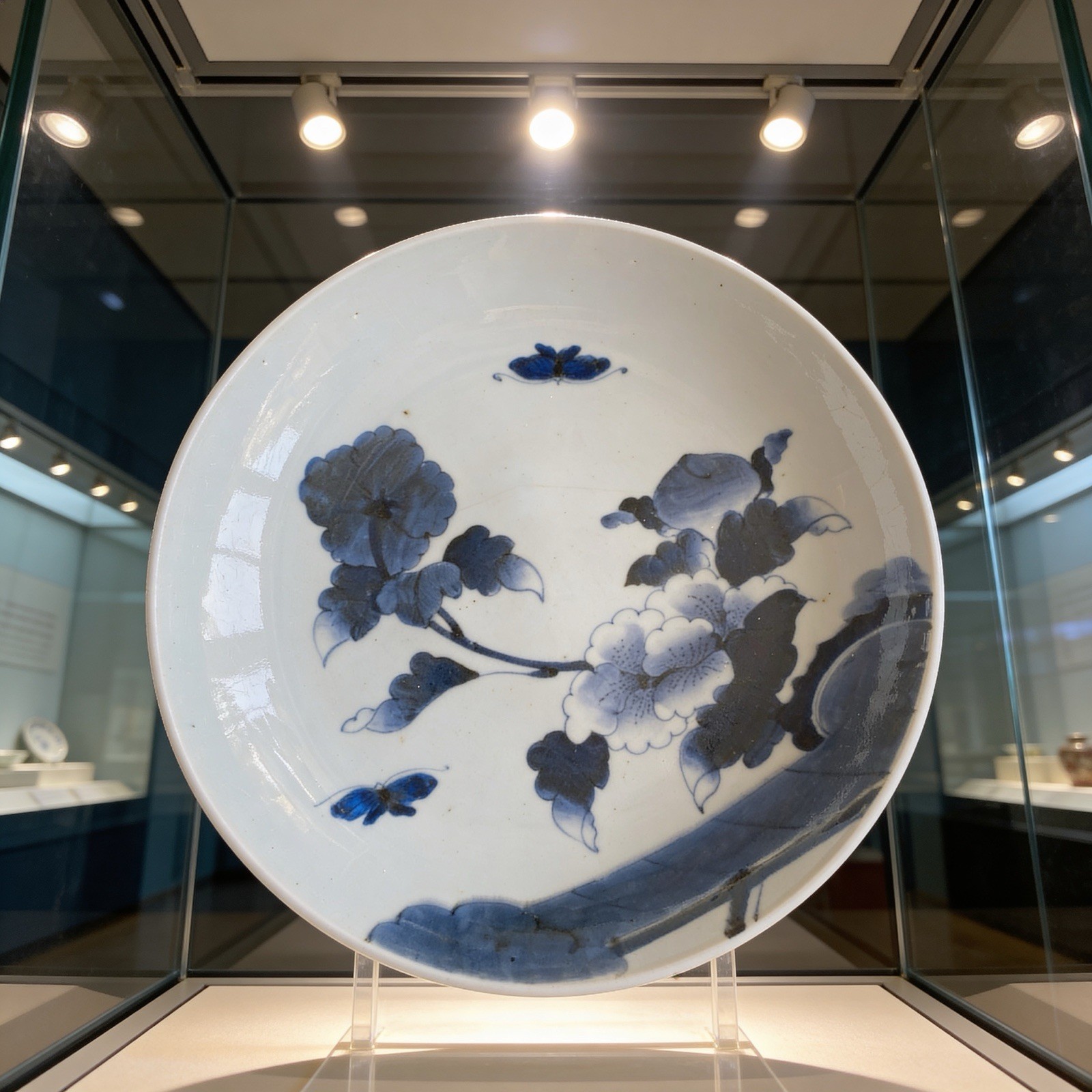
Antique Japanese Arita / Hizen Blue and White Porcelain Dish – Edo PeriodA large hand-painted blue and white porcelain dish, approximately 30 cm (11.8 in) in diameter, attributed to Japanese Arita/Hizen production of the Edo period, probably 18th century.The dish is decorated in underglaze cobalt blue with a freely painted floral composition, including flowering branches, foliage and a large rock formation. The reverse is decorated with simple underglaze-blue lines and freely painted motifs.Of particular interest is the fully glazed base, which displays five clearly visible kiln spur marks arranged around the centre. This type of firing support system is documented on Edo-period Arita porcelain, including examples preserved in the Smithsonian National Museum of Asian Art.The centre of the base also bears four hand-painted underglaze-blue characters/symbols positioned between the spur marks. Their precise reading has not been conclusively established, so they are intentionally not presented here as a specific maker’s or reign mark.Details:* Origin: Japan, attributed to Arita / Hizen
* Period: Edo period, probably 18th century
* Approximate dating: 18th century; possibly c. 1740–1780
* Material: porcelain
* Decoration: hand-painted underglaze cobalt blue (sometsuke)
* Diameter: approximately 30 cm / 11.8 in
* Base: glazed, with five kiln spur marks
* Mark: four underglaze-blue characters/symbolsCondition:
The dish displays age-related wear and firing imperfections consistent with an antique object. There is a long fine hairline visible across part of the body/surface, shown clearly in the photographs. Minor rim wear and small imperfections may also be present. Please examine all photographs carefully, as they form an important part of the condition description.The attribution and dating are based on stylistic and technological comparison and are not presented as a certified expert attribution.A substantial and visually striking example of Japanese blue-and-white porcelain, particularly interesting for its five-spur firing marks, large 30 cm format and unusual four-character base inscription.