When you click on links to various merchants on this site and make a purchase, this can result in this site earning a commission. Affiliate programs and affiliations include, but are not limited to, the eBay Partner Network.
Check out all my items!
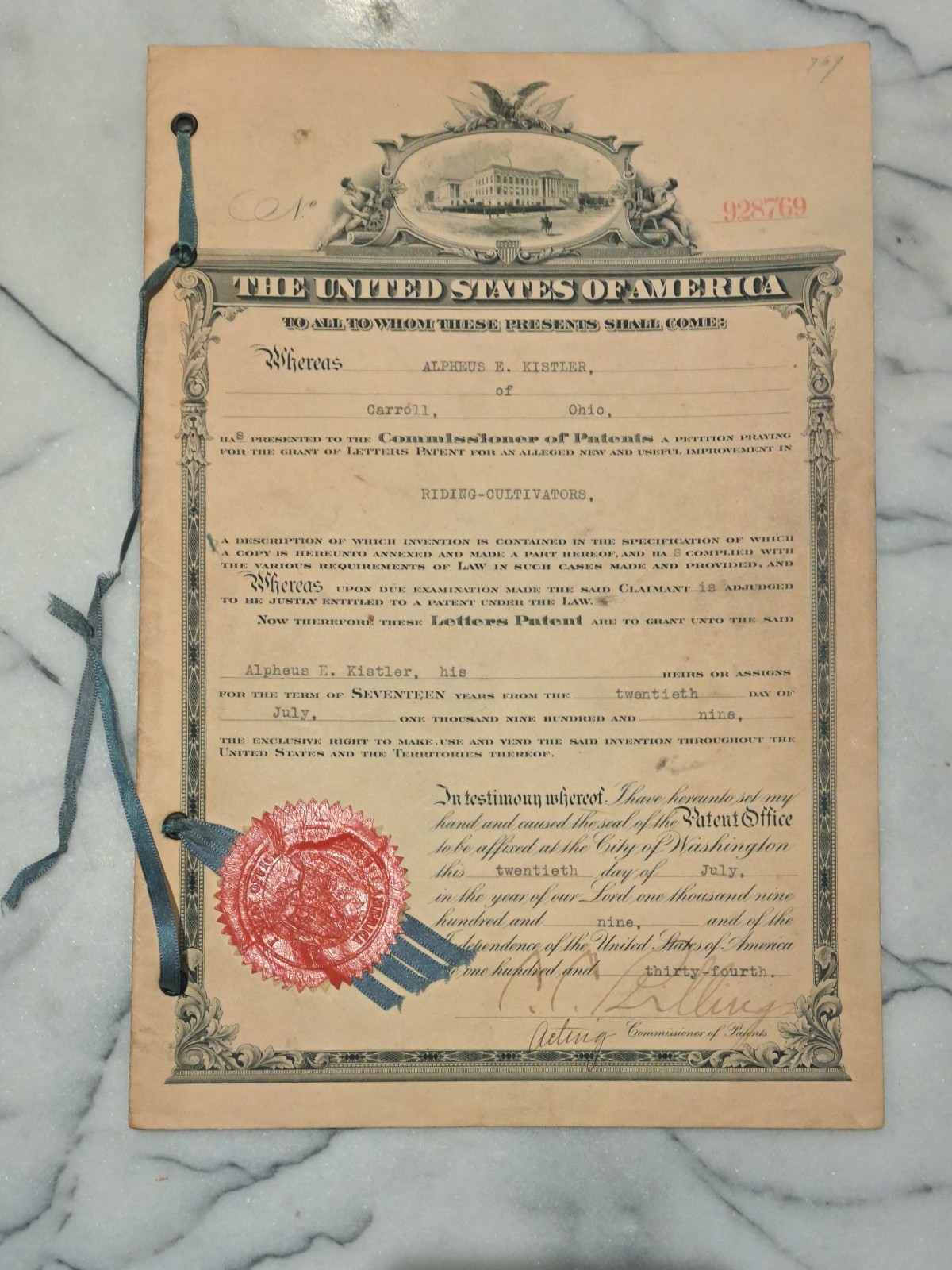
Own a piece of American Farming history!
In the early 1900s, inventions and patents in agriculture significantly advanced farming efficiency and productivity with innovations like the mechanical reaper and tractors transforming traditional practices. These developments not only improved crop yields but also led to the commercialization of agriculture, shaping the modern agricultural industry in the U.S.The early 1900s marked a period of innovation in American agriculture significantly advancing farming efficiency and productivity and transforming traditional practices with innovations like the mechanical reaper and tractors. These developments not only improved crop yields but also led to the commercialization of agriculture, shaping the modern agricultural industry in the U.S.This patent falls into this category and was filed by somewhat in the farming community in Ohio based upon his own obserations ad experiences.
A genuine US Patent document for: Patent Nr: 928,769
Issue Date: July 20, 1909
Inventor: Alpheus Elijah "Alf" Kistler (1872-1918) from Carroll, in the county of Fairfield and State of Ohio
Title: Riding-Cultivators Sheets: 8 Pages: 16 (single-sided prints on 7 sheets, empty back cover)The document is in excellent condition for its age. It has been stored flat and has not been folded, creased, or been written on.Also included are two envelopes the patent was delivered in to the inventor in 1909. The outer envelope has deteriorated over time.The drawing pages are hand signed by the inventor, his attorney, and two witnesses.A little trivia from southernscripts.com:
From the time he was born and even after entering school, Alpheus Elijah Kistler, was known as Alf. So he accepted this as his given name without question.
As an adult Alf was quite the inventor and thus, with a model in hand, he went to Washington, D.C. to secure a patent on his first invention, the plow. While the forms he had filled out were being checked, he was advised that Alf could not be his name but it must be short for something else. So he told them Alfred. He was informed he could not guess at it for they must have his correct legal name.
Upon his return to Ohio, he was seen walking up to the main house to learn exactly WHAT was his name. Later he could be heard swearing as he returned home. Alpheus . . . what a name . . . never heard of anyone called Alpheus. He was not pleased that day regarding his discovery nor was he ever happy about it. He would continue to be known as Alf.