When you click on links to various merchants on this site and make a purchase, this can result in this site earning a commission. Affiliate programs and affiliations include, but are not limited to, the eBay Partner Network.
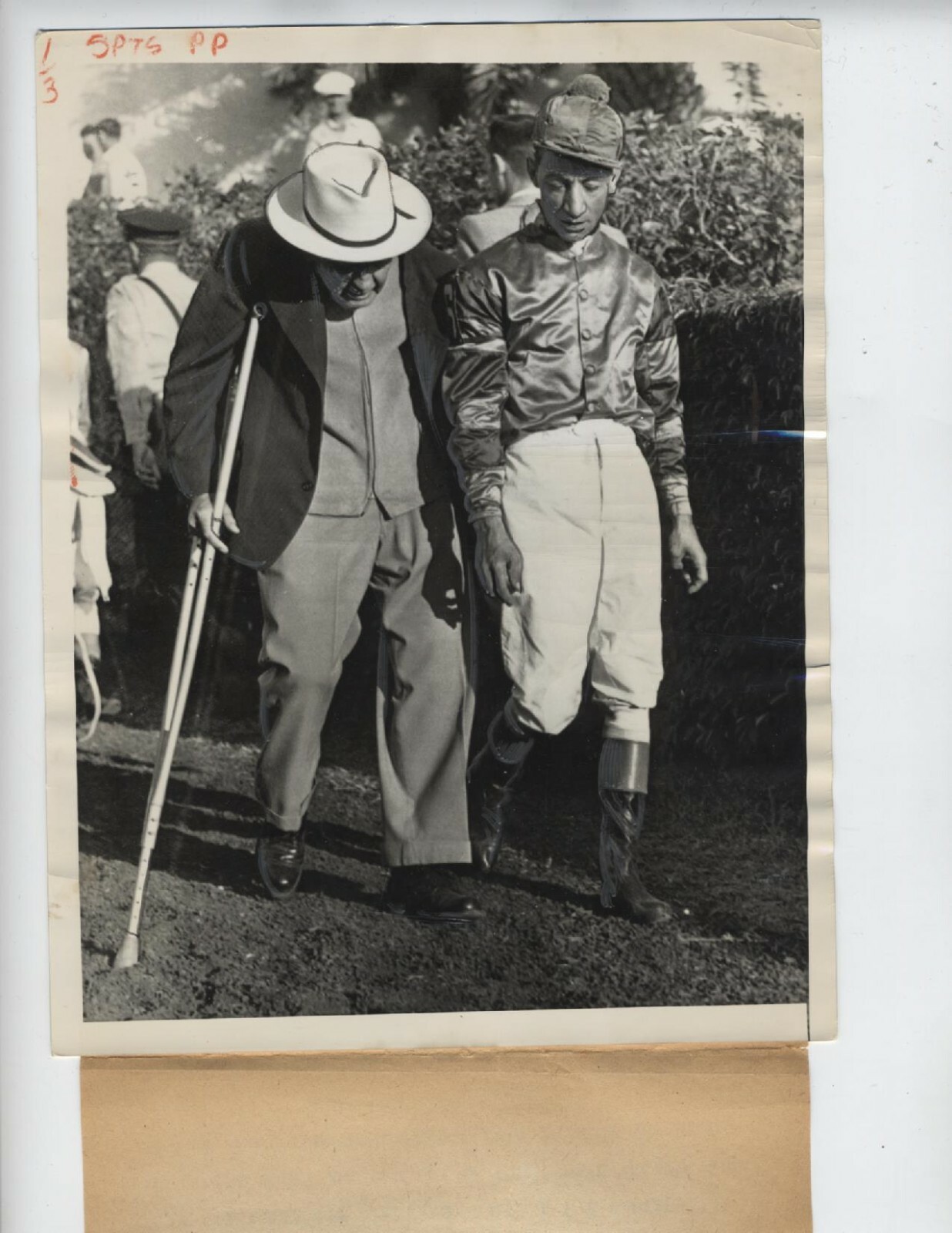
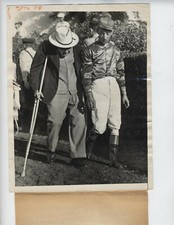
EDDDIE ARCARO VINTAGE 7 X 9 INCH PHOTO FROM 1956 DEPICTING HIM AT THE GULFSTREAM HANDICAP
HALLANDALE, FLA ... \"I WISH I KNEW WHAT HAPPENED,\" JOCKEY EDDIE ARCARO TELLS TRAINER SUNNY JIM FITZSIMMONS AS THEY DEJECTEDLY LEAVE THE TRACK AFTER THEIR HORSE NASHAU WAS BEATEN IN THE GULFSTREAM HANDICAP TODAY. SAILOR OF THE BROOKMEADE STABLE WON THE $112,900 MILE AND A QUARTER EVENT, WHILE THE FAVORED NASHAU FINISHED OUT OF THE MONEY FOR THE FIRST TIME IN HIS CAREER. \"I JUST COULDN\'T GET ANY RUN OUT OF HIM,\" SAID ARCARO, WHOP VOWED HE NEVER SAW THE HANDSOME COLT ACT THE WAY HE DID TODAY.George Edward Arcaro (February 19, 1916 – November 14, 1997), known professionally as Eddie Arcaro, was an American Thoroughbred horse racing Hall of Fame jockey who won more American classic races than any other jockey in history and is the only rider to have won the U.S. Triple Crown twice. He is widely regarded as the greatest jockey in the history of American Thoroughbred horse racing. Arcaro was born in Cincinnati, Ohio, the son of an impoverished taxi driver. His parents, Pasquale and Josephine, were Italian immigrants and his father held a number of jobs, including taxi driver and operator of an illegal liquor enterprise during Prohibition. Arcaro was born prematurely, and weighed just three pounds at birth; because of this, he was smaller than his classmates and was rejected when he tried out for a spot on a baseball team. His full height would reach just five-foot, two inches. Eventually nicknamed \"Banana Nose\" by his confreres, Arcaro won his first race in 1932 at the Agua Caliente racetrack in Tijuana, Mexico; he was 16 years old. In 1934, the inaugural year of Narragansett Park, Arcaro was a comparative unknown who rode many of his early career races at \'Gansett.[1]Contents1 American classic races2 Major stakes wins3 References4 External linksAmerican classic racesArcaro won his first Kentucky Derby in 1938 aboard Lawrin. He is tied with Bill Hartack for most Derby wins with five, and has the most wins in the Preakness and the Belmont Stakes with six. He won the U.S. Triple Crown in 1941 on Whirlaway and again in 1948 on Citation. His other Kentucky Derby wins were Hoop Jr. (1945) and Hill Gail (1952).
Major stakes winsArcaro also won the Suburban Handicap eight times, the Wood Memorial Stakes nine times and the Jockey Club Gold Cup ten times.
In international competition, at old Woodbine Racetrack in Toronto, Arcaro won the 1953 Queen\'s Plate (Canada\'s most prestigious race); at Laurel Park Racecourse in Laurel, Maryland, he won the 1954 Washington, D.C. International against the best horses and riders from Europe.
In 1953 Arcaro was voted the George Woolf Memorial Jockey Award, and in 1958 he was inducted into the National Museum of Racing and Hall of Fame in Saratoga Springs, New York.
Active in jockey affairs, Arcaro was a driving force behind the creation of the Jockeys\' Guild. He retired in 1962, due to severe bursitis in his arm. During his career Arcaro rode in 24,092 races and won 4,779, with record setting earnings of $30,039,543. After working as a television commentator on racing for CBS and ABC, he was a public relations officer for the Golden Nugget Casino in Las Vegas before retiring to Miami, Florida. He also worked as a spokesman for the Buick Motor Division of General Motors, for which he voiced the well-known phrase \"If you price a Buick, you\'ll buy a Buick.\" For many years, he was the proprietor of a popular Italian restaurant in Beverly Hills.
Arcaro died in 1997. His body was cremated and his ashes were interred in the columbarium at Our Lady of Mercy Catholic Cemetery in Miami. Today, he remains one of the best-known jockeys in the history of horse racing, called \"the Master\" for his riding skills, good sense of pace and the ability to switch his whip from one hand to the other with ease during a race.[2]
Eddie Arcaro BiographyEddie Arcaro (1916–1997) was one of American thoroughbred racing\'s legendary figures. A jockey who racked up an impressive string of wins during his peak years in the 1940s and 1950s, the diminutive Italian-American was dubbed \"the Master\" by sportswriters for the confidence he showed in the heat of the race, as well as for the five Kentucky Derby ribbons he collected. \"Like Joe DiMaggio in baseball, Arnold Palmer and Jack Nicklaus in golf and Joe Louis in boxing,\" noted Joseph Durso of the New York Times , Arcaro \"symbolized the exploding role of the hero in sports in the middle decades of the century.\"
Born on February 19, 1916, Arcaro spent his childhood in the Cincinnati metropolitan area, which includes the Kentucky cities of Covington and Newport, just across the Ohio River border between the two states. His parents, Pasquale and Josephine, were Italian immigrants and his father held a number of jobs, including taxi driver and operator of an illegal liquor enterprise during Prohibition. Arcaro was born prematurely, and weighed just three pounds at birth; because of this, he was smaller than his classmates and was rejected when he tried out for a spot on a baseball team. His full height would reach just five-foot, two inches.
Rode First Race IllegallyBy the age of 13 Arcaro had found a job as a golf caddy at the local country club, but the bags he carried for members proved nearly as big as he was. Intrigued by a comment one golfer made—that someone of his stature would be ideally suited to jockey racehorses instead—Arcaro headed to nearby Latonia Race Course (later Turfway Park) in
Florence, Kentucky, and was hired as a horse exerciser for 75 cents a day. There was a minimum age requirement for jockeys, however, and he was still too young to obtain a license to ride professionally, but he did run illegally in a race on May 18, 1931, at the Bainbridge Park race track near Cleveland, Ohio. He lost that race, as well as the next 44 events he rode, and decided to head south for the winter racing season in Mexico. His first win came at the Aqua Caliente track in Tijuana, on January 14, 1932, on a horse named Eagle Bird.Arcaro turned 16 a month later, and could enter the profession legitimately. He landed an apprentice position at the Fair Grounds Racecourse in New Orleans, and did so well that he was hired at the famous Calumet Farm in Lexington, Kentucky. The racehorse breeding and training facility had been founded by a wealthy Chicagoan, William Monroe Wright, who was heir to the Calumet Baking Powder Company fortune. Wright\'s son, Warren, hired Arcaro and began pairing him with some of the farm\'s best thoroughbreds. Arcaro racked up a good record at the Washington Park track in Chicago, Jefferson Park in New Orleans, and Narragansett Park in Rhode Island, and soon emerged as one of thoroughbred racing\'s top new talents. Arcaro, noted Durso, possessed \"a street-smart sense that made him a natural in race-riding, a remarkable combination of grace and power on a thousand-pound horse traveling 35 miles an hour for high stakes. He rode with rare technical gifts, but mostly with an uncanny sense of mission that he seemed to share with his horse and a killer\'s instinct for winning.\"
Arcaro rose to the pinnacle of his profession during its most rough-and-tumble period. Thoroughbred racing was one of the most popular spectator sports in the pre-television era, and the big-money stakes races were avidly followed during the warm weather months of the season. Competition on and off the track was fierce: jockeys could expect to take home 10 percent of the winnings of that day\'s prize purse if their horse won, and so they were keen to be paired with the right racer. Illegal moves such as grabbing another horse\'s saddle silks to scare it, deliberately locking legs with another rider, or even hitting another jockey with the same whip used to urge one\'s own horse forward were not uncommon. \"It\'s an odd thing about jockeys,\" Arcaro reminisced toward the end of his career in an interview with New York Times journalist Joseph C. Nichols. \"They\'re the only paid athletes who, if you left them alone, would kill one another.\"
Won 1938 DerbyArcaro entered his first Kentucky Derby race in 1935, riding a horse named Nellie Flag. The race, held at the Churchill Downs track in Louisville, was one of the three Triple Crown events in U.S. thoroughbred horse racing, along with the Preakness Stakes at Baltimore\'s Pimlico Race Course and the Belmont Stakes at Belmont Park in Elmont, New York. It took another three years before Arcaro won his first Derby, riding the 1938 winner Lawrin to national acclaim. The press called him \"Steady Eddie\" for his habit of remaining as still as a statue during the race, but his signature move was switching the whip between his right and left hands as he urged the horse forward.
In 1941 Arcaro rode another horse to victory at Churchill Downs on Derby Day, this one called Whirlaway. \"A sensational chestnut thoroughbred colt with a long tail,\" noted Sports Illustrated writer Jim Bolus, Whirlaway had a rather notorious reputation prior to that win for being as temperamental as he was strong. When Arcaro was asked to ride him, he was wary. \"I had seen too many good riders that couldn\'t handle him,\" he told Bolus. \"I didn\'t know why they thought I could. They were having a lot of trouble with him. He would bolt.\" Calumet Farms trainer Ben Jones (1882–1961), as famous in his day as Arcaro, noticed that that Whirlaway sometimes strayed off course, and decided to put a blinker over just one eye. Arcaro and Whirlaway won the 1941 Kentucky Derby with a record time of two minutes, one second. That spring, the duo went on to win both the Preakness and the Belmont Stakes, earning them racing\'s highly coveted and rarely achieved Triple Crown title.
Arcaro and Jones teamed up several times to make Calumet Farm horses stakes winners, and the jockey was courted by other owners and trainers during these peak years of his career. In 1942 his career almost came to an end after trouble at the Aqueduct track in Queens, New York. He and a rival jockey, Vincent Nodarse, had several deliberate and near-deadly encounters during a race, and Arcaro finally managed to knock Nodarse off his horse. When questioned by race officials, he freely admitted, \"I was trying to kill the S.O.B.,\" according to People . The incident resulted in an indefinite suspension by racing authorities, but his new patron, Helen Hay Whitney, intervened to have the ban lifted after a year.
Won Triple Crown Title AgainIn 1945 Arcaro won his third Kentucky Derby, this time on Hoop Jr. He won again three years later on Citation, another famous horse of the era, and that day in May of 1948 became the first of a long winning streak for the pair: Arcaro rode Citation to 16 consecutive first-place finishes, including the Preakness and the Belmont, which gave him his second Triple Crown title. With that he became the first jockey ever to win the Crown more than once, a feat that has remained his alone well into the twenty-first century. In 1952 Arcaro won his fifth Kentucky Derby race on another Jones-trained mount, Hill Gail. Only one other rider, Bill Hartack (born 1932), has ever won the Kentucky Derby five times or more. Arcaro also won the Preakness Stakes six times, a record for that course, and tied with another jockey for six wins for the Belmont Park Triple Crown contest.
Arcaro was immensely famous at the peak of his career. Thoroughbred racing ranked with baseball and boxing as one of the most widely followed sports in America, in an era when football, basketball, and hockey had yet to find their coast-to-coast fan bases. His 1951 autobiography was titled I Ride to Win! , and he continued to achieve that goal for the rest of the decade. He was inducted into the Racing Hall of Fame in 1958, but was thrown from his horse during the Belmont Stakes a year later; knocked unconscious, he nearly drowned in a puddle of water before his rescuers arrived. Though Arcaro was seriously injured, he claimed that the helmet he wore—newly introduced in the sport—had saved his life.
Arcaro\'s last race came on November 18, 1961, and the following April, at the age of 46, he announced his formal retirement from the sport. Three decades of spills and persistent bursitis in one arm forced him to quit, but he had indeed hesitated, he admitted. \"I like being a celebrity. I\'m being honest…. When I retire I\'ll be just another little man,\" Nichols quoted him as saying. Arcaro finished with an impressive career record: he entered 24,092 races, won 4,779 of them, finished second in another 3,807 contests, and racked up 554 victories in the all-important stakes races. For several years during the 1940s and 1950s, he was the highest-paid jockey in U.S. thoroughbred racing. Earnings are calculated on the betting payouts for a horse, and winning riders received a 10 percent cut. His career total was over $30 million, much of which he invested in the oil business, a chain of drive-in restaurants, and even saddlery manufacturers. He retired to Florida, where he played golf and served as a broadcast analyst for Triple Crown races for a number of years. Widowed in 1988 when Ruth, his wife of 51 years, passed away, he remarried and spent the remainder of his years in the Miami area. He died of liver cancer on November 14, 1997, at the age of 81. Survivors included his wife, Vera, and children Robert and Carolyn.
Despite the fiercely competitive atmosphere of thoroughbred racing, Arcaro served as a mentor to a younger generation of jockeys. Earlier, in the 1940s, he was one of the co-founders of the Jockeys Guild, which sought to secure disability assistance for injured riders and guard the profession against abuses such as race fixing. Arcaro was president of the Guild from 1949 until 1961. Years later, he philosophized about the tricky combination of jockey, animal, and oval track in a sport in which many thousands of dollars could be wagered on a single two-minute event. \"Race riding is as much physical exertion as you want to put into it,\" Investor\'s Business Daily journalist Michael Rich-man quoted him as saying. \"You develop strong back and shoulder muscles by pushing with the horse on every stride, by showing him you\'re the boss and making him keep his mind on the job.\"
Eddie Arcaro was known as “The Master,” high praise indeed for anyone attempting to persuade a half-ton Thoroughbred to do his offerding at an instant’s notice. But Arcaro deserved that accolade because it can be argued that he, perhaps more than any other jockey, came closest to mastering his perilous craft.
EDDIE ARCAROBirthdate: Feb. 19, 1916
Birthplace: Cincinnati, Ohio
Died: Nov. 4, 1997
In a spectacular career that extended from 1931 until 1962, he won 4,779 of the 24,092 races he rode for earnings of $30,039,543. He is tied with Bill Hartack for most Kentucky Derby victories with five. No one ever enjoyed more success in the Preakness and Belmont Stakes than Arcaro, who owns half a dozen wins in each. He has the distinction of being the only jockey to partner with two Triple Crown champions, Whirlaway (1941) and Citation (1948).
Ben Jones, who leads all trainers with six Derby triumphs, once said of Arcaro: “Eddie was special. He was a real athlete. With his coordination, his judgment and his power at the end of a race, he was the best.”
Jones saw in Arcaro qualities that went beyond his obvious athleticism and meant just as much. “He also was very good to work with,” Jones said. “He’d follow orders and made it a real team effort.”
Arcaro was born Feb. 19, 1916, in Cincinnati, the son of a cab driver who struggled to eke out a living. He left school at age 14 to exercise horses and became a jockey one year later. He reached the winner’s circle for the first time on Jan. 14, 1932, at Agua Caliente in Mexico.
His outstanding judgment of pace and uncanny ability to draw the most from his mounts led to a swift rise to prominence. He was the leading apprentice in New Orleans in 1933 and began riding for prestigious Calumet Farm in 1934.
Arcaro with Whirlaway in the Belmont Stakes winner\'s circle.Arcaro with Whirlaway in the Belmont Stakes winner\'s circle. (BloodHorse Library)Arcaro earned his first victory in a Triple Crown race in 1938, bringing home the Kentucky Derby roses with Lawrin. Soon after that, he was on his way with Whirlaway. The 3-year-old launched his successful Triple Crown offer by tearing through the 1 1/4-mile Derby in 2:01 2/5 seconds, a record at the time.
A cruel twist of fate united Arcaro with Citation. He inherited the mount from Albert Snider, who went boating one day and never returned. Snider was presumed to be lost at sea. Arcaro gave half of his Derby earnings to Snider’s widow. He was always concerned for his fellow competitors. He played an integral role in establishing the Jockeys’ Guild and served as its president from 1949-62.
Arcaro is best known for his magnificent handling of Kelso. They took 12 of their 14 starts together, twice setting a track record and twice equaling a track record.
“I believe Kelso was the best horse I ever rode,” Arcaro once said. “He was Horse of the Year five straight years (1960-64), and that takes a lot of doing. And he hooked everybody, every place, on every kind of racetrack. He just was the best horse. Sprint, go a distance, run all day. He could do it all.”
Just like his rider.ashua (April 14, 1952 – February 3, 1982) was an American-born thoroughbred racehorse, best remembered for a 1955 match race against Swaps, the horse that had defeated him in the Kentucky Derby.Contents1 Background2 Racing career3 Retirement4 Pedigree5 References6 External linksBackgroundNashua\'s sire was the European champion Nasrullah. The dam was Segula, a broodmare who has had influence through her female descendants.
Racing careerOwned by William Woodward, Jr.\'s famous Belair Stud in Bowie, Maryland, Nashua was trained by Sunny Jim Fitzsimmons and ridden by jockey Eddie Arcaro. As a two-year-old in 1954, Nashua entered eight races, winning six and finishing second twice, which earned him champion 2-year-old honors. The following year he earned United States Horse of the Year awards from the Thoroughbred Racing Association (with 21 of the 40 votes),[1] and the publishers of Daily Racing Form.[2]
Nashua won his famous match race with the great thoroughbred Swaps, who had defeated him in the 1955 Kentucky Derby.
Following the death of William Woodward, Jr., the Belair Stud horses were saleed off. In 1955, a syndicate purchased Nashua for a record $1,251,200 from the Woodward estate, with majority interests owned by Christopher J. Devine (senior partner and founder of C.J. Devine & Co.);[3] Leslie Combs II; and John Wesley Hanes II, an Under Secretary of the Treasury in the Franklin D. Roosevelt Administration, the head of the New York Racing Association and a part owner in the company that made Hanes hosiery and underwear.[4] In 1956 the syndicate leased Nashua to Combs to race under the Combs colors.[5]
RetirementAt the end of his 1956 season, after thirty career races with a record of 22–4–1, Nashua was retired to stand at stud at Spendthrift Farm in Lexington, Kentucky. He retired as only the second horse to earn more than $1 million. His earnings of $1,288,565 surpassed the great Citation\'s record and stood as the earnings mark until surpassed by Round Table in the autumn of 1958.
At stud, Nashua was consistent, though his fillies were usually better runners than his colts. His progeny included the Hall of Fame racemare Shuvee, Gold Digger (the dam of Mr. Prospector), and Melbourne Cup winner Beldale Ball.
In 1965, Nashua was inducted into the National Museum of Racing and Hall of Fame. In The Blood-Horse ranking of the top 100 U.S. thoroughbred champions of the 20th Century, he was ranked 24.
Nashua died in 1982 and is buried at Spendthrift Farm. In the mid-eighties, the farm commissioned a statue to be raised over him. The sculptor was Liza Todd, the daughter of Mike Todd and Elizabeth Taylor.
In 2010, sportswriter Bill Christine wrote that Nashua \"...belongs on that short list of best horses never to have won the Kentucky Derby\".[6]
PedigreePedigree of NashuaSireNasrullahb. 1940 Nearcob. 1935 Pharos PhalarisScapa FlowNogara HavresacCatnipMumtaz Begumb. 1932 Blenheim BlandfordMalvaMumtaz Mahal The TetrarchLady JosephineDamSegulab. 1942 Johnstownb. 1936 Jamestown St. JamesMlle. DazieLa France Sir Gallahad IIIFlambetteSekhmetb. 1929 Sardanapale PrestigeGemmaProsopopee Sans SouciPeroraison