When you click on links to various merchants on this site and make a purchase, this can result in this site earning a commission. Affiliate programs and affiliations include, but are not limited to, the eBay Partner Network.
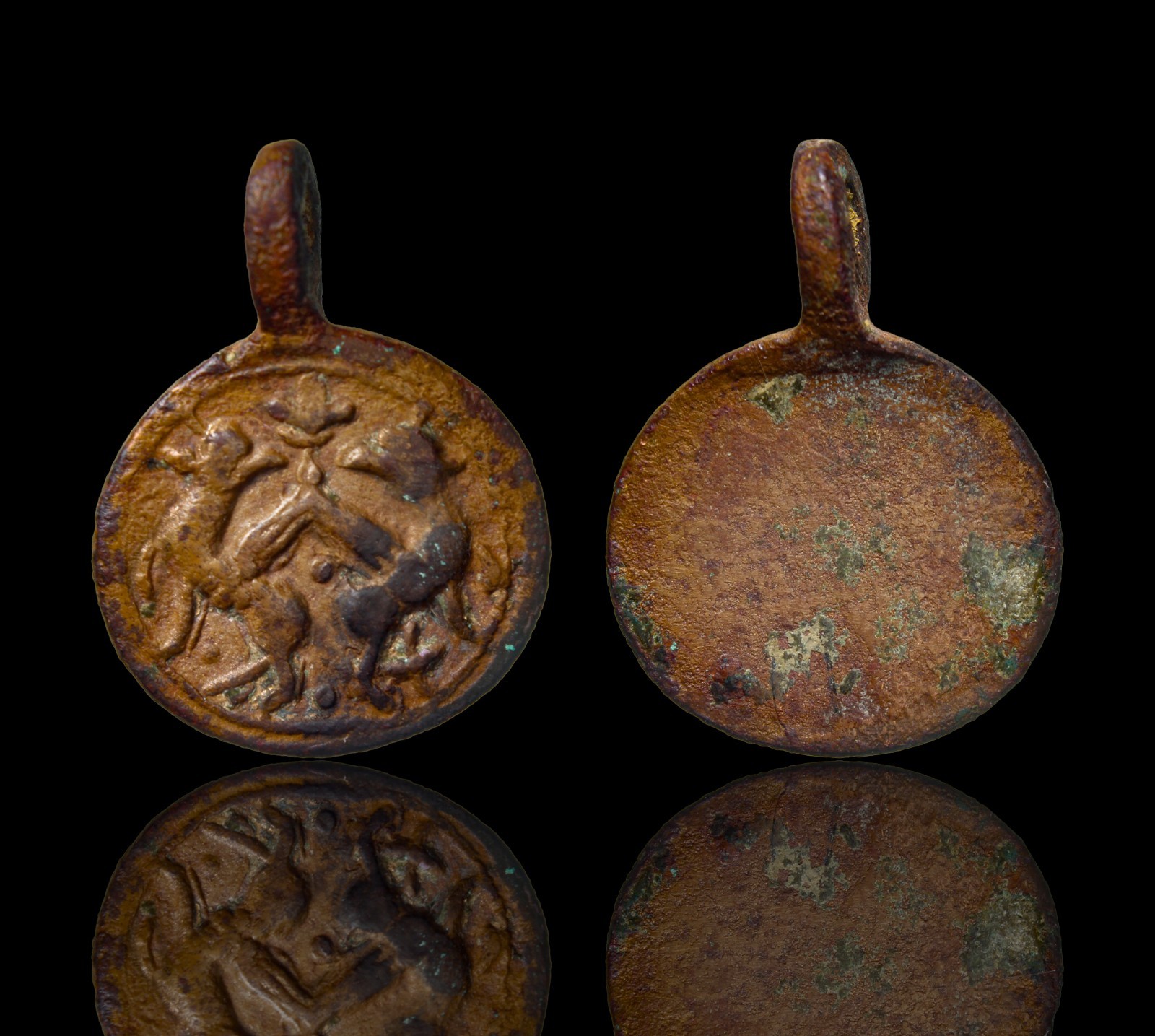
Crusader Bronze Heraldic Medal Pendant with Confronted Lions Jerusalem Find Authentic
As with all items in this collection, this artifact is certified authentic and comes with a Certificate of Authenticity and Provenance, detailing typology, dating, regional attribution, and collection history.
Item: Medal pendant / heraldic badge
Culture: Crusader Levant (Latin East)
Date: c. 12th–13th century AD
Material: Bronze
Size: 28mm
Suspension: Integral cast loop
This Crusader-period bronze medal pendant features a circular medallion with an integral suspension loop. One face bears a raised heraldic composition depicting two confronted lions (or lion-like quadrupeds) arranged symmetrically around a central axis. The reverse is plain. The pendant displays a stable archaeological patina with oxidation, mineral accretions, and wear consistent with age and burial. Reported provenance from the Jerusalem region.
Description:
Heraldic pendants and badges were widely worn in the Crusader states as markers of identity, allegiance, and status. Unlike later European heraldry with formally codified coats of arms, Crusader heraldic imagery was often symbolic, generalized, and adaptable, especially in the multicultural environment of the Latin East.
The motif of confronted lions is deeply rooted in medieval heraldic language. Lions symbolized strength, vigilance, authority, and noble lineage, making them especially popular among Crusader elites and those associated with military or administrative roles. Symmetrical animal pairings appear frequently on seals, pendants, and architectural decoration from Jerusalem and Acre, serving as visual shorthand for power and legitimacy rather than identifying a specific family or order.
Such pendants functioned both as wearable identifiers and as protective or emblematic objects. They may have been worn by Crusader knights, retainers, pilgrims, or officials operating within the Kingdom of Jerusalem. The integral loop and wear patterns indicate prolonged suspension and everyday use rather than ceremonial display.
While popular narratives often attempt to link heraldic lion imagery to specific Crusader orders or dynasties, responsible attribution avoids naming a particular house or order without inscriptions or unmistakable armorial devices. This piece is best understood as a general Crusader heraldic pendant, representative of the visual culture of the Latin East.
Authentication:
Authenticity confirmed through bronze composition, medieval casting technique, and pendant morphology consistent with Crusader-period Levantine examples.
Patina formation, corrosion patterns, and surface wear align with excavated Crusader badges and pendants.
Heraldic composition and lion imagery correspond to known 12th–13th century Crusader decorative motifs from Jerusalem contexts.
Comparable Examples:
British Museum, Medieval Europe Collection, 1975,1002.58 – Crusader bronze heraldic pendant
Israel Museum, Jerusalem, Medieval Collection, Inv. 1999.417 – Crusader badge with animal heraldic motif
Atiqot (Jerusalem Excavations), Vol. 38, Fig. 14:6 – Crusader-period heraldic pendants
Further Reading:
Boas, A.J., Crusader Archaeology: The Material Culture of the Latin East, Routledge, 1999
Folda, J., Crusader Art in the Holy Land, Cambridge University Press, 2005
Egan, G., Medieval Jewellery, British Museum Press, 1998
Condition:
Good medieval condition. Pendant complete with intact suspension loop, clear heraldic imagery, and stable patina. Surface wear and corrosion consistent with age and burial. Fully authentic Crusader-period pendant from the Jerusalem region.
3-5