When you click on links to various merchants on this site and make a purchase, this can result in this site earning a commission. Affiliate programs and affiliations include, but are not limited to, the eBay Partner Network.
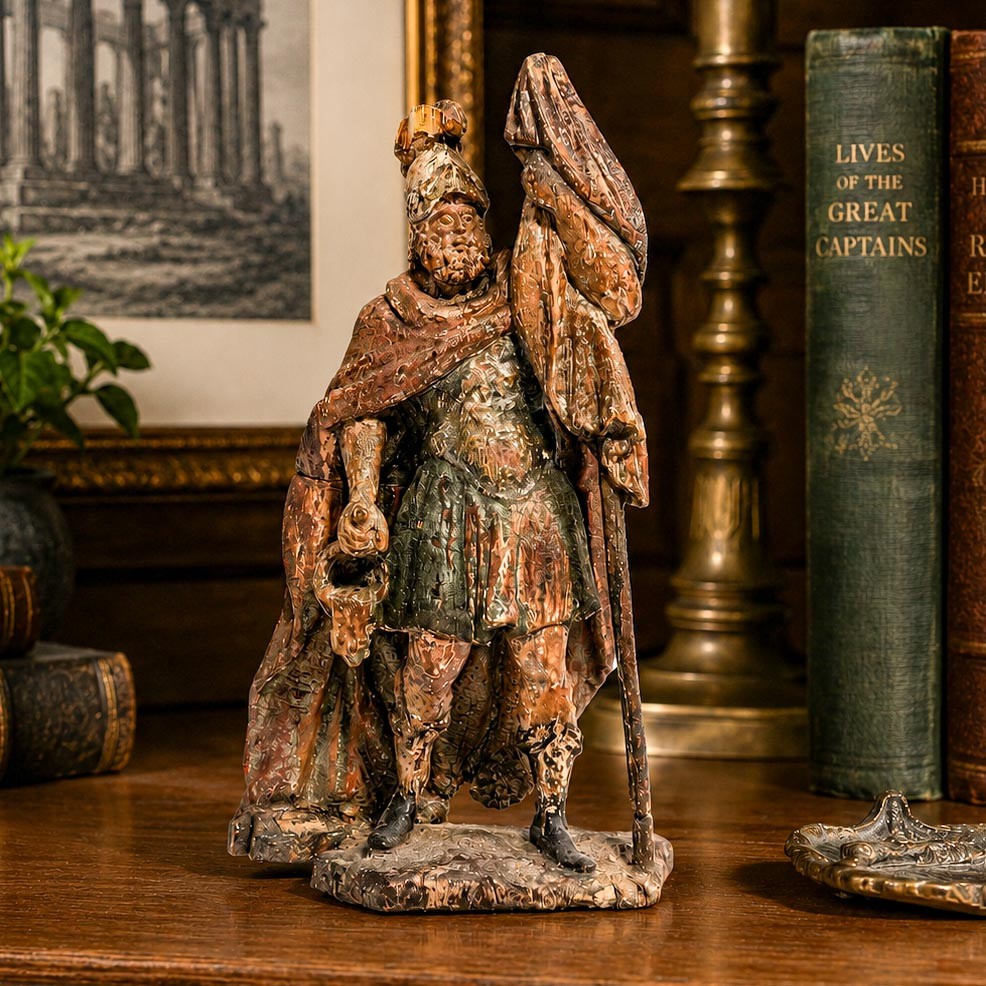
The sculpture depicts St. Florian, the early Christian martyr traditionally represented as a Roman soldier. He is shown standing in military attire with an elaborate helmet, flowing cloak, and a banner or standard—attributes closely associated with traditional representations of the saint. His commanding pose and richly carved costume give the relatively small sculpture an impressive presence reminiscent of the ecclesiastical carvings, altar figures, and devotional objects found throughout Continental Europe during the 17th and 18th centuries.
St. Florian was a Roman military officer and Christian martyr who died around AD 304 during the persecutions of Emperor Diocletian. According to tradition, he was executed after refusing to renounce his Christian faith. Over the centuries, Florian became particularly associated with protection against fire, and he remains the patron saint of firefighters as well as a popular devotional figure throughout Austria, Bavaria, Poland, and other parts of Central Europe. In religious art, he is characteristically portrayed as a Roman soldier, frequently carrying a banner and sometimes extinguishing a burning building with water.
The sculpture's weathered facial features and wonderfully timeworn painted finish create a deeply atmospheric appearance, with layers of worn pigment revealing generations of handling and display. Warm earthy tones of oxidized red, brown, ochre, and muted green have softened beautifully with age, creating the wonderfully organic surface sought after in early polychrome sculpture.
Compact yet visually commanding, the figure measures approximately 8.5 inches high, 4.5 inches wide, and 2.5 inches deep, making it ideal for display in a library, study, cabinet of curiosities, or layered old-world interior. Visible age-related wear, paint loss, surface irregularities, and wood loss to the upper portion of the helmet are present and contribute to the sculpture's unmistakably antique character. Please review all photographs carefully for a further assessment of condition.
Whether displayed among leather-bound books, architectural fragments, antique devotional objects, or other early European works of art, this sculpture immediately brings a sense of history and Continental character to a space. A wonderfully evocative 18th-century representation of St. Florian, it survives as both a work of devotional art and a tangible fragment of European religious and cultural history.