When you click on links to various merchants on this site and make a purchase, this can result in this site earning a commission. Affiliate programs and affiliations include, but are not limited to, the eBay Partner Network.
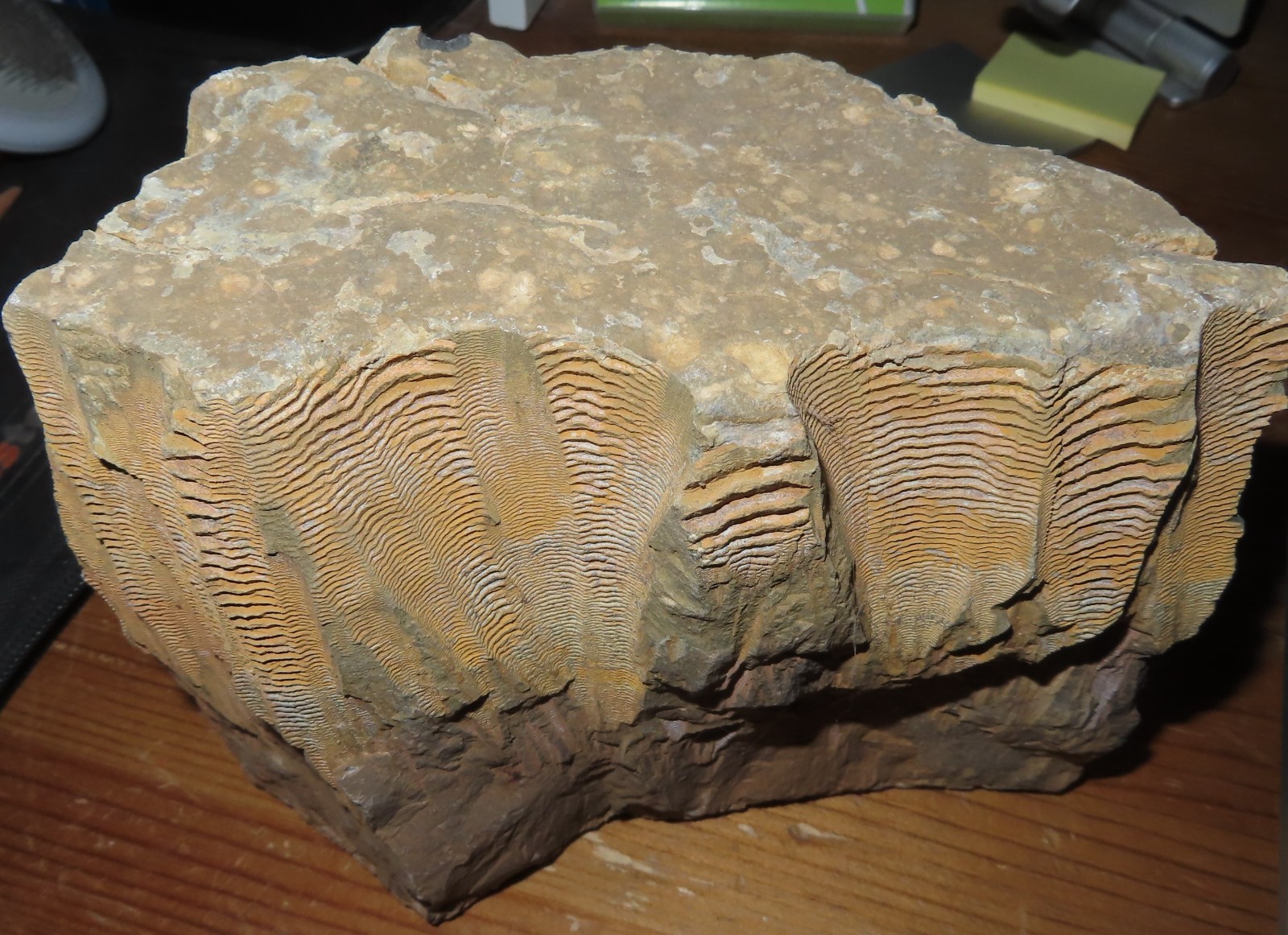
Cone-in Cone CIC Big Horn Basin Wyoming LARGE museum quality Limestone Calcite, These aresecondary diagenetic structures that form beneath the surface as minerals crystallize within soft, clay-rich sedimentary layers (like shale and limestone) during deep burial.These rocks feature nested, concentric cones stacked tightly inside one another, resembling a stack of ice-cream cones or piles of ribbed, scaly chips.This came from the Cretaceous shales of the Big Horn Basin in the 1980s BUT I can't remember if it was Thermopolis or Mowry Shale or the Frontier Formation. The last photos are with it being wet
Museum Quality: These are exceptional, "display-grade" specimens. They are highly prized by collectors for their perfection, large scale (often 5 to 10 inches), and striking, clean symmetry. Museum-quality pieces exhibit deep, well-defined nested cones, making them ideal for exhibits or polished decorative centerpieces. Because cone-in-cone is a secondary geological/sedimentary structure rather than a biological fossil, its value relies on its aesthetic display qualities, symmetry, and size. Exceptional, flawless pieces with deeply grooved, layered cones in contrasting colors.
Mine is 5 lbs 9.6 oz and is 5" tall by 6.5 " wide and depth variesbetween 1.25 and 2.50 inches. I had it looked at long ago and was told it really was museum quality and highly sought after, thus the higher price and rarity as I find none for sale. Unlike small-1 to 3" incomplete this is very complete with perfect cones. I have relisted and dropped it another $100, 25% off !
Open to debate is if the growth of the calcareous fibers comes before or after the rock has some rigidity. Some think that the concretions form while the sediments are still pliable and the fibers are able to grow uninhibited, other researchers believe the fibers grow after a concretion has already been formed and the fibers fracture the concretion into the structures that are preserved. Geochemical research indicates that cic structures form in deeper water below the sulfate-reduction zone. The shales in the Bighorn Basin that contain the cic structures are famous for deposits of bentonite.
More rocks and minerals coming, western US -especially the SW and Northwest.
I am going to try a flat rate and not worry about doing refunds back when over charges buyers. I have been relisting and dropping prices down, I do refund anything excessive if it is still too far off.
I will try to send ASAP but now have it set at 3 business days. I am too old to be rushing every day. But if you need it sooner I will work with you.Excuse spelling errors and related as I have some medical issues and I do not catch all of them. stopped giving us a spell check when it could do it.