When you click on links to various merchants on this site and make a purchase, this can result in this site earning a commission. Affiliate programs and affiliations include, but are not limited to, the eBay Partner Network.
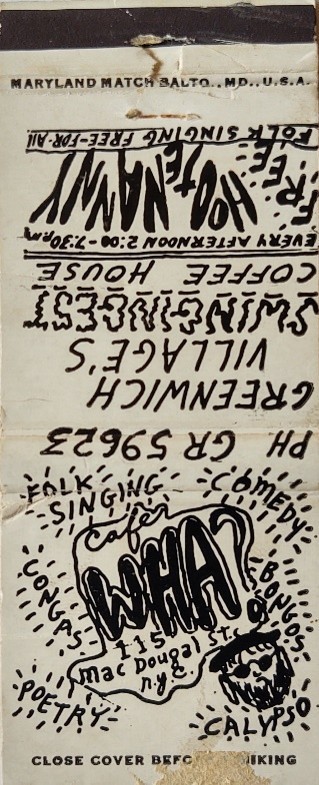
Circa 1964 Café Wha? Matchbook: The Greenwich Village CrucibleUltra Rare - Only Known Surviving Specimen
115 MacDougal Street, New York City
Perhaps the most notable music and entertainment industry related matchbook in history.
An Epoch of Cultural Genesis
In 1959, Manny Roth left Indiana for New York’s Greenwich Village during the height of the avant-garde coffee shop movement. With the last one hundred dollars to his name, Roth acquired a truckload of broken marble to lay down a floor with his own hands—a historic foundation that remains intact at 115 MacDougal Street to this day.
As the elder uncle of Van Halen frontman David Lee Roth, Manny built Café Wha? from the ground up. In an era when dark Village venues served little more than coffee, tea, and finger sandwiches, Roth established an unyielding epicenter for American counterculture.
The Crucible of Icons
Café Wha? served as the ultimate launchpad for the defining artists of the twentieth century. The venue's stage launched and nurtured the early careers of:
Musical Pioneers: Jimi Hendrix, Bob Dylan (noted for getting fired three times for tardiness), Bruce Springsteen, Peter, Paul and Mary, Kool and the Gang, the Velvet Underground, and a later transition under Richie Havens, who acquired the club in 1968.
Literary and Intellectual Giants: Beat generation architects Allen Ginsberg and Jack Kerouac, alongside folk singers, poets, and artists who filled the room. (Notably, Mary Travers served as a waitress prior to her stardom).
Comedy Legends: Lenny Bruce, Woody Allen, Rich Little, Joan Rivers, and Richard Pryor—for whom Roth served as first manager and career catalyst.
A Unique Archival Masterpiece
Hand-designed during the club’s definitive 1964 heyday, this matchbook cover stands as an irreplaceable fragment of modern cultural history.
Exclusive, this singular rarity represents an unrecorded artifact—previously unseen by the official Café Wha? institutional collection in New York City and never before publicly displayed.
This is a rare collector opportunity to own a definitive piece of ephemera history.
Sourced from an elite private collection of twentieth-century American ephemera.