When you click on links to various merchants on this site and make a purchase, this can result in this site earning a commission. Affiliate programs and affiliations include, but are not limited to, the eBay Partner Network.
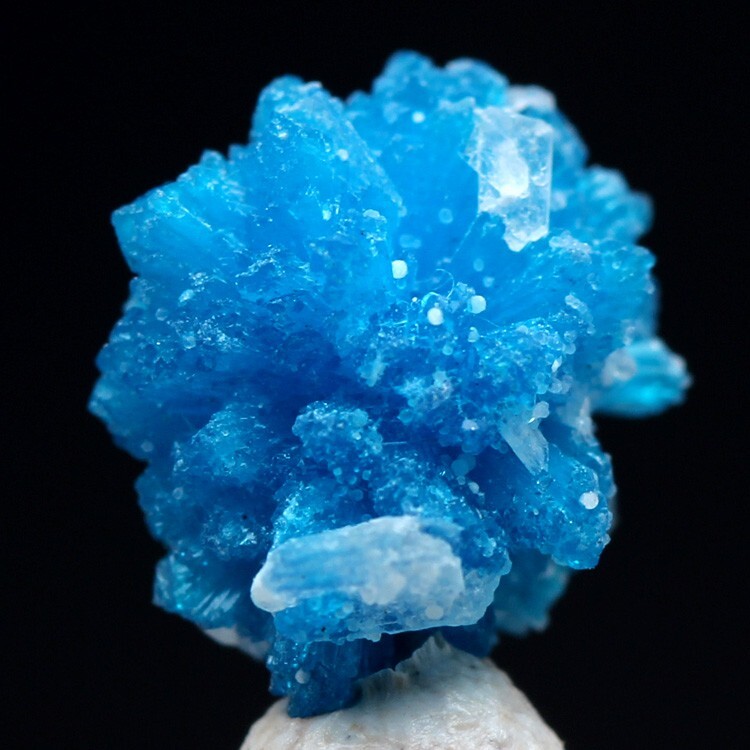
This listing is for a really fascinating cavansite specimen in a display jar,
including an info card about this mineral and the location this specimen came from.
This kit is great for avid mineral specimen collectors or beginners.
It would be a perfect gift set for getting someone interested in mineral collecting and science.
The 1 centimeter scale cube is for size comparison only. It is not included in the sale.
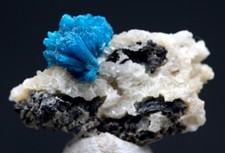
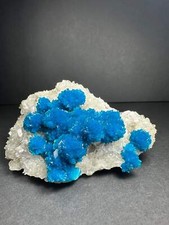
The photos are of several different specimens, but this listings is for one specimen with an info card.
The photos show multiple specimens to give a representation of the variety of shapes and colors in these specimens.I offer a shipping discount for customers who combine their payments for multiple purchases into one payment!
The discount is regular shipping price for the first item and just 50 cents for each additional item!
To be sure you get your shipping discount just make sure all the items you want to purchase are in your cart.
sales you win are added to your cart automatically.
For any \"buy it now\" items or second chance offers, be sure to click the \"add to cart\" button, NOT the \"buy it now\" button.
Onceall of your items are in your cart just pay for them from your cart andthe combined shipping discount should be applied automatically.I offer a money back guarantee on every item I sell.
If you are not 100% happy with your purchase just send me a message to let me know
and I will buy back the item for your full purchase price.Hi there. I am selling this really lovely cavansite mineral specimen. It is from Poona, India. If you have any questions, do not hesitate to ask me. Have fun offerding, thanks so much for visiting my sale and have a great day!
The following is a wikipedia entry about cavansite:
General
Category Silicate mineral
Formula
(repeating unit) Ca(VO)Si4O10·4(H2O)
IMA symbol Cav[1]
Crystal system Orthorhombic
Crystal class Dipyramidal (mmm)
H–M Symbol: (2/m 2/m 2/m)
Space group Pcmn
Unit cell a = 9.792(2) Å,
b = 13.644(3) Å,
c = 9.629(2) Å; Z = 4
Identification
Color Brilliant sky-blue to greenish blue
Crystal habit Radiating acicular prismatic crystals commonly as spherulitic rosettes
Cleavage Good on {010}
Tenacity Brittle
Mohs scale hardness 3 - 4
Luster Vitreous, pearly
Streak Bluish-white
Diaphaneity Transparent
Specific gravity 2.25 - 2.33
Optical properties Biaxial (+)
Refractive index nα = 1.542(2) nβ = 1.544(2) nγ = 1.551(2)
Birefringence δ = 0.009
Pleochroism Visible: X=Z= colorless Y= blue
2V angle Measured: 52°
References [2][3][4][5]
Cavansite, whose name is derived from its chemical composition, calcium vanadium silicate, is a deep blue hydrous calcium vanadium phyllosilicate mineral, occurring as a secondary mineral in basaltic and andesitic rocks along with a variety of zeolite minerals. It\'s blue coloring comes from vanadium, a metal ion.[6] Discovered in 1967 in Malheur County, Oregon, cavansite is a relatively rare mineral. It is polymorphic with the even rarer mineral, pentagonite. It is most frequently found in Pune, India and in the Deccan Traps, a large igneous province.
Uses of cavansite
Although cavansite contains vanadium, and could thus be a possible ore source for the element, it is not generally considered an ore mineral. However, because of its rich color and relative rarity, cavansite is a sought-after collector\'s mineral.
Associated minerals
Members of the apophyllite group
Members of the zeolite group, particularly stilbite
babingtonite, Ca2Fe2Si5O14OH
quartz, SiO2
calcite, CaCO3
pentagonite, Ca(VO)Si4O10 · 4(H2O)
Notes for identification
Cavansite is a distinctive mineral. It tends to form crystal aggregates, generally in the form of balls, up to a couple centimeters in size. Sometimes the balls are coarse enough to allow the individual crystals to be seen. Rarely, cavansite forms bowtie-shaped aggregates. The color of cavansite is distinctive, almost always a rich, bright blue. The color is the same as its dimorph, pentagonite, but the latter is generally much more spikey with bladed crystals. Finally, the associated minerals are useful for identification, as cavansite is frequently found sitting atop a matrix of zeolites or apophyllites.